

General liability insurance is a business insurance policy that protects your company from financial costs tied to third-party bodily injury, property damage, and certain legal claims. Also called Commercial General Liability (CGL), it is the foundational coverage recognized by industry standards bodies like ISO and required by landlords, lenders, and clients across virtually every industry. Roughly 40% of small businesses operate without it, leaving their assets exposed to claims that average $20,000 and frequently exceed $100,000. If you own or operate a small business, understanding what general liability covers is not optional. It is the first step toward protecting everything you have built.
What does general liability insurance cover?
General liability insurance covers three primary risk categories: bodily injury to third parties, damage to others’ property, and personal or advertising injury. Each category addresses a distinct type of claim your business could face on any given workday.
Bodily injury coverage pays for medical costs, legal fees, and settlements when a customer, vendor, or visitor is injured on your premises or because of your operations. Slip-and-fall incidents are the most frequent general liability claims, with average costs around $20,000 and potential for far higher amounts in severe cases. That single statistic explains why even low-traffic businesses need this coverage in place before opening their doors.

Property damage coverage applies when your business operations damage someone else’s property. A contractor who accidentally breaks a client’s window, or a delivery driver who knocks over a display case, faces a property damage claim. General liability pays for the repair or replacement costs and any related legal defense.
Personal and advertising injury coverage protects against claims of libel, slander, copyright infringement in advertising, and similar offenses. This coverage matters for any business that runs ads, publishes content, or makes public statements about competitors or clients.
Beyond these three pillars, most policies include a medical payments component. Medical payments coverage provides no-fault reimbursement for minor injuries, typically $5,000–$10,000, without requiring the injured party to prove negligence. This feature resolves small incidents quickly and reduces the risk of those incidents escalating into lawsuits.
General liability does not cover everything. The policy excludes employee injuries, professional errors, damage to your own business property, and accidents involving business vehicles. Those risks require separate policies: Workers’ Compensation, Professional Liability, Commercial Property, and Commercial Auto, respectively.
Pro Tip: Review your policy’s exclusions page before signing. Many business owners assume general liability is a catch-all policy. It is not. Knowing the gaps upfront lets you fill them with the right add-on coverage.
How does general liability insurance work?
General liability insurance functions through a structured claims process tied to your policy type, coverage limits, and how defense costs are handled. Understanding these mechanics helps you select the right policy and avoid surprises when a claim arises.
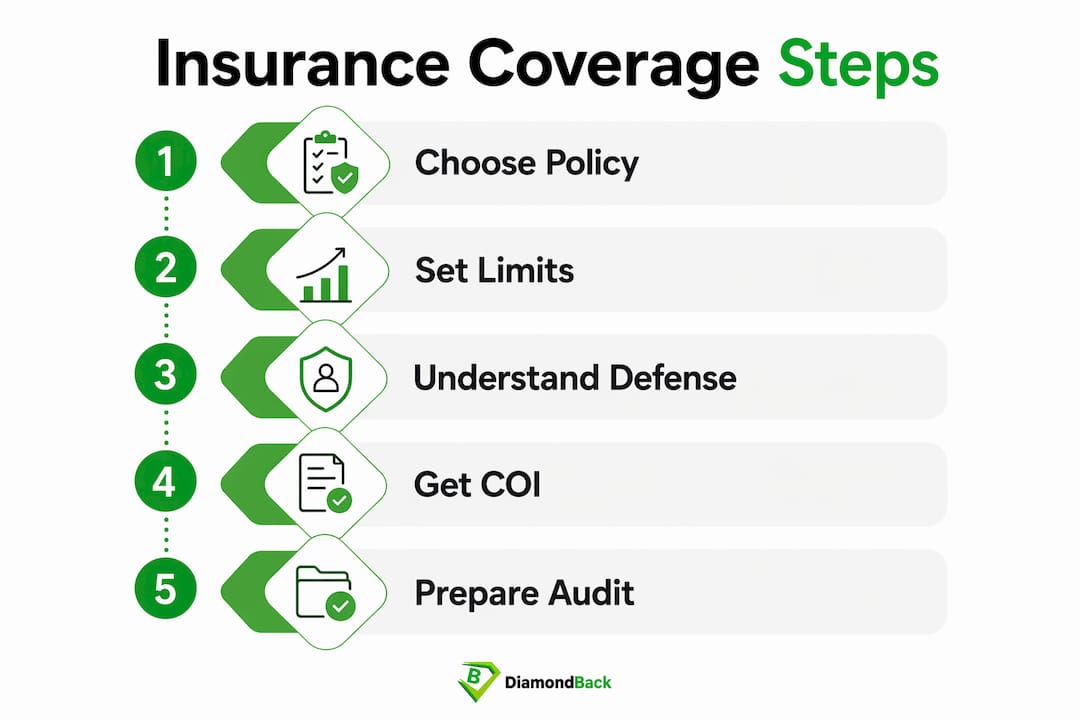
1. Choose your policy type. Most general liability policies use occurrence-based coverage, which protects against claims from incidents that happened during the policy period, even if the claim is filed years later. Claims-made policies only cover claims filed while the policy is active. Occurrence-based is the preferred standard because it eliminates costly “tail coverage” gaps after a policy expires.
2. Understand your coverage limits. Standard policies carry $1 million per occurrence and $2 million aggregate. The per-occurrence limit caps what the insurer pays for a single claim. The aggregate limit caps total payouts across all claims in a policy year.
3. Know how defense costs work. Defense costs paid outside policy limits preserve your full coverage amount for settlements. When defense costs come from inside the limits, every dollar spent on attorneys reduces what remains for a payout. Always check your policy declarations page for this detail.
4. Obtain your Certificate of Insurance. A Certificate of Insurance (COI) is a one-page document proving your coverage is active. COIs are contractually required by commercial landlords, project clients, and lenders before you can sign leases or start jobs. Keeping your COI accessible prevents delays in securing contracts and business opportunities.
5. Prepare for the premium audit. Many insurers conduct an annual audit to verify your actual payroll, revenue, or square footage against the estimates used to set your premium. If your business grew during the year, you may owe additional premium at audit time. Budget for this possibility when you purchase the policy.
Pro Tip: Ask your insurer whether your policy pays defense costs inside or outside the policy limits. This single detail can determine whether you have enough coverage left to settle a serious claim.
What does general liability insurance cost?
General liability insurance costs vary significantly based on your industry, location, claims history, and chosen coverage limits. Understanding the cost range helps you budget accurately and avoid underinsuring your business.
Annual premiums range from $300–$600 for low-risk solo operators such as consultants or freelancers, and climb to $2,000–$8,500 for high-risk trades like roofing, electrical work, or general contracting. The table below shows how risk level and business type affect typical annual costs.
| Business Type | Risk Level | Estimated Annual Premium |
|---|---|---|
| Consultant or freelancer | Low | $300–$600 |
| Retail shop owner | Moderate | $600–$1,500 |
| General contractor | High | $2,000–$5,000 |
| Roofing or electrical contractor | Very high | $5,000–$8,500+ |
Several factors drive your specific premium. Insurers weigh your industry classification, annual revenue, number of employees, physical location, and prior claims history. A business with one prior slip-and-fall claim will pay more than a comparable business with a clean record.
Coverage limits and endorsements also affect price. Raising your per-occurrence limit from $1 million to $2 million adds cost, but it may be required by a key client contract. Adding an additional insured endorsement, which extends coverage to a landlord or general contractor, typically costs a modest flat fee per endorsement.
General liability premiums are tax-deductible as ordinary business expenses. That deductibility reduces the real out-of-pocket cost, making GL coverage one of the most affordable protections available relative to the financial risk it offsets.
Why is general liability insurance important for your business?
General liability insurance is the financial safety net that keeps a single lawsuit from wiping out your business. Without it, you pay legal defense costs, settlements, and judgments from your own pocket, and those costs can exceed what most small businesses hold in reserve.
General liability is not legally mandated in most states, but it is effectively required by the market. Commercial landlords demand proof of coverage before signing a lease. General contractors require subcontractors to carry it before stepping on a job site. Lenders ask for it before approving business loans. Without active coverage, you cannot access many of the contracts and spaces your business needs to operate.
“General liability insurance is not just a financial product. It is the credential that signals to landlords, clients, and partners that your business is serious, stable, and prepared to operate responsibly.”
The importance of general liability extends beyond individual claims. It protects your personal assets if your business is structured as a sole proprietorship or partnership, where personal and business finances can blur. Even for LLCs and corporations, a large uninsured judgment can pierce the corporate veil under certain circumstances.
A common misconception is that general liability covers all business risks. It does not. GL only shields against third-party claims. Your own property, your employees, your professional errors, and your vehicles all require separate coverage. Treating GL as a complete solution leaves serious gaps in your risk management.
Pro Tip: Treat general liability as your business’s first line of defense, not its only one. Pair it with Workers’ Compensation, Professional Liability, and Commercial Property coverage to address the full range of risks your operation faces.
What general liability insurance does not cover
General liability insurance has clear boundaries. Knowing what falls outside those boundaries prevents costly assumptions and coverage gaps.
The policy does not cover the following:
Employee injuries. If a worker is hurt on the job, Workers’ Compensation insurance pays for their medical costs and lost wages. General liability only covers injuries to third parties, not your own staff.
Professional errors and omissions. A consultant who gives bad advice, or a designer who delivers work that causes a client financial loss, faces a professional liability claim. General liability does not respond to these situations. Professional Liability (also called Errors and Omissions) insurance covers this risk.
Damage to your own property. If your office equipment is stolen or your tools are damaged, Commercial Property insurance pays for replacement. General liability only covers damage you cause to someone else’s property.
Business vehicle accidents. If your company vehicle causes an accident, Commercial Auto insurance responds. General liability excludes auto accidents entirely, even if the vehicle was used for business purposes.
Business Owner’s Policies (BOPs) bundle general liability with commercial property coverage, which addresses two of these gaps in one package. However, BOPs are not catch-all solutions. They still exclude employee injuries, professional errors, and commercial auto. Verify your BOP’s exclusions carefully before assuming you are fully covered.
Key Takeaways
General liability insurance is the foundational commercial coverage every small business needs to protect against third-party bodily injury, property damage, and advertising injury claims.
| Point | Details |
|---|---|
| Core coverage areas | GL covers bodily injury, property damage, and personal or advertising injury to third parties. |
| Standard policy limits | Most policies carry $1 million per occurrence and $2 million aggregate as the industry standard. |
| Occurrence-based is preferred | Occurrence-based policies cover incidents during the policy period regardless of when the claim is filed. |
| Cost varies by risk level | Annual premiums range from $300 for low-risk operators to $8,500 or more for high-risk trades. |
| GL has real exclusions | Employee injuries, professional errors, and vehicle accidents all require separate policies. |
What I have learned from watching businesses get this wrong
The single most expensive mistake I see small business owners make is treating general liability as a box to check rather than a policy to understand. They buy the cheapest option, file the COI with their landlord, and never look at the policy again. Then a claim arrives and they discover their defense costs come from inside the policy limits, leaving them with far less coverage than they expected.
The second mistake is assuming a Business Owner’s Policy covers everything. BOPs are convenient, but they are not complete. I have spoken with business owners who were blindsided by employee injury claims they assumed their BOP would handle. Workers’ Compensation is a separate product, and skipping it because you thought your BOP had it covered is an expensive lesson.
My strongest advice is to prioritize occurrence-based policies and verify the defense cost structure before you sign anything. Check your declarations page for the phrase “defense costs outside the limits.” If it says inside, ask your broker what it would cost to change that. The difference in premium is usually small. The difference in coverage when you need it is enormous.
Certificates of Insurance deserve more attention than most business owners give them. Digital COI access speeds up contract signings and removes a common bottleneck that delays the start of jobs and leases. If your insurer cannot produce a COI quickly, that is a service problem worth addressing before it costs you a contract.
Review your coverage limits every year as your business grows. A $1 million per-occurrence limit that felt adequate when you had two employees may be insufficient when you have twenty and a busy client-facing location. Your risk profile changes. Your coverage should keep pace.
— Vladimir
Getting general liability coverage through Diamondbackins
Small business owners who need general liability coverage quickly and without the friction of traditional brokers have a direct path through Diamondbackins.
Diamondbackins is an online insurance platform that aggregates quotes from multiple top-rated insurers, so you can compare coverage options and pricing in minutes rather than days. The platform delivers instant quotes, supports digital Certificate of Insurance access, and lets you purchase coverage directly online without phone calls or paperwork delays. For small business owners who need to meet a landlord’s COI requirement or satisfy a client contract before a job starts, that speed matters. You can get instant coverage quotes and review your options without committing to a single carrier. Diamondbackins also covers complementary policies, including Workers’ Compensation options, so you can address multiple coverage gaps in one place.
FAQ
What is general liability insurance in simple terms?
General liability insurance is a business policy that pays for third-party bodily injury, property damage, and advertising injury claims against your company. It covers legal defense costs and settlements so a single lawsuit does not drain your business finances.
Who needs general liability insurance?
Any business that interacts with clients, customers, or the public needs general liability coverage. Landlords, lenders, and contractors routinely require proof of active GL coverage before signing agreements.
What is the difference between general liability and professional liability?
General liability covers physical injuries and property damage caused by your business operations. Professional liability covers financial losses a client suffers due to your professional errors, advice, or services. Most service-based businesses need both.
How much does general liability insurance cost per year?
Annual costs range from $300–$600 for low-risk businesses and $2,000–$8,500 or more for high-risk trades. Your industry, revenue, location, and claims history all influence your final premium.
Does general liability cover employee injuries?
General liability does not cover employee injuries. Workers’ Compensation insurance is the required coverage for on-the-job injuries to your staff, and it operates as a completely separate policy from general liability.
Recommended
- The Essential Guide to General Liability Insurance for Small Businesses – Diamondback Insurance – Solutions with Instant Online Quotes
- Understanding General Liability Insurance A Must-Have for Businesses – Diamondback Insurance – Solutions with Instant Online Quotes
- Demystifying the Cost of General Liability Insurance for Small Businesses – Diamondback Insurance – Solutions with Instant Online Quotes
- What is General Liability Insurance? Your Shield in the Business World – Diamondback Insurance – Solutions with Instant Online Quotes