

Fleet insurance is a single commercial policy that covers multiple vehicles owned or operated by one business under one contract. Unlike individual vehicle policies, it consolidates your entire fleet’s coverage into one renewal date, one premium, and one claims contact. For trucking companies, delivery businesses, and any operation running three or more vehicles, this structure delivers real financial and administrative advantages. Understanding how fleet insurance works, what it covers, and when it makes sense is the first step toward protecting your business and controlling your costs.
What is fleet insurance and how does it work?
Fleet insurance is defined as a consolidated commercial auto policy that insures multiple business vehicles under a single agreement. The insurer evaluates the entire fleet as one risk unit rather than underwriting each vehicle separately. This actuarial approach, assessing the fleet’s combined risk, allows insurers to price coverage more competitively than they could for individual policies.
The policy covers all listed vehicles and, depending on the terms, all approved drivers. You pay one premium, manage one renewal date, and file claims through one adjuster who already knows your fleet. That simplicity is not just convenient. It directly reduces the time and cost your business spends on insurance administration.

Adding or removing vehicles during the policy term happens through endorsements, which insurers typically process within 24–48 hours. That speed matters when your business is growing and you cannot afford gaps in coverage.
What are the key advantages of fleet insurance for businesses?
The most direct advantage is cost. Fleet insurance typically saves businesses 15%–30% on premiums compared to insuring each vehicle individually, with some estimates reaching 40% for fleets beyond three units. Insurers apply pooled risk and volume incentives that lower the per-vehicle premium across the board. The more vehicles you add, the stronger your negotiating position becomes.
Administrative savings are just as significant. Fleet managers who consolidate into one policy report a 40% reduction in administrative overhead compared to managing separate policies. One renewal date means one set of documents to track, one billing cycle to reconcile, and one broker relationship to maintain. That frees your team to focus on operations rather than paperwork.
Claims handling also improves. A single adjuster with full knowledge of your fleet can cut claims processing time by up to 2–3 weeks compared to managing claims across multiple individual policies. Faster settlements mean less vehicle downtime and fewer disruptions to your delivery schedule or service commitments.
Pro Tip: Review your total fleet premium annually and compare it against what individual policies would cost at current market rates. The gap widens as your fleet grows, so the right time to switch is often earlier than most business owners expect.
Who qualifies for fleet insurance?
Most insurers set the minimum threshold at two to five vehicles, with the specific number varying by carrier. However, the financial break-even point for most businesses is three vehicles. At two vehicles, individual policies often remain cheaper because underwriters can still apply specialized pricing to each unit. At three or more, the pooled risk model consistently works in your favor.
Insurers evaluate several factors when setting your fleet premium. Your fleet’s composition matters: a mix of light delivery vans and heavy commercial trucks carries different risk than a uniform fleet of identical vehicles. Driver profiles, including age, license history, and years of commercial driving experience, also influence pricing. Your claims history over the past three to five years is the most heavily weighted factor of all.
Fleet policies also offer flexible “any driver” coverage, which lets any approved driver operate any vehicle in the fleet. This removes the administrative burden of assigning specific drivers to specific vehicles, which is particularly valuable for businesses with rotating shifts or shared vehicle pools. The trade-off is a slightly higher base premium, but the operational savings in scheduling and compliance typically outweigh that cost.
Pro Tip: When applying for fleet coverage, prepare a clean driver roster with license classifications and incident records for each driver. Insurers reward organized, well-documented fleets with better initial pricing.
What types of coverage are available under a fleet policy?
Fleet policies offer three primary coverage tiers, and you can mix coverage levels across vehicles within the same policy. That flexibility lets you match protection to each vehicle’s value and role.
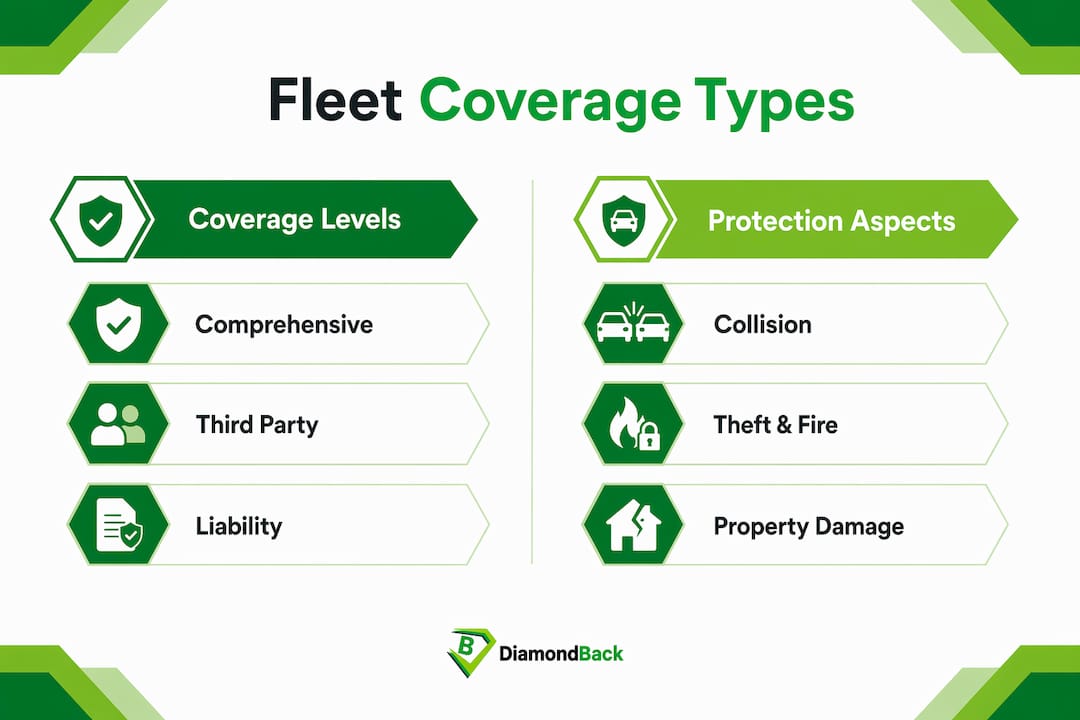
Comprehensive coverage protects against collision, theft, fire, weather damage, and vandalism. This tier suits high-value vehicles, newer trucks, or any unit that would be costly to replace out of pocket.
Third party fire and theft covers damage your vehicles cause to others, plus loss from fire or theft to your own vehicles. This is a mid-tier option appropriate for vehicles with moderate replacement value.
Third party property damage is the minimum level. It covers liability for damage your vehicles cause to other people’s property or vehicles but provides no protection for your own fleet assets. This tier works for older, fully depreciated vehicles where replacement cost is low.
Liability protection is built into all three tiers and covers your business and drivers for bodily injury and property damage claims from third parties. The coverage limits you select directly affect your premium. Higher limits cost more upfront but protect your business from catastrophic out-of-pocket exposure after a serious accident. Choosing the right fleet insurance coverages for each vehicle type is one of the most consequential decisions you will make when structuring a fleet policy.
How does fleet insurance compare to individual vehicle policies?
The practical difference between fleet and individual policies shows up most clearly in three areas: administration, cost, and claims impact.
Managing individual policies for a fleet of ten vehicles means ten renewal dates, ten billing cycles, and ten separate adjusters if accidents occur in the same month. A fleet policy collapses all of that into one. The administrative efficiency gains compound as your fleet grows, making the operational case for consolidation stronger at every stage.
On cost, the savings are real but not universal. For fleets with very diverse risk profiles, such as a mix of specialty vehicles, refrigerated units, and standard cargo trucks, individual policies sometimes allow more precise underwriting that produces lower per-vehicle premiums. If one vehicle class carries significantly higher risk than the others, bundling it into a fleet policy can pull the entire premium upward. A knowledgeable broker can model both scenarios before you commit.
The most important caveat with fleet insurance is claims impact. A serious at-fault accident affects your entire fleet’s renewal pricing, not just the vehicle involved. With individual policies, a claim on one vehicle affects only that policy. This is the primary reason some businesses with highly variable risk across their fleet choose to keep certain vehicles on separate policies while bundling the rest.
| Scenario | Fleet policy | Individual policies |
|---|---|---|
| 3–5 uniform vehicles | Lower per-vehicle premium | Higher total cost |
| 10+ vehicles, mixed use | Significant savings, simpler admin | Complex, expensive to manage |
| Specialist or high-risk vehicle | May raise fleet premium | Isolated pricing, no fleet impact |
| Claims frequency is high | One claim affects all vehicles | Claims isolated per vehicle |
| Rotating drivers | “Any driver” coverage available | Driver-specific assignment required |
Key Takeaways
Fleet insurance is the most cost-effective and administratively efficient coverage structure for any business operating three or more commercial vehicles under one ownership.
| Point | Details |
|---|---|
| Fleet insurance definition | One policy covers all business vehicles, with one premium, one renewal, and one adjuster. |
| Break-even threshold | Savings reliably materialize at three vehicles; two vehicles often favor individual policies. |
| Premium savings range | Businesses typically save 15%–30% per vehicle, with up to 40% possible for larger fleets. |
| Coverage flexibility | Comprehensive, third party fire and theft, and third party property damage can be mixed within one policy. |
| Claims risk | A single at-fault claim affects the entire fleet’s renewal pricing, not just one vehicle. |
What I have learned about timing the switch to fleet insurance
From my experience working with fleet managers across trucking and transportation, the biggest mistake businesses make is waiting too long to consolidate. Most operators assume they need a large fleet before fleet insurance makes sense. The data says otherwise. The break-even is three vehicles, and the administrative relief starts on day one.
The second mistake is selecting coverage levels based on premium cost alone. I have seen businesses underinsure their highest-value trucks to save a few hundred dollars a year, then face five-figure out-of-pocket costs after a collision. The right approach is to match coverage tier to replacement cost, not to budget pressure.
Working with a broker who specializes in commercial fleet underwriting makes a measurable difference. General commercial insurance brokers often lack the carrier relationships and fleet-specific knowledge to negotiate pooled risk pricing effectively. A fleet-focused broker knows which carriers reward clean driver rosters and which ones penalize mixed vehicle compositions. That knowledge translates directly into better terms at renewal.
The long-term strategic value of fleet insurance is scalability. Once your policy structure is in place, adding a new vehicle is a 24-hour endorsement process rather than a new underwriting application. That speed supports growth without creating coverage gaps.
— Vladimir
How Diamondbackins can help you secure fleet coverage
Diamondbackins specializes in commercial trucking and fleet insurance, giving business owners instant access to tailored quotes from multiple top-rated carriers in one place.
Whether you operate a regional delivery fleet in Georgia or a long-haul trucking operation in Virginia, Diamondbackins provides commercial fleet coverage in Georgia and fleet protection in Virginia with competitive rates and a fully online process. You can compare quotes, review coverage options, and secure your policy in minutes, without the back-and-forth of traditional brokers. If you are ready to review your fleet’s coverage and see what consolidation could save you, Diamondbackins is built to make that process fast and transparent.
FAQ
What is the fleet insurance definition in simple terms?
Fleet insurance is a single commercial policy that covers two or more business vehicles under one contract, one premium, and one renewal date. It replaces the need to manage separate individual policies for each vehicle.
How many vehicles do you need to qualify for fleet insurance?
Most insurers require a minimum of two to five vehicles, but the financial break-even point where fleet insurance consistently saves money is three vehicles.
What are the main benefits of bundling fleet insurance?
Bundling fleet insurance reduces per-vehicle premiums by 15%–30%, cuts administrative overhead significantly, and speeds up claims processing through a single adjuster familiar with your entire fleet.
Is fleet insurance necessary for small businesses?
Fleet insurance is not legally required beyond standard commercial auto liability minimums, but it becomes the most cost-effective and manageable structure once a business operates three or more vehicles regularly.
Does a claim on one vehicle affect the whole fleet’s premium?
Yes. With a fleet policy, an at-fault claim affects the entire fleet’s renewal pricing. This is the primary reason some businesses keep high-risk or specialist vehicles on separate individual policies.