

A single serious accident can cost your trucking business anywhere from $200,000 to well over $7 million, and that number can climb into the tens of millions if a jury renders what the industry calls a “nuclear verdict.” With FMCSA reporting over 120,000 injury crashes every year across the U.S., the financial and operational threat is constant. Rising premiums, tightening margins, and mounting regulatory demands make effective risk management not just smart business practice but an essential survival strategy. This guide gives you a clear, step-by-step path to reducing claims, controlling insurance costs, and building a safer fleet from the ground up.
Table of Contents
- Understanding trucking risks: What’s at stake?
- The trucking risk management process: Step by step
- Essential controls to reduce claims and costs
- Monitoring, compliance, and keeping costs low
- Nuances, edge cases, and common pitfalls
- Why most trucking risk management advice fails—and what actually works
- Next steps: Protect your fleet with the right coverage
- Frequently asked questions
Key Takeaways
| Point | Details |
|---|---|
| Know your risk categories | Identify safety, compliance, financial, operational, and reputation risks unique to your fleet. |
| Use structured processes | Applying a step-by-step risk assessment framework streamlines risk reduction and claims control. |
| Leverage technology for savings | Telematics, dashcams, and predictive maintenance can lower claims and insurance premiums. |
| Stay compliant and proactive | Track metrics, keep documents current, and review programs quarterly for insurance and safety success. |
| Avoid common pitfalls | Mind midsize fleet risks, underreporting dangers, and compliance blind spots to protect profitability. |
Understanding trucking risks: What’s at stake?
Before you can reduce risk, you need to know exactly what you’re dealing with. Fleet managers who treat risk as a single, vague threat tend to overspend in the wrong areas and underprotect where it counts. The five core categories of risk in trucking are safety, compliance, financial, operational, and reputational, and each one feeds into the others.
Safety risk is the most visible. Crashes, injuries, cargo spills, and driver fatigue events all carry direct costs in vehicle repair, medical expenses, lost productivity, and legal liability. Compliance risk involves FMCSA regulations, hours-of-service logs, vehicle inspections, and driver qualification files. If you fall short here, you face fines, out-of-service orders, and potential loss of your operating authority. Financial risk includes both the direct costs of incidents and the indirect costs of rising premiums, legal defense, and settlement payments. Operational risk covers breakdowns, driver turnover, and route inefficiencies that erode your margins. Reputational risk, often the most underestimated, affects your ability to attract qualified drivers, retain shipper relationships, and grow your book of business.
| Risk category | Average cost per incident | Primary driver |
|---|---|---|
| Injury crash | $200,000 to $500,000 | Driver behavior, road conditions |
| Fatal crash | Up to $7,000,000 | Speed, fatigue, distraction |
| Nuclear verdict | $10,000,000 or more | Litigation environment |
| Compliance violation | $5,000 to $25,000 per violation | Documentation lapses |
| Cargo loss | $50,000 to $300,000 | Theft, handling errors |
Understanding why specialized trucking insurance reduces risk starts with recognizing that generic commercial auto policies simply don’t account for the scale or complexity of these exposures. You also need to pair strong coverage with safety best practices that prevent incidents from happening in the first place.
“One severe incident, whether a fatal crash or a high-profile cargo loss, can trigger insurance non-renewal, driver recruiting problems, and shipper contract losses all at the same time. The financial damage compounds long after the initial event.”
Now that the stakes are clear, let’s break down the process of addressing these risks step by step.
The trucking risk management process: Step by step
Knowing your risks is one thing. Having a repeatable system to address them is what separates high-performing fleets from those that scramble from crisis to crisis. The core risk management process follows a six-step cycle: identify, assess, prioritize, control, monitor, and review.
Step 1: Identify. Start by cataloging every exposure your fleet faces. This includes driver behavior patterns, vehicle condition, routes, cargo types, and regulatory requirements. Pull your FMCSA Safety Measurement System (SMS) data, review past claims, and talk to your drivers. They often know where the real problems are before management does.
Step 2: Assess. For each risk you’ve identified, score it on two dimensions: likelihood and impact. A high-frequency, low-severity risk like minor fender benders in a freight yard is handled differently than a low-frequency, high-severity risk like a rollover on an interstate. This scoring forms the foundation of your risk matrix.
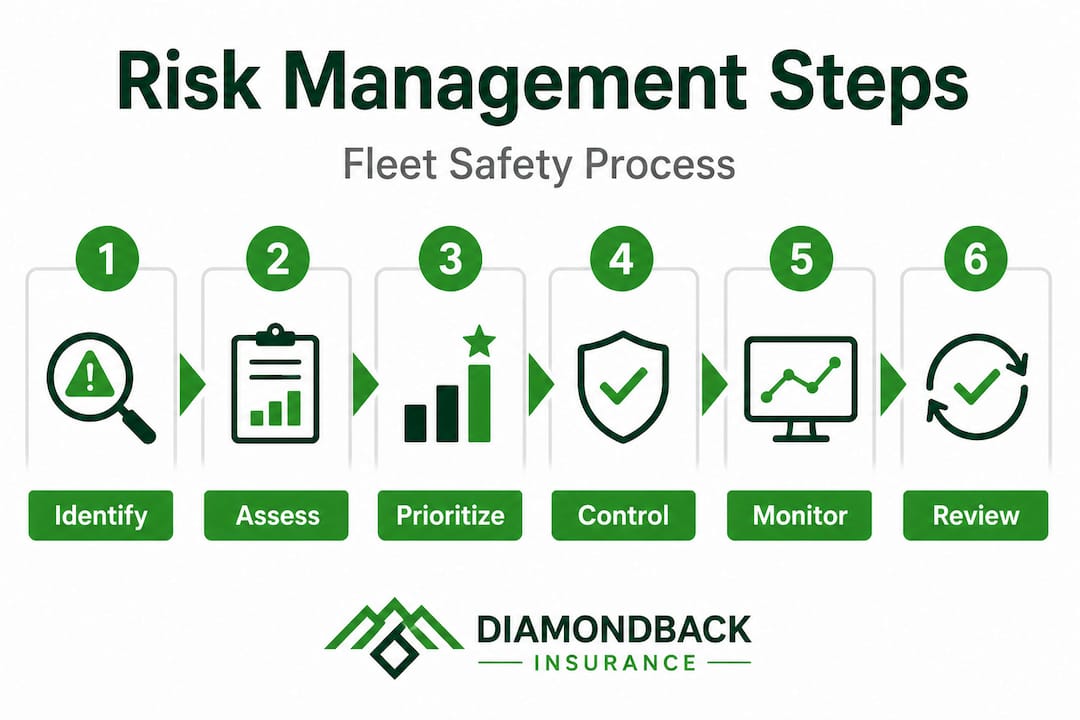
Step 3: Prioritize. A risk matrix maps each threat on a grid, plotting likelihood against impact. High-likelihood, high-impact risks demand immediate action and the most resources. Low-likelihood, low-impact risks can be monitored without major investment. This framework helps you allocate your budget and attention where they produce the most value.
| Risk | Likelihood | Impact | Priority |
|---|---|---|---|
| Rear-end collision | High | High | Immediate action |
| Driver fatigue violation | Medium | High | Urgent |
| Vehicle breakdown | High | Medium | Scheduled control |
| Cargo theft | Low | High | Contingency plan |
| Minor parking lot damage | High | Low | Monitor |
Step 4: Control. Implement preventive and mitigating measures based on your priority list. This is where you choose your specific tools and programs, covered in detail in the next section.
Step 5: Monitor. Track key performance indicators (KPIs) such as accident frequency, near-miss reports, CSA scores, and claims costs. Regular monitoring lets you catch trends before they become expensive problems.
Step 6: Review. Adjust your program as conditions change. New routes, new cargo types, new regulations, and fleet growth all require updated assessments. Make sure you also review insurance requirements for truck fleets whenever your operations change significantly.
Pro Tip: Don’t wait for your annual review to update your risk program. Daily driver vehicle inspection reports (DVIRs) and weekly safety briefings catch problems that would otherwise go unnoticed for months, saving you far more than the time they take.
With the framework in place, you’re ready to put risk controls into action.
Essential controls to reduce claims and costs
Risk identification and assessment only pay off when you act on what you learn. The right controls, properly implemented, produce measurable reductions in both accident frequency and insurance premiums. The data here is compelling: technology reduces claims by 23 to 40% and lowers premiums by 10 to 25%, while seven-year Motor Vehicle Record (MVR) and Pre-Employment Screening Program (PSP) screenings significantly reduce the risk of hiring drivers with hidden violations. Documented preventive maintenance programs are equally important.
Driver screening and qualification. Pull a seven-year MVR for every driver candidate, not just the standard three-year check. Use FMCSA’s PSP to review a driver’s inspection and crash history before they ever sit in one of your trucks. This single step eliminates a disproportionate share of future claims. One driver with a history of hard braking events and prior violations can cost a fleet more in a single year than the time invested in thorough screening.
Telematics and electronic logging devices (ELDs). Telematics platforms track speed, harsh braking, lane departure, engine idling, and hours of service in real time. Dashcams and telematics reduce claims and insurance costs while also providing exculpatory evidence when your driver is not at fault in an accident. Predictive maintenance alerts from connected vehicles mean fewer roadside breakdowns and DOT violations. These tools also signal to insurers that you’re operating a professionally managed fleet, which directly influences your premium at renewal.
Preventive maintenance. A documented maintenance schedule with timestamped records protects you on two fronts: it reduces mechanical failures that cause accidents, and it provides written proof of due diligence if you’re ever involved in litigation. Brake failures and tire blowouts are among the most common causes of serious truck crashes. Keeping these systems in optimal condition is both a safety imperative and a liability shield.
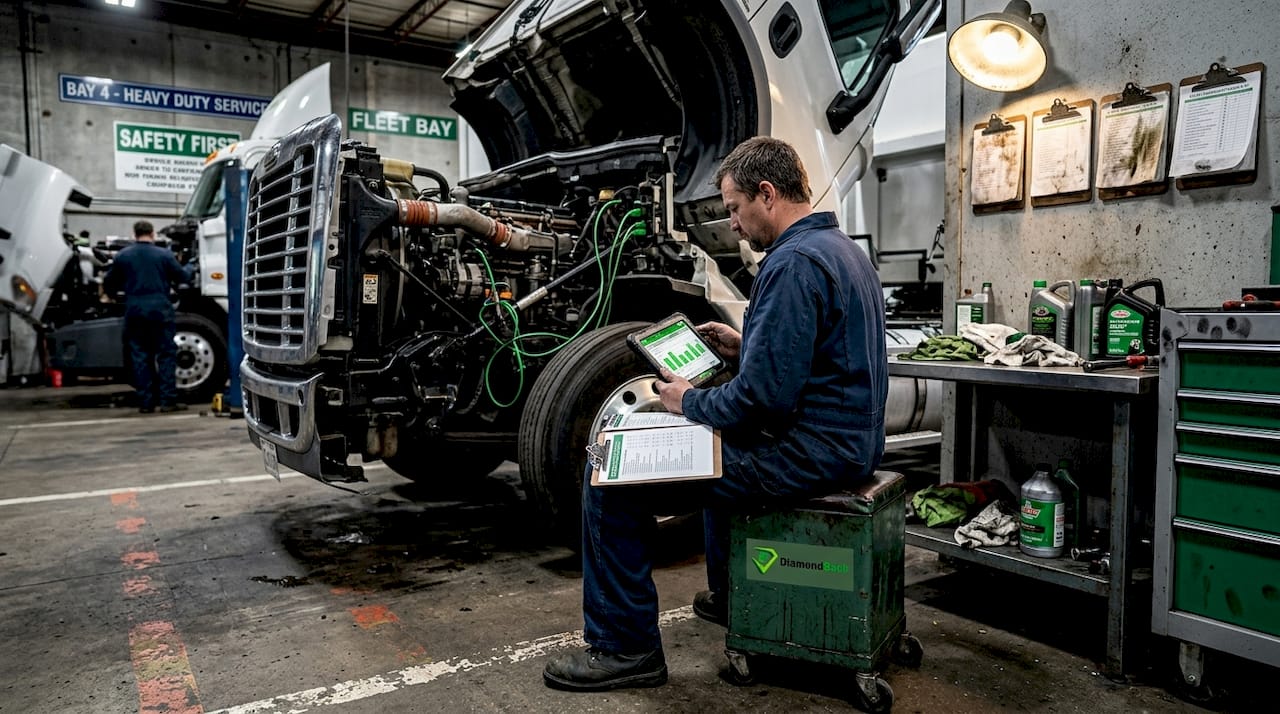
Driver coaching. Telematics data is only valuable if you use it. Build a formal coaching program where fleet managers review event data weekly with individual drivers. Recognize and reward safe behavior. Address risky patterns before they result in a claim. This approach to continuous improvement is what separates fleets that see sustained cost reductions from those that buy technology and don’t act on what it tells them.
Understanding the factors affecting truck insurance rates makes it easier to connect your control investments directly to premium savings. And if you’re unsure where your current program has gaps, reviewing common trucking insurance mistakes is a productive starting point.
Pro Tip: If your budget is limited, prioritize telematics and ELD integration first. These tools deliver the fastest return on investment by simultaneously reducing claims, satisfying insurer requirements, and providing immediate driver coaching data.
Once controls are in place, ensure ongoing compliance and track progress for the best results.
Monitoring, compliance, and keeping costs low
Implementing controls is not a one-time project. Sustained results require consistent monitoring and a proactive approach to regulatory compliance. The FMCSA’s Compliance, Safety, Accountability (SMS) program measures your fleet across seven behavioral categories: unsafe driving, hours-of-service compliance, driver fitness, controlled substances and alcohol, vehicle maintenance, hazardous materials compliance, and crash indicator. Poor scores in any category can trigger FMCSA interventions and alert insurers to elevated risk, directly impacting your premiums and insurability.
A structured compliance monitoring program isn’t just about avoiding penalties. Structured programs reduce claims by 40% and cut premiums by up to 25% compared to fleets that rely on informal or reactive approaches. Benchmarking your performance against industry averages also helps you identify which areas need the most investment and demonstrates to underwriters that you manage your fleet to a measurable standard.
Here is a practical quarterly compliance checklist for fleet managers:
- Pull and review CSA scores for all seven BASIC categories.
- Audit DVIRs for completeness and corrective action follow-through.
- Verify all driver qualification files are current, including medical certificates and license endorsements.
- Review all roadside inspection reports and address any recurring violations.
- Confirm that hours-of-service logs are accurate and that ELD data matches paper records where applicable.
- Update your insurance carrier on any significant changes to your fleet size, routes, or cargo types.
Keeping your essential insurance documents for truckers organized and current is part of this ongoing process. If an insurer or regulator requests records and you can’t produce them quickly, it signals disorganization and increases your risk profile.
“Documentation gaps are one of the leading causes of avoidable claims escalation. When you can’t prove what maintenance was done or what your driver’s qualification file contained, a manageable claim can become a catastrophic loss.”
Understanding potential pitfalls and nuances helps you fine-tune your program and avoid costly mistakes.
Nuances, edge cases, and common pitfalls
Even well-run fleets encounter situations that fall outside their standard risk management framework. Knowing these edge cases in advance helps you prepare rather than react.
Midsize fleets face higher crash rates per vehicle than either small owner-operators or large enterprise carriers. The reason is structural: midsize fleets have grown beyond the tight oversight of a small operation but haven’t yet built the formal safety infrastructure of a large carrier. This is a critical window where investment in controls and compliance produces the greatest return.
Cross-border operations introduce additional complexity. Your U.S. insurance policy may have territorial limitations that leave you exposed when trucks operate in Canada or Mexico. Review your policy language carefully and discuss endorsements with your insurer before expanding routes internationally.
Underreporting is a serious and underappreciated risk. When drivers or dispatchers fail to document near-misses, minor accidents, or vehicle defects, you lose the data you need to identify trends. More importantly, if a minor unreported incident later becomes part of a larger claim or investigation, the lack of documentation can be interpreted as negligence or bad faith.
Nuclear verdict exposure deserves special attention. Plaintiffs’ attorneys increasingly target trucking companies with claims of “negligent entrustment,” arguing that a carrier knew or should have known about a driver’s risk profile. Strong hiring practices, ongoing monitoring, and documented corrective actions are your primary defenses.
Understanding why trucking policies differ across fleet types helps you avoid the trap of assuming your current coverage addresses all of these exposures. Policies designed for one type of operation often have gaps that only become apparent after a loss.
“Underreporting creates blind spots that no safety program can fix. If your drivers don’t trust the reporting process, you’re managing a version of reality that doesn’t match what’s happening on the road.”
Having covered the landscape, it’s time for an expert perspective on what actually works for real fleets.
Why most trucking risk management advice fails—and what actually works
Most risk management advice in trucking focuses on compliance checkboxes and post-incident reviews. The problem is that by the time you’re reviewing what went wrong after a crash, you’ve already absorbed the loss. The proactive, predictive approach consistently outperforms reactive compliance-based programs, but it requires a different mindset.
Annual safety reviews feel productive, but they’re largely ceremonial if they aren’t backed by daily habits. The fleets that genuinely reduce their loss ratios over time are the ones where safety is embedded in daily operations. Morning pre-trip inspections are taken seriously. Telematics alerts are reviewed and acted on the same day. Drivers are recognized publicly for safe performance, not just disciplined for violations.
Predictive technologies like AI-powered dashcams and machine learning-based driver scoring are changing the game. These systems don’t just record what happened; they identify drivers who are trending toward risk before an incident occurs. That proactive window, where you can intervene with coaching before a crash happens, is where the real cost savings live.
Culture matters more than any single technology or policy. When drivers feel that safety is a genuine organizational priority and not just a liability management exercise, they make better decisions independently. Tie your safety KPIs directly to a bonus structure where drivers earn meaningful rewards for clean quarters. Make safety performance visible across the team. When it becomes a source of professional pride rather than a compliance burden, the results follow.
We’ve seen time and again that fleets partnering with trucking insurance experts who understand operational context, not just policy language, are better positioned to build coverage strategies that align with their actual risk profile. That alignment between operations and coverage is where real savings are found.
Next steps: Protect your fleet with the right coverage
You’ve built the framework, applied the controls, and set up your monitoring systems. The final piece is making sure your insurance coverage is as optimized as your operations. Comprehensive, well-structured coverage is a cornerstone of any serious risk management program, and the right policy should reflect the effort you’ve put into reducing your risk profile.
At Diamondback Insurance, we make it straightforward to compare fleet insurance quotes from multiple top-rated carriers in one place, without the back-and-forth of a traditional broker. Whether you’re managing five trucks or fifty, our platform gives you instant access to tailored options that match your specific operations. Get your truck insurance quotes online today and see how the right coverage, paired with strong risk controls, can meaningfully reduce what you pay at renewal.
Frequently asked questions
What are the top 3 risks for trucking businesses?
Safety incidents, regulatory compliance violations, and high insurance costs are the biggest risks impacting trucking fleets, as reflected in FMCSA and industry data on crash costs and compliance penalties.
How can telematics lower my fleet’s insurance premium?
Telematics can reduce claims by up to 40% and lower insurance premiums by 10 to 25% by giving carriers objective data on driver behavior and demonstrating active risk management.
Why do insurance premiums vary so much between fleets?
Premiums are driven by crash history, CSA scores, fleet size, and the presence of formal safety programs. Midsize fleets with higher crash rates and no structured controls consistently pay more than those that can demonstrate documented risk reduction efforts.
What is a risk matrix and how is it used in trucking?
A risk matrix helps fleet managers prioritize threats by scoring likelihood and impact for each identified risk, guiding where to focus controls and resources for maximum effect.
Is insurance enough for effective trucking risk management?
Insurance is critical but not sufficient on its own. It must be paired with driver training, telematics, preventive maintenance, and ongoing compliance monitoring to meaningfully reduce both risk and long-term costs.