

Technology is defined as the primary driver reshaping every core function in insurance, from underwriting and risk assessment to claims resolution and customer engagement. The role of technology in insurance is no longer limited to back-office automation. It now determines competitive positioning, pricing accuracy, and the speed at which carriers serve policyholders. 81% of insurance executives report AI is embedded in some business workflows, yet most deployments remain function-specific rather than enterprise-wide. That gap between adoption and scale is where the real opportunity sits for insurers, fleet managers, and transportation businesses alike.
How does technology improve underwriting and risk assessment?
AI-augmented underwriting is the most significant shift in insurance risk management in decades. Traditional underwriting relied on historical loss data, manual review, and underwriter judgment applied to standardized forms. AI models now analyze internal policy data alongside external sources such as telematics feeds, satellite imagery, weather records, and credit signals to build nuanced risk profiles that no human team could assemble at scale.
The operational payoff is measurable. Automation reduces manual errors and accelerates quote turnaround by 30–40%, giving carriers a direct competitive edge on speed without sacrificing accuracy. Standardized data frameworks like ACORD enable cross-system integration, so data flows cleanly between policy administration, claims, and pricing platforms without manual re-entry.
| Factor | Traditional underwriting | AI-augmented underwriting |
|---|---|---|
| Data sources | Historical loss data, paper forms | Telematics, satellite, credit, IoT |
| Quote turnaround | Days to weeks | Minutes to hours |
| Error rate | High due to manual entry | Significantly reduced via automation |
| Risk granularity | Broad class-based pricing | Individual risk profiling |
| Scalability | Limited by headcount | Scales with data volume |
The main adoption barrier is not technology availability. Two in three executives cite poor data quality as the primary constraint on AI effectiveness. Legacy systems that store data in incompatible formats create friction that no algorithm can fully overcome without upstream data remediation.
Pro Tip: Before deploying any AI underwriting tool, audit your data for completeness and consistency across policy years. Clean data produces accurate models. Incomplete data produces confident but wrong predictions.
What is the impact of technology on claims processing?
Claims processing is where digital transformation in insurance delivers the most visible financial returns. AI-assisted intake tools capture first notice of loss data through digital channels, reducing the manual effort that traditionally slowed resolution. Automated damage assessment tools, trained on millions of vehicle and property images, produce repair estimates in minutes rather than days.

The cost impact is substantial. Digital adoption and AI-native operations can reduce claims handling costs by 30–40%. That figure represents real margin recovery for carriers operating in high-frequency, low-severity lines like commercial auto and trucking. Only 22% of insurers have scaled these technologies in production as of mid-2026, which means the majority of the industry still leaves that cost reduction on the table.
Fraud detection is another area where AI outperforms legacy rule-based systems. Machine learning models identify anomalous claim patterns across thousands of variables simultaneously, flagging suspicious submissions before payment is issued. AI enables claims cost reduction of up to 40% when fraud detection, intake automation, and damage assessment work together as an integrated system rather than separate point solutions.
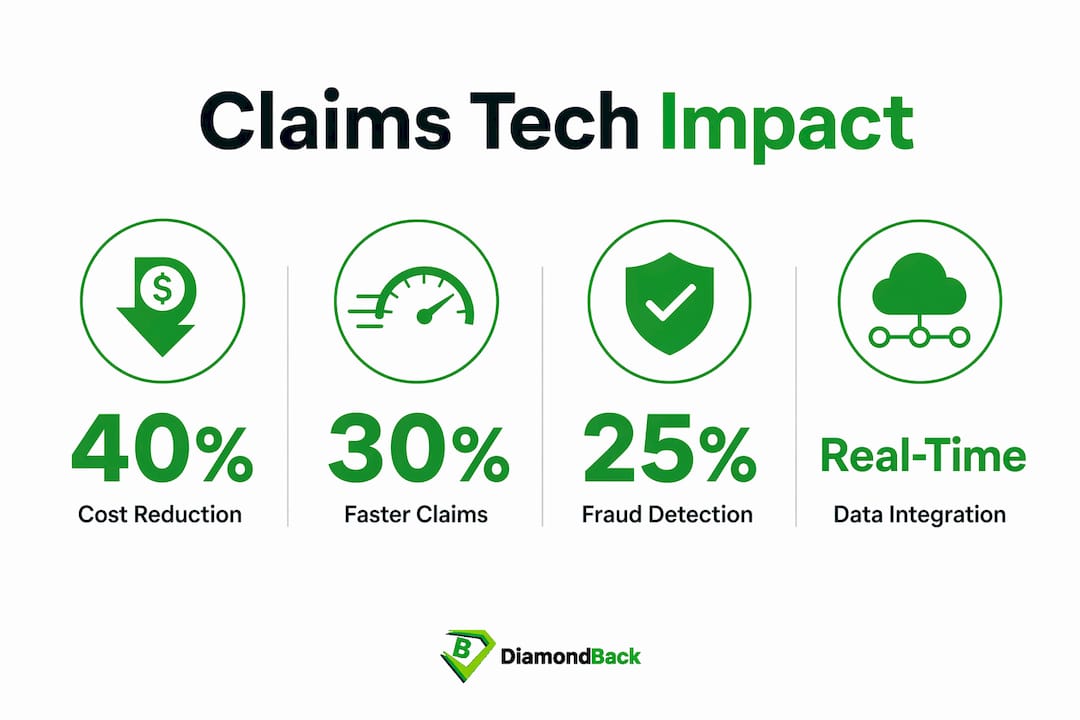
Real-time data integration accelerates validation. Carriers that connect claims platforms to external data sources such as police reports, weather APIs, and repair shop networks resolve claims faster and with greater accuracy. For trucking fleets, this means faster return to operations after an incident, which directly reduces downtime costs.
Pro Tip: Avoid deploying claims technology as isolated point solutions. A standalone fraud detection tool that does not share data with your intake platform creates gaps that fraudsters and inefficiencies both exploit. Integrated architecture is the standard to build toward.
Why do digital transformation efforts in insurance fail?
Only 25% of insurance transformation initiatives are highly successful. The failure pattern is consistent: fragmented, siloed approaches where individual business units deploy technology independently without centralized governance or shared data standards. Under 40% of insurers centrally manage transformation initiatives, which means the majority operate without the coordination needed to scale results.
Architecture mismatch compounds the problem. Most carriers built their core systems in the 1980s and 1990s. Layering AI tools on top of those systems without redesigning the underlying workflows produces marginal gains at best. BCG research confirms that 70% of transformation effort should focus on workflow redesign for AI-first operating models, while technology and data setup account for only 20%. Most insurers invert that ratio, spending heavily on software licenses while underinvesting in process change.
About 80% of transformation budgets are earmarked for technology procurement or operating expenses, with little allocated to change management or workforce upskilling. That imbalance explains why technology investments frequently produce disappointing returns. Tools without trained users and redesigned processes do not deliver the outcomes vendors promise.
The path forward requires leadership alignment, a centralized transformation office with authority across business units, and a workforce development program that builds AI literacy at every level. Digital maturity depends more on integrated systems and organizational culture than on the volume of technology spending. Carriers that treat transformation as a technology project rather than an organizational change program consistently underperform.
What are the key insurance technology trends for 2026?
The insurtech innovations shaping the next phase of the industry are not speculative. They are already in production at leading carriers, and the performance gap between early adopters and the rest of the market is widening.
1. AI scaling from pilot to core function. Insurers that have successfully scaled AI as a core operating capability achieve up to 21% higher revenue growth and 51% greater share price growth over three years compared to peers. Only 10% of insurers have reached that level of AI maturity, which makes it the single highest-leverage investment available to carriers today.
2. Direct-to-consumer digital platforms. D2C platforms remove broker friction from the purchase process, allowing commercial customers to compare quotes, customize coverage, and bind policies in minutes. For fleet operators and trucking businesses, this means faster coverage decisions and lower acquisition costs on both sides of the transaction.
3. Predictive analytics and IoT for risk mitigation. Telematics devices in commercial vehicles generate continuous data on driver behavior, route conditions, and vehicle health. Carriers use this data to price risk more accurately and to alert fleet managers to conditions that increase loss probability before a claim occurs.
4. Managed services and outsourcing. Outsourcing certain technology functions accelerates agility and lowers costs compared to internal build efforts. Carriers that outsource infrastructure management, data engineering, and compliance monitoring free internal teams to focus on product and customer experience.
5. Data standardization as the foundation for AI. Mature insurers embed data standards across the entire value chain, outperforming peers on profitability and AI effectiveness. ACORD standards, when applied enterprise-wide, create the interoperability that makes every downstream AI application more reliable.
| Trend | Primary benefit | Adoption stage |
|---|---|---|
| Enterprise AI scaling | Revenue growth, cost reduction | Early adopters only (10%) |
| D2C digital platforms | Faster purchase, lower costs | Growing rapidly |
| IoT and telematics | Proactive risk mitigation | Mainstream in commercial auto |
| Managed services | Speed to market, cost control | Increasing adoption |
| Data standardization | AI reliability, interoperability | Critical foundation stage |
Key Takeaways
Technology transforms insurance operations only when AI, data standards, and workflow redesign work together as an integrated system rather than separate investments.
| Point | Details |
|---|---|
| AI adoption is widespread but shallow | 81% of insurers use AI in some workflows, but only 10% have scaled it enterprise-wide. |
| Claims cost reduction is proven | Digital and AI-native claims operations reduce handling costs by 30–40% in production. |
| Transformation fails without governance | Only 25% of initiatives succeed; centralized management and workflow redesign are the differentiators. |
| Data quality determines AI outcomes | Two in three executives cite poor data quality as the primary barrier to AI effectiveness. |
| Culture matters as much as technology | Digital maturity depends on integrated systems and organizational alignment, not spending volume alone. |
Why I think the industry is solving the wrong problem
After years of watching carriers invest heavily in AI tools and still fall short of their transformation goals, I have come to a clear conclusion: the insurance industry is treating a workflow problem as a technology problem. The tools available today, from AI underwriting platforms to automated claims intake systems, are genuinely capable. The failure point is almost never the software.
What I have seen consistently is that carriers deploy technology on top of processes designed for a pre-digital world and then wonder why results disappoint. BCG’s research on AI-first insurers confirms what I have observed directly: real transformation requires redesigning core processes end-to-end so that AI agents handle routine decisions and humans focus on exceptions. That is a fundamentally different operating model, not an upgrade to the existing one.
The governance question is equally underappreciated. NAIC guidance on AI requires human oversight and explainability in AI systems to protect fairness and compliance. That is not a constraint to work around. It is a design requirement that forces carriers to build AI systems with clear accountability structures. Carriers that treat regulatory oversight as a burden rather than a design input consistently build systems that create compliance risk downstream.
My honest advice to any insurance professional reading this: invest 70% of your transformation energy in process redesign and change management before you spend another dollar on software. The technology will work when the organization is ready to use it properly.
— Vladimir
How Diamondbackins uses technology to protect your fleet

Diamondbackins applies the same digital principles that leading carriers use at the enterprise level to serve fleet managers and trucking businesses directly. The platform aggregates quotes from multiple top insurers in real time, giving you an accurate comparison in minutes rather than days. You can save up to 25% on fleet costs by using a digital platform that removes broker overhead and delivers transparent pricing instantly. For fleet operators who need coverage decisions quickly, Diamondbackins provides a fully online purchase process with no phone calls required. You can also review the fleet insurance workflow guide to understand how technology improves every step from quote to claims resolution for commercial fleets.
FAQ
What is the role of technology in insurance today?
Technology serves as the operational backbone of modern insurance, embedding AI, automation, and data analytics into underwriting, claims, and customer service. The impact of tech on insurance now determines pricing accuracy, claims speed, and competitive positioning across the industry.
How does AI reduce claims processing costs?
AI-assisted intake, fraud detection, and automated damage assessment reduce claims handling costs by up to 40% when deployed as an integrated system. Carriers that apply these tools in isolation see smaller gains because data does not flow between disconnected platforms.
Why do most insurance digital transformation efforts fail?
Only 25% of transformation initiatives succeed, primarily because carriers apply technology to legacy workflows instead of redesigning processes for an AI-first operating model. Centralized governance and workflow redesign are the two factors that separate successful programs from underperforming ones.
What is data standardization and why does it matter for insurers?
Data standardization means applying consistent data formats and definitions, such as ACORD standards, across all systems in the insurance value chain. Mature insurers that embed these standards enterprise-wide outperform peers on AI effectiveness and profitability because their models train on clean, consistent data.
How can fleet managers benefit from insurance technology trends?
Fleet managers benefit directly from telematics-based pricing, digital claims platforms that accelerate resolution, and D2C insurance platforms that reduce purchase time and cost. Carriers using IoT data from commercial vehicles can also alert fleet operators to risk conditions before a loss occurs.