

To operate legally as a non-emergency medical transportation provider, you need at least $1,000,000 combined single limit (CSL) commercial auto liability, general liability coverage, workers’ compensation if you employ drivers, and a certificate of insurance (COI) with exact wording your broker demands. If you cross state lines, FMCSA’s 49 CFR Part 387 raises that floor.
Here’s the fast checklist:
- Commercial auto liability: $1,000,000 CSL minimum for most broker contracts
- Interstate carriers: $1.5 million for 1 to 15 passengers, $5 million for 16 or more
- General liability: typically $1M/$2M
- Workers’ compensation: required wherever you have employees
- Hired & non-owned auto (HNOA) and physical damage where applicable
- COI must state additional insured status, primary and non-contributory wording, and a cancellation notice period as required, delivered directly from your insurer
Pro Tip: Never forward your own COI to a broker or Medicaid unit. Most reject self-submitted certificates and require the document to come straight from your insurance agent or carrier.
Key Takeaways
NEMT providers who buy to broker minimums instead of state minimums avoid the credentialing rejections that stall revenue the longest.
| Point | Details |
|---|---|
| Set your floor by broker demand | Buy to your strictest broker’s requirement, commonly $1,000,000 CSL, not just your state’s legal minimum. |
| Know your federal trigger | Interstate carriers must meet FMCSA Part 387 thresholds of $1.5M for 1 to 15 passengers, $5M for 16 or more. |
| Get COI wording exact | Additional insured, primary & non-contributory, and 30-day cancellation notice must all appear on the certificate. |
| Deliver the COI correctly | Have your insurer or agent send the certificate directly to brokers to avoid automatic rejection. |
| Compare carriers before buying | Diamondbackins provides instant, tailored quotes so fleet managers can match coverage to broker wording requirements quickly. |
Table of Contents
- What Are the Core NEMT Insurance Requirements?
- Does FMCSA or Your State Set Your Insurance Minimum?
- What Do NEMT Brokers Require From Providers?
- Which Policy Endorsements Should You Request From Your Agent?
- What Documents Do You Need for NEMT Credentialing?
- How Do You Build a Compliance Workflow for NEMT Insurance?
- Why Broker Minimums Usually Beat the Legal Minimum
- Get Credential-Ready Coverage Without the Broker Runaround
- Sources
What Are the Core NEMT Insurance Requirements?
Commercial auto liability is the backbone of your coverage, but it has to be written correctly. Your policy needs a for-hire passenger endorsement, since a standard commercial auto policy assumes cargo or business use, not paid passenger transport. Without that endorsement, a claim involving an injured rider can get denied outright.
CSL, or combined single limit, means your policy pays out of a single pool rather than splitting bodily injury and property damage into separate caps. Most NEMT brokers specify CSL because it simplifies claims handling and avoids disputes over which sublimit applies. Expect broker contracts to ask for $1,000,000 CSL as a baseline, even in states where the legal minimum is lower.
General liability protects you from claims that have nothing to do with a vehicle collision, like a passenger slipping getting into your van or a wheelchair lift malfunction causing injury during boarding. Brokers commonly want $1M per occurrence and $2M aggregate on your GL policy.
- Workers’ compensation kicks in the moment you have a single W2 driver, and most states require it regardless of headcount
- HNOA becomes critical the moment you use contractor-owned vehicles or let staff drive personal cars for company trips, since your commercial auto policy won’t extend to those vehicles
- Physical damage coverage matters most for financed or leased vehicles, where a lender typically requires it as a loan condition
If you run wheelchair-accessible vans (WAVs), your carrier needs to know. WAVs carry different underwriting risk than sedans because of lift mechanisms, securement systems, and higher passenger vulnerability, and misclassifying vehicle type on your application can void coverage exactly when you need it most.
Does FMCSA or Your State Set Your Insurance Minimum?
The honest answer: whichever one is stricter. FMCSA’s Part 387 applies specifically to interstate for-hire passenger carriers, and it sets a hard federal floor most NEMT operators never actually hit, since the majority of NEMT trips stay within state lines.
| Passenger capacity | Federal minimum (interstate) |
|---|---|
| 1 to 15 passengers | a substantial minimum |
| 16 or more passengers | a higher substantial minimum |
If you’re intrastate only, your state DOT or DMV and your state Medicaid transportation unit set the real requirement. Virginia’s DMV, for example, publishes passenger-capacity-based minimums ranging from roughly $350,000 for small vans up to $5 million for larger vehicles, a structure that varies significantly from neighboring states.
Layer broker contracts on top of both, and the broker’s number usually wins because it’s typically the highest of the three. A $1,000,000 CSL broker requirement will govern your buying decision even if your state only asks for $350,000, since the broker relationship is what generates your revenue.
What Do NEMT Brokers Require From Providers?
Medicaid transportation brokers function as gatekeepers, and their credentialing checklists have become the unofficial industry standard for NEMT insurance regardless of what a state technically mandates. A typical broker packet demands:
- $1,000,000 CSL commercial auto liability with for-hire passenger endorsement
- General liability at $1M per occurrence, $2M aggregate
- Additional insured status naming the broker or health plan on your policy
- Primary and non-contributory wording, so your policy pays first before any other coverage
- An advance notice of cancellation, commonly around 30 days, exceeding typical policy defaults
- Sublimits tied to your specific access management (SAM) contract terms, where applicable
Pro Tip: Pull the actual provider manual from every broker you plan to contract with before buying a policy. Manuals change year to year, and the coverage that satisfied a broker in 2024 may not satisfy the same broker’s 2026 revision.
Providers who buy only their state’s legal minimum routinely discover they can’t pass credentialing once a broker reviews their COI. That single mismatch has ended more NEMT applications than any driving record issue, according to NEMT Consulting’s breakdown of common rejection causes.

Which Policy Endorsements Should You Request From Your Agent?
Getting the right coverage in place means giving your agent specific instructions, not just asking for “NEMT insurance.” Walk in with this list:
- Request combined single limit language explicitly if your target broker requires CSL. A split-limit policy that technically meets the dollar amount can still get flagged during credentialing review.
- Specify the additional insured endorsement by name, along with primary and non-contributory wording, and confirm the COI will show a 30-day cancellation notice rather than your carrier’s default.
- Add hired and non-owned auto coverage if you use contractor drivers or allow staff to use personal vehicles for company trips.
- Include physical damage coverage on any financed or leased vehicle, since your lender’s contract almost certainly requires it independent of what your broker asks for.
- Confirm whether your contract requires SAM-specific sublimits, which some access management arrangements build directly into the insurance terms.
Pro Tip: Bring a copy of the broker’s provider manual to your insurance meeting. Agents who specialize in transportation insurance basics can match policy language to manual requirements in one sitting instead of several rounds of corrections.
Every one of these items should show up on the finished COI, not just inside the policy itself. Credentialing staff review the certificate, not your full policy file.
What Documents Do You Need for NEMT Credentialing?
Your certificate of insurance needs to display the insurer’s name, policy number, policy period, your exact legal business name, coverage limits, additional insureds, and cancellation language, all matching what the broker’s manual specifies word for word.
- COI showing all required fields above, sent directly from your insurer or agent to the broker or Medicaid unit
- Workers’ compensation certificate or a documented exemption if you have no employees
- Vehicle inspection permits and, for wheelchair-accessible vans, ADA compliance documentation
- Driver background check and drug-screening results on file
| Point | Details |
|---|---|
| COI delivery method | Have the insurer or agent send the certificate directly to avoid rejection for self-submitted documents. |
| Exact wording match | Every field on the COI must mirror the broker’s provider manual language precisely. |
| Vehicle documentation | WAV fleets need separate ADA compliance proof alongside standard inspection permits. |
How Do You Build a Compliance Workflow for NEMT Insurance?
Getting compliant isn’t a single purchase. It’s a sequence, and skipping a step usually means restarting credentialing weeks later.
- Verify the actual minimums in writing. Call your state Medicaid transportation unit and every broker you plan to contract with, and get their coverage requirements in an email or PDF, not a phone summary.
- Instruct your agent with exact language. Hand over the wording for additional insured status, primary and non-contributory terms, and cancellation notice, then confirm your carrier can deliver the COI directly to the broker.
- Assemble your documentation packet. Driver files, vehicle inspection records, and workers’ comp proof should be ready before you submit credentialing paperwork, since a partial submission often restarts the review clock.
- Set automated renewal tracking. Missing a COI renewal date can suspend your broker contract even when your underlying policy never lapsed.
Pro Tip: Review your policy annually, not just at renewal. Fleet composition changes, contractor arrangements shift, and a policy that fit your operation 18 months ago can leave real gaps today. Checking your insurance requirements against your current fleet once a year catches those gaps before a broker audit does.
Why Broker Minimums Usually Beat the Legal Minimum
The conventional advice on NEMT insurance treats state minimums as the finish line. That’s backward. State minimums are the legal floor, not the operational one, and providers who stop there are optimizing for the wrong constraint.
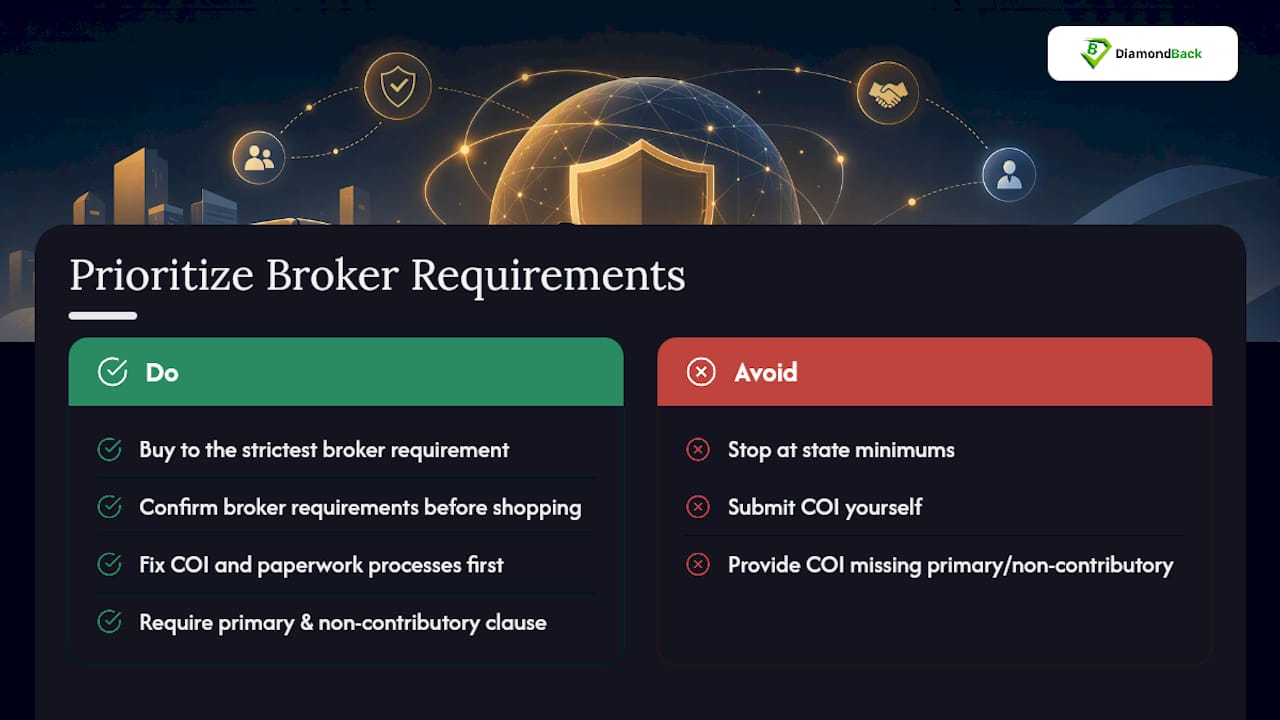
Every broker contract I’ve reviewed in researching this topic pushes past whatever the state technically requires, and for good reason: brokers carry liability exposure through the providers they credential, so they protect themselves with higher thresholds. That means the real question isn’t “what does my state require,” it’s “what does the highest-demanding broker in my market require.” Buy to that number from the start, and you never have to re-shop coverage mid-contract negotiation.
The other overlooked piece is documentation discipline. Insurance requirements get all the attention, but a perfectly compliant policy with a COI that’s missing the primary and non-contributory clause, or one your business submitted yourself instead of your carrier, gets rejected just as fast as no insurance at all. Fix the paperwork process before you fix the coverage amount, because the amount is usually the easy part.
— Vladimir
Get Credential-Ready Coverage Without the Broker Runaround
Buying NEMT insurance the traditional way means calling multiple agents, waiting days for quotes, and hoping each carrier can actually produce the COI wording your broker demands. Diamondbackins cuts that timeline down by pulling instant, tailored quotes from multiple top insurers into one comparison, so you can see commercial auto, general liability, and workers’ compensation options side by side before committing to a carrier.
The platform is built for exactly the kind of pressure fleet managers face during credentialing: transparent pricing, no guesswork on what’s included, and the ability to compare carriers that can meet additional insured and primary and non-contributory wording requirements. Once you settle on coverage, trucking insurance explained in plain terms walks through policy features so you know exactly what you’re buying before you confirm the exact COI wording with your agent.
Start a quote today, confirm the specific endorsements your broker’s provider manual requires, and get your documentation moving toward credentialing this week rather than next month by using a comprehensive fleet vehicle maintenance checklist for managers. Get your instant online quote now and see where your current coverage stands against broker expectations.
Sources
- FMCSA — Licensing and insurance requirements for hire motor carriers (49 CFR Part 387)
- NEMT insurance requirements: what every new transportation business owner needs to know (NEMT Consulting)