
Expect to pay roughly $2,500 to $8,000 per year for a full-coverage food truck insurance package, or about $200 to $650 per month, depending on your truck’s value, your state, and how many employees you carry. Bare-minimum liability-only coverage can be relatively low annually, though most lenders and commissary landlords require more than that. Your driving record, coverage limits, and deductible choices move the number in either direction. Get a few tailored quotes before you settle on a budget, as costs vary widely.
TL;DR:
- Food truck insurance costs typically range from $2,500 to $8,000 annually, depending on coverage levels, truck value, location, and staffing levels.
- A business owner’s policy averages about $84 per month, with commercial auto costs around $170 per month for midsize builds, but high-value trucks may cost more.
- Adding employees increases your budget by between $1,000 and $2,500 annually due to workers’ compensation requirements.
- Upgrading deductibles or bundling policies can reduce premiums, but underinsuring risks can expose you to significant financial loss.
- Accurate quotes depend on preparing detailed truck and equipment data, consistent coverage scenarios, and shopping from multiple insurers for comparison.
Table of Contents
- Food Truck Insurance Cost by Policy Type
- What Should You Budget for Your Food Truck?
- What Factors Drive Your Premium the Most?
- How Can You Lower Your Premium Without Underinsuring?
- How Do You Get an Accurate Food Truck Insurance Quote?
- How Diamondback Insurance Fits Into Your Search
- A Quote-Aggregation Perspective on Food Truck Budgeting
- Get a Tailored Food Truck Insurance Quote Now
- Sources
Food Truck Insurance Cost by Policy Type
Every food truck insurance quote is really a stack of separate policies bundled together, and each one prices differently based on your operation.
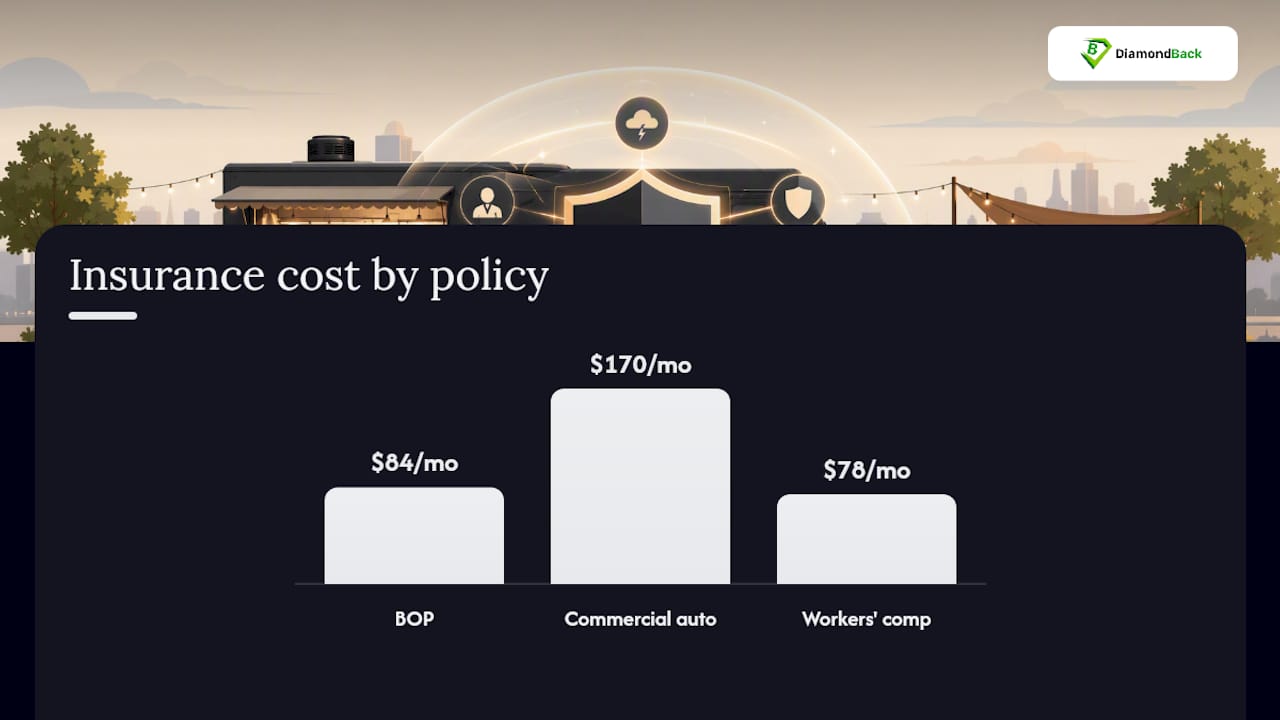
A Business Owner’s Policy (BOP) bundles general liability and commercial property coverage into one contract, and it’s typically the most economical starting point. Insureon reports a median BOP cost of $84 per month for food truck operators, which covers customer injury claims, property damage, and equipment loss from fire or theft.
General liability and product liability protect you if a customer claims foodborne illness or gets hurt near your truck. Most operators carry $1 million per occurrence with a $2 million aggregate limit, and standalone general liability tends to run cheaper than the BOP bundle if you don’t need the property piece.
Commercial auto is usually your single biggest line item. A custom-built mobile kitchen isn’t a delivery van. It’s a rolling commercial kitchen worth $50,000 to $200,000 or more, and that value drives the premium up significantly. Insureon puts the median commercial auto cost at $170 per month, though high-value custom builds push well past that.
Workers’ compensation becomes mandatory once you hire staff in most states, and pricing depends heavily on payroll and job classification, not just headcount. Expect roughly $78 per month in median cost, though rules and rates vary by state.
Equipment or inland marine coverage protects fryers, generators, refrigeration units, and point-of-sale systems separately from the vehicle itself. Premiums scale directly with the replacement value you list.
Umbrella or excess liability adds a layer above your underlying limits, typically costing a moderate additional annual premium, worth considering for high-volume events or catering contracts where lawsuits could exceed base limits.
What Should You Budget for Your Food Truck?
Your realistic insurance budget depends less on averages and more on which operator profile you actually fit.
-
Solo owner-operator, standard build. If you’re running one truck with no employees, standard equipment, and a clean driving record, expect to land in the $2,500 to $4,500 annual range. That works out to roughly $200 to $375 per month for combined general liability, commercial auto, and basic equipment coverage.
-
Small crew, one to two employees. Adding staff triggers workers’ compensation requirements in nearly every state, which typically adds $1,000 to $2,500 annually depending on payroll and job classification. The total budget shifts to somewhere between $4,000 and $6,500 per year.
-
High-value catering or urban rig. Custom stainless builds, specialty cooking equipment, and dense-city operating areas push premiums toward a higher annual range once you factor in higher commercial auto limits, elevated equipment values, and semi truck windshield replacement cost guide for large catering contracts.
Seasonal vendors have another lever worth knowing about: monthly financing or pay-as-you-go billing ties your premium to actual months operated instead of forcing a full annual payment upfront, which helps cash flow during slow winter stretches.
What Factors Drive Your Premium the Most?
Two nearly identical trucks can get quotes that differ by thousands of dollars, and it almost always comes down to a handful of underwriting variables.
- Truck and build-out value. A newer, custom-fabricated kitchen with commercial-grade equipment costs more to insure than an older converted step van, simply because replacement cost is higher.
- State location and workers’ comp rules. State-by-state differences in workers’ comp regulations mean the same payroll can generate very different premiums depending on where you operate.
- Driver history and mileage. A clean record and predictable routes keep commercial auto rates down; tickets or accidents in the last three years push them up fast.
- Payroll and job classification. Insurers price workers’ comp based on what your employees actually do, not just how many you have on staff.
- Coverage limits and deductibles. Higher limits and lower deductibles both raise premium, while raising your deductible or trimming excess limits you don’t need brings it back down.
How Can You Lower Your Premium Without Underinsuring?
Cutting costs is smart. Cutting coverage below what you actually need is how a single bad claim wipes out years of savings.
Pro Tip: Before you cut anything, ask your insurer to show you the premium difference for each coverage option side by side. A $50 monthly savings that leaves you exposed to a $40,000 claim isn’t a discount, it’s a gamble.
- Bundle general liability and property into a BOP rather than buying them separately. It’s often cheaper, though experts caution against underinsuring just to hit a lower number.
- Raise your physical-damage and equipment deductibles from $500 to $1,000 or $2,500, which commonly cuts premiums by roughly 10% to 25%, provided you keep cash reserves to cover the higher out-of-pocket cost.
- Use pay-as-you-go workers’ comp billing if your payroll swings seasonally.
- Ask about discounts for driver safety training, vehicle security systems, and documented maintenance logs.
- If you only work a handful of festivals or events per year, a short-term event policy like FLIP can start around $26 per month instead of locking you into a full annual contract.
How Do You Get an Accurate Food Truck Insurance Quote?
Getting quotes you can actually compare takes some prep work upfront.
- Gather your truck’s VIN, year, make, and an itemized equipment list with replacement values before you call anyone.
- Have payroll broken out by job classification, plus your anticipated annual mileage and any past claims history.
- Ask each insurer to quote the same coverage scenario, for example $1 million per occurrence and $2 million aggregate with a $1,000 deductible, so you’re comparing apples to apples.
- Confirm what’s excluded, since foodborne illness claims, cooking fire exclusions, and damage in rented commissary space trip up a lot of first-time buyers.
- Get at least three quotes. Carrier appetite varies widely for the same risk profile, and re-shop again at renewal or after any major change to your operation.
How Diamondback Insurance Fits Into Your Search
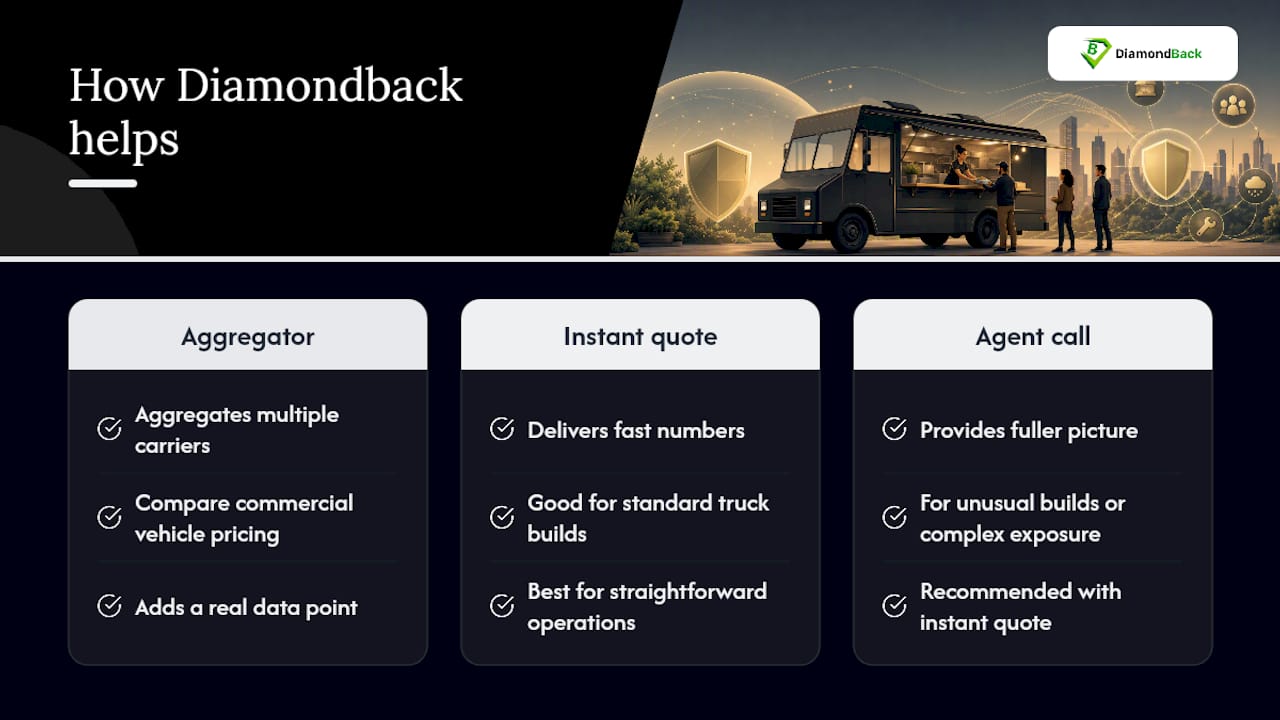
An insurance platform aggregates quotes from multiple carriers so you can compare commercial vehicle pricing side by side instead of calling insurers one at a time. An instant online quote works well for standard truck builds and straightforward operations where you want fast numbers to compare. If your rig has an unusual build, multi-state payroll, or complex catering exposure, pairing that instant quote with a conversation with an agent can help provide a fuller picture. Either way, running your numbers through an aggregator adds a real data point to your decision process.
A Quote-Aggregation Perspective on Food Truck Budgeting
If you’re budgeting for a food truck right now, build your equipment list first, then get three quotes before touching your deductible settings. Balancing coverage against cash flow isn’t about buying the cheapest policy. It’s about knowing exactly what you’re trading away for that lower number, and making that trade on purpose rather than by accident.
— Vladimir
Get a Tailored Food Truck Insurance Quote Now
Shopping food truck coverage the traditional way means separate calls to separate agents for your BOP, your commercial auto, and your workers’ comp, each with its own paperwork. This platform offers an alternative to that runaround by pulling quotes from multiple insurers so you see your price range in minutes, not days.
This works especially well once you already know your rough numbers from the ranges above and want to see what your specific truck, state, and driving record actually cost. You can compare deductible scenarios side by side, request a certificate of insurance once purchased, and avoid back-and-forth phone tag. If you’re also running other vehicles in your operation, the types of liability coverage guide breaks down limits worth knowing before you commit. Start your instant online quote today and see where your truck actually lands.
Sources
This article is general information, not a substitute for advice from a qualified financial advisor. Consult a qualified financial professional about your own circumstances before acting on anything here.