
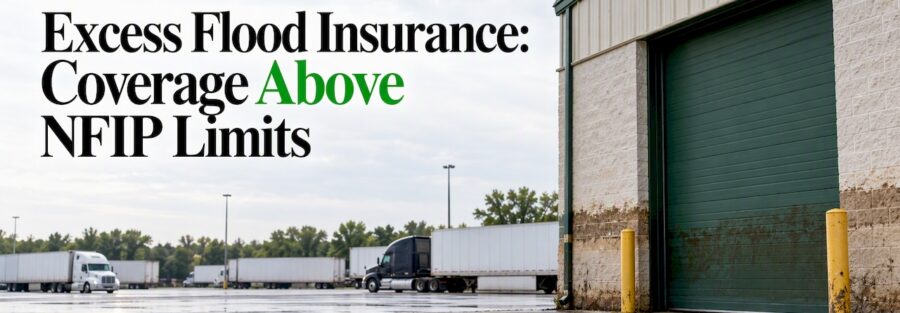
Excess flood insurance is private coverage that pays for flood damage above the limits of your primary flood policy, most often a National Flood Insurance Program (NFIP) policy. If your building would cost more to rebuild than the NFIP will pay, the excess policy covers the gap. It is sold by private insurers only, so it is not something you can add through FEMA. This guide explains how it works, who needs it (homeowners and trucking or logistics businesses with yards, terminals and warehouses), what to check before you buy, and how to get quotes online.
TL;DR
- Excess flood insurance sits on top of a primary flood policy and pays only after the primary limits are used up.
- NFIP building limits are $250,000 for a single-family home and $500,000 for other residential and non-residential buildings. Contents are capped at $100,000 for residential property.
- It is sold by private insurers. Price and eligibility depend on property value, location and flood risk.
- Read the underlying-policy requirements, exclusions and waiting period before you bind, and start early.
- You can start a flood quote online with us in minutes and compare options before you commit.
Table of Contents
- What excess flood insurance is and how it works with NFIP
- The NFIP limits that create the gap
- Who needs excess flood insurance
- What excess flood coverage typically does not fix
- How price and eligibility are set
- Waiting periods: why you should buy before the storm
- Perspective: how we think about excess flood
- How to buy excess flood insurance step by step
- What happens when you file a claim
- Get a flood quote with Diamondback
- FAQ
- Sources
What excess flood insurance is and how it works with NFIP
What does “excess” actually mean here? It means coverage that begins where another policy ends. The Pennsylvania Insurance Department explains that excess flood insurance is available only from private insurers and covers the part of a loss that is not or will not be reimbursed by the primary policy. Think of two layers. The first layer is your NFIP policy, up to its limit. The second layer is the excess policy, which responds only after the first has paid its maximum.
Why does the first layer matter so much? Because the excess policy is built around it. Most excess flood forms assume a specific underlying limit and attach above that number. If you let the primary policy lapse or carry less than the form expects, you can end up with a gap in the middle that nobody pays. We cover that point in detail below, because it is the most common misunderstanding we see.
Is excess flood the same as private flood insurance? Not exactly. Private flood insurance is a broad term for any flood policy from a non-NFIP insurer. It can replace NFIP outright. Excess flood is a specific kind of private coverage designed to stack on top of a primary policy. The Texas Office of Public Insurance Counsel notes that private flood is a growing market, with more companies offering endorsements or separate policies, including excess coverage. If you are weighing a full replacement rather than a top-up, our guide to NFIP versus private flood walks through that decision.

The NFIP limits that create the gap
The gap exists because NFIP limits are fixed, while rebuild costs are not. According to FEMA’s Answers to Questions About the NFIP, building coverage is capped at $250,000 for single-family homes and $500,000 for other residential and non-residential buildings. Contents coverage is limited to $100,000 for residential property and $500,000 for non-residential property.

Here is what that means in practice, using a simple example. Suppose a single-family home would cost $420,000 to rebuild after a severe flood. The NFIP building limit stops at $250,000. That leaves $170,000 of structural loss that you would carry yourself unless you bought an excess layer. The same logic applies to a commercial building. A truck terminal or warehouse with a $900,000 replacement cost is capped at $500,000 under the NFIP, which leaves $400,000 uncovered. These figures are illustrations, not quotes, but the arithmetic is the reason excess flood exists.
Does the NFIP pay actual replacement cost? Not in every case, and this is worth confirming in your own policy. The limits above are maximums, not promises of payment. What the policy pays depends on the building type, how the loss is valued and what your declarations page says. Excess policies often have their own valuation terms, so compare them side by side rather than assuming they match.
Who needs excess flood insurance
Homeowners in high-value or flood-prone areas. If your home would cost more than $250,000 to rebuild, the NFIP alone will not make you whole. That is increasingly common as construction costs and property values rise. Coastal and river-adjacent homes are the usual candidates, but a home in a lower-risk zone can also exceed the limit. Eligibility and cost both depend on property value, location and flood risk, according to the Pennsylvania Insurance Department.
Trucking companies and logistics operators. This is where we spend most of our time. A carrier’s exposure to flood is not only the trucks. It includes the office, the shop, the dispatch center, the yard, the fuel and maintenance equipment, and sometimes a cross-dock or warehouse. A terminal in a floodplain can easily hold more value than the $500,000 NFIP ceiling for a non-residential building. If that describes your property, read our walkthrough on how to insure a floodplain warehouse online and our overview of commercial building flood insurance, coverage, limits and costs.
Property owners with mortgage requirements. Lenders set their own flood insurance rules, and they differ by loan type and property. Ask your lender what it requires, in writing, before you choose limits. Do not assume the NFIP minimum satisfies a lender that wants coverage equal to replacement cost.
Owners of high-value contents or equipment. Residential contents are capped at $100,000 under the NFIP. If you keep expensive equipment, tools or inventory on site, check whether the excess form extends to contents or only to the building.
What excess flood coverage typically does not fix
Does it cover everything flood-related? No. Before you buy, understand what the primary layer leaves out, because an excess policy that follows the primary policy’s terms may leave out the same things. FEMA states that the NFIP does not cover business interruption, additional living expenses or damage caused by earth movement, even when the movement is flood-related.
For a trucking business, the business interruption gap is significant. If a flood closes your terminal for three weeks, the lost revenue is not a covered NFIP loss. Some private forms offer more, and some do not, so ask each insurer specifically what its form says about income loss, extra expense and temporary relocation. Our piece on commercial flood versus property coverage explains how flood differs from the property policy you may already carry, and why a standard property policy typically does not respond to rising water.
What about vehicles and cargo? Flood damage to trucks and freight is generally handled under different coverages than building flood. Physical damage and cargo policies have their own terms, so review those separately. Our Trucking Cargo and PD page explains what we offer on that side, and our guide to flood insurance coverage options for your business and fleet shows how the pieces fit together.
How price and eligibility are set
There is no single rate table for excess flood. The Pennsylvania Insurance Department says eligibility and cost are based on property value, location and flood risk. In plain terms, a higher-value property in a higher-risk area costs more, and some locations may be harder to place. Underwriters also look at the building’s construction, elevation and flood history. Our commercial flood underwriting guide lists what a commercial underwriter usually asks for, so you can gather it before you apply.
Why can excess flood cost more than you expect? Excess policies are generally sold on the surplus lines market, which has different rules from the standard market. The Texas Office of Public Insurance Counsel advises that anyone considering a surplus lines flood policy should read its explanation of surplus lines insurance first. Surplus lines carriers have more freedom on forms and pricing, which can allow higher limits and coverage for risks the standard market declines. The trade-off is that state oversight of forms and rates works differently, so you need to read the policy yourself.
Will there be a deductible? It depends on the program. Some excess forms follow the primary policy’s terms once the underlying limit is exhausted, and in those cases a separate building deductible may not apply. Others set their own. Ask for the deductible and the attachment point in writing, and do not infer one from the other.
We do not publish prices for flood coverage, because the premium comes from the insurer after underwriting. The most reliable way to know your number is to request quotes with your actual property details.
Waiting periods: why you should buy before the storm
Flood policies do not start the day you apply. According to the Pennsylvania Insurance Department, NFIP policies usually carry a 30-day waiting period, while private flood policies typically have shorter waits, such as 10 to 14 days, though this varies. Excess coverage can have its own terms, so confirm the effective date before you rely on it.
The practical lesson is simple: buy the coverage in the quiet season, not when a storm is forecast. Many insurers will not bind new flood coverage once a named storm is approaching. If you are planning ahead, our explainer on the flood insurance waiting period covers how the timing works, and the 2026 planning version is written for owners scheduling renewals and new purchases.
Perspective: how we think about excess flood
We see two mistakes more than any others. The first is assuming the primary policy limit equals the property value. It rarely does, and the owner finds out after the loss. The second is buying an excess layer without checking that it lines up with the primary policy underneath it. A gap or mismatch at the attachment point can turn a well-intended purchase into a dispute.
For trucking and logistics owners, our view is that flood belongs in the same planning conversation as liability, cargo and workers compensation. A flooded terminal is not only a property loss. It interrupts dispatch, delays freight and strains customer relationships. That is why we encourage owners to price the building first, then ask hard questions about what happens to operations while repairs are underway.
We also think comparing is part of doing this properly. Excess flood is not a commodity, and the differences are in the terms: attachment point, valuation, exclusions, deductible and waiting period. Looking at several offers side by side is the fastest way to see those differences.
— Vladimir
How to buy excess flood insurance step by step
Step one: confirm your primary policy. Pull your declarations page and note the building limit, contents limit, deductible and policy term. If you do not have a primary flood policy yet, you will usually need to arrange one, either through the NFIP or a private carrier, so the excess has something to sit on.
Step two: estimate the real rebuild cost. Use a current replacement cost estimate, not the purchase price or tax assessment. Land value is not part of the rebuild, and market value swings with location. A contractor’s estimate or an insurer’s valuation is a better guide. The difference between that figure and your primary limit is the amount of excess you are shopping for.
Step three: gather your property facts. Underwriters will want the address, construction type, year built, elevation or flood zone information, and any flood loss history. For commercial property, add occupancy, use and whether goods or equipment are stored at ground level.
Step four: compare terms, not only premiums. Ask each insurer how its form treats the attachment point, contents, additional expenses, business income, deductible and exclusions. A cheaper premium that excludes something you need is not a saving.
Step five: check the start date. Confirm when coverage begins and when your primary policy’s waiting period ends, so the two layers are active together.
What happens when you file a claim
How does a claim work with two policies? The details depend on your forms, so read them before a loss, not after. In general, the primary policy responds first. The excess policy is triggered only when the underlying limit is exhausted, as the Pennsylvania Insurance Department describes it: excess covers the part of a loss not reimbursed by the primary policy.
In practice, that means you should notify both insurers promptly, document the damage with dated photos and video, and keep every receipt for emergency repairs. Ask each carrier what proof of loss it requires and by when. Do not wait for the primary claim to finish before you tell the excess carrier, because notice requirements in your policy may start the clock earlier. If a form is unclear, ask your insurance professional or the carrier’s claims department to explain it in writing.
For a business, add one more habit: keep your records off site. Flood can destroy the office where your policy documents, vehicle lists and invoices live. A secure cloud backup protects those records, and managed providers such as IT services for transportation and logistics can set up backup and disaster recovery so your claim paperwork survives the same event you are insuring against.
Get a flood quote with Diamondback
We built our platform so you can compare flood options without a long back-and-forth. You enter your property details once, see tailored options from multiple insurers, and can buy online when you are ready. If you are a trucking company with a yard or terminal, or a homeowner whose rebuild cost is above NFIP limits, start with our flood insurance quote page and review what each option includes.
If you would rather see how the process works first, our article on getting a flood insurance quote online instantly explains each step. For a full picture of your business protection, you can also explore our Business Owners and Trucking Insurance pages.
FAQ
Is excess flood insurance required?
No law requires it, but a lender or a loan program may set its own flood requirements. Ask your lender what level of building coverage it expects, and get that answer in writing before you choose limits. Even without a requirement, it can protect you from paying the difference between the NFIP cap and your rebuild cost.
Can I buy excess flood without an NFIP policy?
It depends on the insurer. Excess coverage is designed to attach above a primary policy, and that primary policy can be an NFIP or a private flood policy. Some programs require a specific underlying limit, so confirm the requirement before you apply.
Does excess flood insurance cover business interruption?
Not automatically. The NFIP does not cover business interruption, so an excess policy that follows its terms may not either, according to FEMA’s NFIP guidance. Ask each insurer whether income loss or extra expense is available and under what conditions.
How long before excess flood coverage starts?
It varies by policy. NFIP policies usually have a 30-day wait, and private flood policies often have shorter ones, such as 10 to 14 days, according to the Pennsylvania Insurance Department. Check the effective date on your quote and buy well before storm season.
Sources
- Flood Insurance, Pennsylvania Insurance Department
- Answers to Questions About the NFIP, FEMA
- Flood Insurance Shopping Guide, Texas Office of Public Insurance Counsel
- Transportation and logistics IT services, NetFusion Designs