

There is no federal cargo insurance minimum. FMCSA requires public liability coverage of $750,000, but cargo coverage is left to the market. In practice, brokers set the practical cargo floor commonly around six figures, with higher common standards set for general freight and high-value loads. Set your limit at or above your maximum single-load value, and confirm that number matches your certificate of insurance.
TL;DR:
- Cargo insurance limits should match or exceed the maximum value of your highest-value load to avoid personal exposure on costly shipments.
- Brokers commonly require cargo coverage of at least $100,000 for general freight, with high-value loads often demanding $250,000 or more.
- Many cargo policies exclude refrigerator breakdown, unattended theft, or multiple shipments stacked at a terminal, which can lead to uncovered damages or losses.
- Premium costs generally range from a few hundred to several thousand dollars annually, depending on coverage limits, commodity risk, and claims history.
- Prioritizing a coverage limit based on the worst-case single load and verifying endorsements reduces the risk of costly gaps in your protection.
Table of Contents
- What Does Motor Truck Cargo Insurance Cover?
- What Are the Regulatory Cargo Insurance Requirements?
- How Do You Set the Right Per-Shipment Limit?
- Which Sub-Limits and Endorsements Actually Matter?
- What Do Cargo Insurance Premiums Typically Cost?
- How Diamondback Insurance Helps You Buy the Right Limit Fast
- Why the “Just Meet the Minimum” Advice Falls Short
- Get an Instant Quote and Verify Your Coverage Today
- Sources
What Does Motor Truck Cargo Insurance Cover?
Motor truck cargo insurance is first-party coverage that pays to repair or replace freight you’re hauling when it’s damaged, stolen, or destroyed while under your care, custody, and control. It typically responds to collision, overturn, fire, theft, and mishandling during loading or unloading. It’s a different product entirely from the general liability or auto liability policy you’re required to carry, and confusing the two is one of the most expensive mistakes an owner-operator can make.
Here’s why the distinction matters. Federal law, through the Carmack Amendment, lets carriers limit their liability to a released or declared value rather than full replacement cost. That means if you never bought cargo insurance and a shipment burns in a trailer fire, your legal exposure might be capped well below what the freight was actually worth. The shipper eats the difference, and you likely lose that customer relationship permanently. Cargo insurance closes that gap by paying out based on actual value, not a statutory ceiling.
Standard motor truck cargo policies generally include:
- Coverage for fire, theft, collision, and overturn while freight is in transit
- Loading and unloading exposure at pickup and delivery points
- Named-peril or all-risk options depending on the carrier and commodity
Common exclusions include mechanical breakdown, employee dishonesty without an endorsement, and certain high-theft commodities unless specifically scheduled. Reviewing common trucking coverage exclusions before you sign a policy saves a lot of grief at claim time.
What Are the Regulatory Cargo Insurance Requirements?
FMCSA requires public liability insurance filings like BMC-91 for the $750,000 auto liability minimum, but there’s no equivalent federal cargo insurance minimum for most general freight carriers. That surprises a lot of new owner-operators who assume cargo coverage is mandated the same way.

Household goods movers are the exception. Under 49 CFR Part 375, movers must offer shippers a choice between released-value protection (minimal liability, often pennies per pound) and full-value protection, and they must clearly disclose which applies. Get that disclosure wrong and you’re looking at a compliance violation, not just an insurance gap.
Outside of household goods, your real-world minimum gets set by contract, not statute:
- Freight brokers typically won’t dispatch a load without a certificate showing at least $100,000 in cargo coverage
- Large shippers and load boards often push that requirement to $250,000 for general freight
- High-value commodities (electronics, pharmaceuticals, precision equipment) routinely require $500,000 or more before a broker will even quote the lane
Your motor carrier insurance filings and your cargo certificate are two separate documents, and brokers check both.
How Do You Set the Right Per-Shipment Limit?
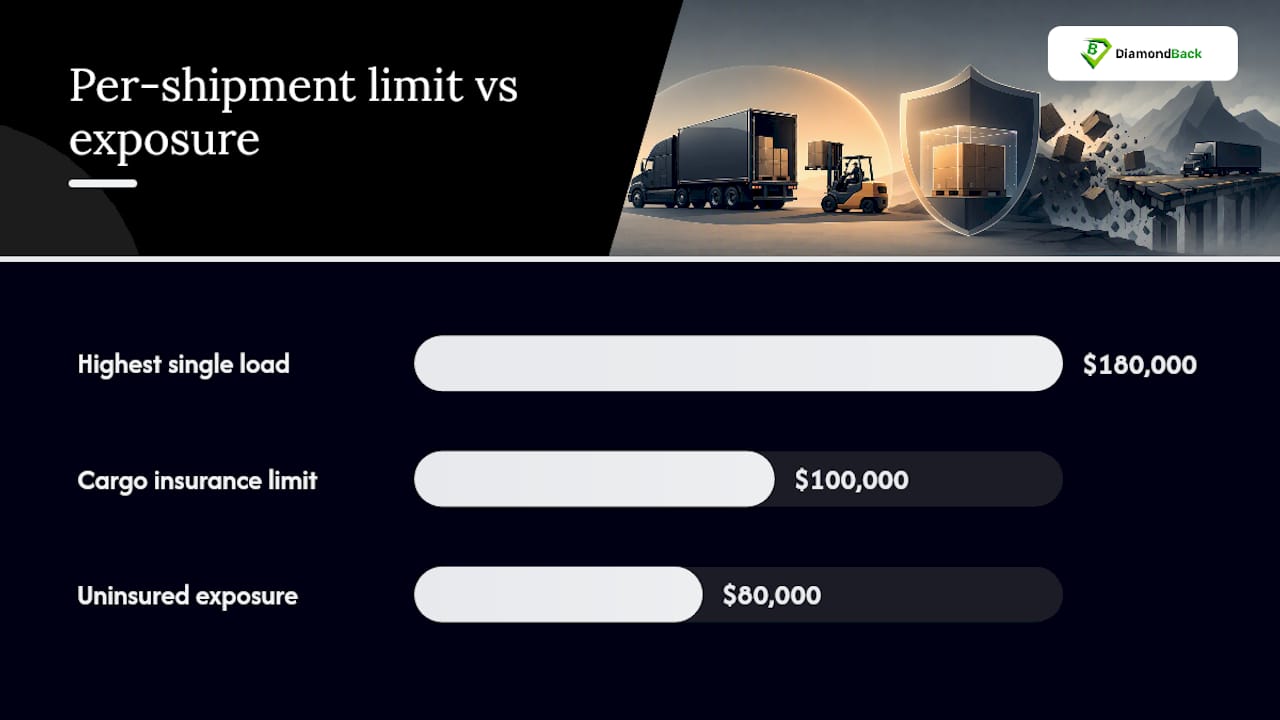
The governing rule is simple: your cargo limit should match or exceed the maximum value of any single load you’re willing to accept. If you regularly haul freight worth $180,000 but carry a $100,000 cargo limit, you’re personally exposed for the remaining $80,000 on every trip, and that gap doesn’t show up until you’re standing next to a wrecked trailer.
Accumulation risk complicates this further. If you stage multiple loads at a terminal, or a single conveyance carries stacked shipments for different customers, your total exposure at that location can exceed any one shipment’s value. The IUMI guide to marine cargo insurance covers this concept in depth, and the same logic applies whether you’re moving containers by sea or freight by trailer.
Before you buy, run through this checklist:
- What’s the highest-value single load your operation realistically hauls?
- What do your broker contracts and shipper agreements require in writing?
- Do you haul unattended (parked, unguarded) loads that carry theft exposure?
- Do you run reefer freight that needs breakdown coverage layered on top?
- If you handle household goods, are your declared-value disclosures current?
For most dry van general freight, practical minimums to meet broker requirements start near six figures, with more comfortable limits and specialized cargo often requiring notably higher coverage levels
Pro Tip: Pull your last twelve months of rate confirmations and find your single highest-value load. That number, not your average shipment, is what should drive your coverage limit.
Which Sub-Limits and Endorsements Actually Matter?
Standard cargo policies are full of sub-limits that carriers don’t discover until they file a claim. Reefer breakdown is the biggest one: most policies exclude mechanical failure of refrigeration units entirely unless you add a specific endorsement, and that sub-limit commonly runs $10,000 to $50,000, which may not cover a full trailer of pharmaceuticals or produce.
Watch for these gaps specifically:
- Unattended-vehicle theft caps, often lower than your overall cargo limit
- Per-trailer or per-conveyance limits on policies covering multiple units
- Auto hauler scheduling requirements for insuring vehicles as cargo
Insurers also attach warranty clauses tied to security practices, GPS tracking, or documented temperature logs for reefer freight. Fail to maintain those records and a claim can be denied outright, regardless of your stated limit. Reviewing your policy add-ons at renewal is the easiest way to catch these before they cost you.
What Do Cargo Insurance Premiums Typically Cost?
Cargo insurance is priced ad valorem, meaning the premium scales with the value you’re insuring and the risk profile of what you haul. Cost analyses show a $100,000 limit might run a few hundred to low thousands annually for a solo operator, while $250,000 to $500,000 limits scale up from there depending on commodity risk, claims history, and fleet size.
Deductibles move the number meaningfully. A higher deductible, say $2,500 instead of $500, lowers your premium but increases what you absorb per claim.
Five factors drive your rate more than anything else:
- Commodity type and theft risk
- Claims history and years in operation
- Radius of operation and lane risk
- Equipment age and security features
- Single-shipment certificates versus an open (blanket) policy
If you ship frequently, an open policy usually beats paying per certificate. Comparing quotes across insurance providers shows how much these five factors actually move your number.
How Diamondback Insurance Helps You Buy the Right Limit Fast
You don’t need to guess your way through this. Diamondback Insurance pulls quotes from multiple carriers side by side, so you can compare $100,000, $250,000, and $500,000 cargo limits against real premiums instead of estimates.
The practical path looks like this: run quotes for the limit band your broker contracts require, review the certificate wording before you bind, and set up an open policy if you’re shipping regularly rather than requesting a new certificate every load. If you run reefer freight, confirm the breakdown endorsement is included, not assumed.
Why the “Just Meet the Minimum” Advice Falls Short
Most cargo insurance guidance stops at “carry $100,000 because that’s what brokers want.” That advice keeps you dispatchable, but it doesn’t keep you solvent. The real number brokers care about is a floor, not a target, and treating it as a target is how carriers end up personally covering the gap on their highest-value loads.
What the research actually supports is a shift in framing: stop asking “what’s the minimum I can get away with” and start asking “what’s the worst single load I’ll ever carry.” That number, not the broker requirement, should set your limit. Accumulation risk at terminals and reefer breakdown exclusions are the two blind spots that catch experienced carriers off guard, not new ones, because veterans assume their long-standing policy already accounts for them.
If you take one thing from this, prioritize matching your limit to your highest-value freight first, then layer in the right endorsements. Everything else, deductible tuning, open versus single-shipment policies, is optimization on top of that foundation.
— Vladimir
Get an Instant Quote and Verify Your Coverage Today
You can get real cargo insurance quotes online in minutes instead of days on the phone with a broker. Whether you’re a solo owner-operator hauling general freight, a small fleet running mixed commodities, or a reefer operator who needs breakdown coverage built in, you compare quotes from multiple insurers side by side and see exactly what each limit band costs before you commit.
Start by running quotes for the limit your contracts actually require, whether that’s $100,000, $250,000, or higher for high-value freight. Then check the certificate wording matches what your broker or shipper needs on file. Visit Diamondbackins to compare cargo coverage options and get a quote you can act on today, or explore trucking company insurance quotes if you’re ready to bind coverage now.
Sources
The guidance above draws on federal regulatory pages and industry cost analyses, not marketing copy: