

Canadian cross-border trucking insurance is the specialized commercial coverage that lets Canadian carriers operate legally and financially protected inside the United States. A standard domestic Canadian policy does not extend across the border. The moment your truck crosses into the U.S., you face federal liability minimums, state-specific litigation exposure, and shipper contract requirements that your home policy was never built to meet. Getting this coverage right protects your operating authority, your cargo, and your business from the kind of claims that can end a carrier’s operations overnight.
What Canadian cross-border trucking insurance actually requires
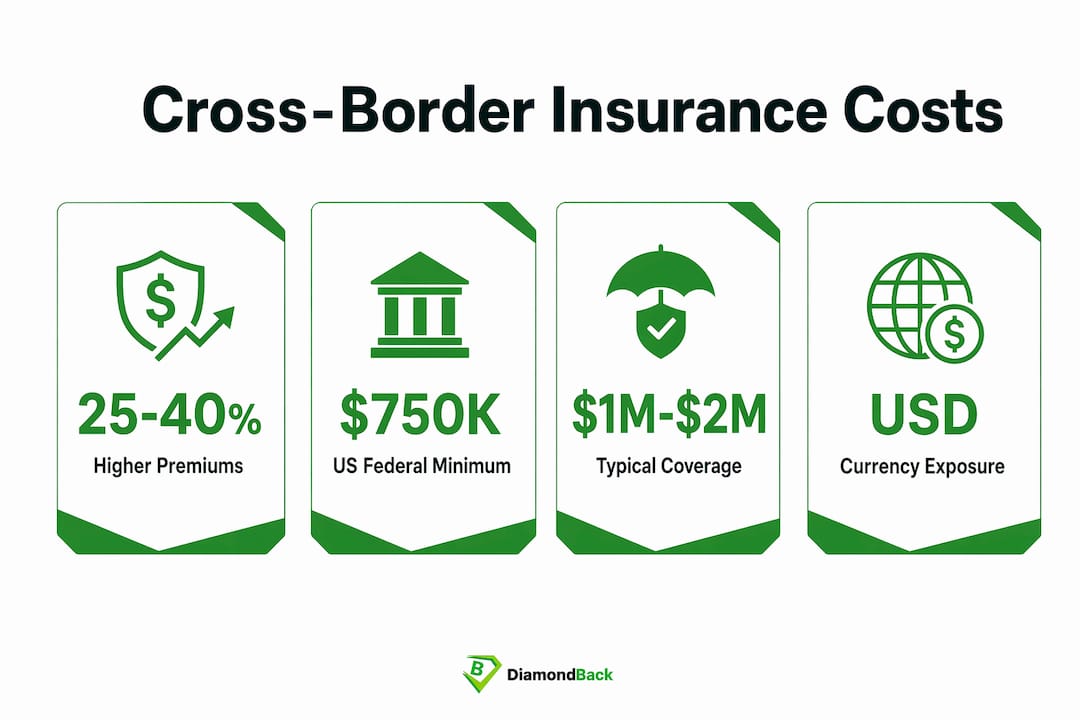
The U.S. federal minimum motor carrier liability is $750,000 USD, but that floor is almost never enough in practice. Most shippers and freight brokers require a combined single limit (CSL) of $1,000,000 to $2,000,000 USD before they will award a load to a Canadian carrier. That gap between the federal minimum and real-world contract requirements is where many owner-operators get caught off guard.
Cross-border freight insurance is not a single policy. It is a stack of coverages, each covering a different exposure. The four core policies every Canadian carrier needs for U.S. operations are primary auto liability, motor truck cargo, non-trucking liability (also called bobtail insurance), and trailer interchange. Standard auto liability policies often miss trucking-specific coverages including motor truck cargo, non-trucking liability, and trailer interchange, which are critical for cross-border operations.
Primary auto liability covers bodily injury and property damage you cause to third parties while hauling a load. Motor truck cargo covers the freight itself while it is in your care, custody, and control. Cargo insurance premiums vary from 0.1% to 2% of cargo value depending on commodity risk. That range matters because electronics, pharmaceuticals, and temperature-sensitive goods sit at the high end, while general dry freight sits at the low end.
Non-trucking liability protects you when your truck is being operated for personal use, not under dispatch. Trailer interchange covers physical damage to a trailer you are pulling under a trailer interchange agreement but do not own. You can read a detailed breakdown of trailer interchange coverage to understand exactly when each policy responds. Missing either of these two coverages creates gaps that a primary liability policy will not fill.
Pro Tip: Ask your broker to confirm in writing that your cargo policy covers the specific commodities you haul. Common exclusions include improper packing, inherent vice, and undeclared hazardous goods. An exclusion you did not know about is the same as no coverage at all.
How much does cross-border trucking insurance cost in 2026?
Canadian cross-border trucking companies pay 25–40% higher premiums than domestic-only carriers. The average annual premium for a single tractor with U.S. exposure runs CAD $15,000 to $22,000. A B-train configuration runs CAD $18,000 to $28,000. Tanker and hazmat units reach CAD $25,000 to $40,000 annually. Those figures reflect the real cost of operating in a U.S. legal environment where jury awards routinely exceed what Canadian courts would order.
U.S. nuclear verdict litigation drives a significant portion of that premium increase. Jurors in states like Texas, Florida, and California frequently award damages exceeding $10,000,000 USD in trucking cases. Global reinsurance markets price that risk into every Canadian carrier’s premium, even if you never haul into those specific states. If you do operate in high-verdict states, your insurer may place you in a non-admitted insurance market, which carries additional cost.
Currency exposure adds another layer to your premium. Your liability is denominated in U.S. dollars, but your premium is often paid in Canadian dollars. Insurers typically build in a 3–8% currency buffer to protect against exchange rate swings. That buffer is not negotiable, but it is worth understanding so you can factor it into your operating cost per mile.
Your fleet’s safety score and claims history directly affect your rate. Carriers with clean records, documented driver training programs, and low CVOR scores consistently receive better pricing at renewal. Telematics data also plays a growing role. Fleets that can prove through GPS records that they avoid high-risk corridors give underwriters concrete evidence to justify lower rates. Understanding how state-specific risks influence your premium helps you plan your lane strategy with insurance cost in mind.
How to manage insurance documentation for border compliance
Outdated or incorrect Certificates of Insurance are one of the most common reasons Canadian carriers face rejected loads at U.S. facilities. The underlying policy may be perfectly valid, but if the certificate shows the wrong legal business name, an expired date, or a missing endorsement, the shipper’s compliance team will turn you away. That rejection costs you the load, the relationship, and potentially a day of deadhead miles.
Your Certificate of Insurance (COI) must show your correct legal business name exactly as it appears on your operating authority. The coverage limits must match or exceed what the shipper or broker contract requires. The certificate must list the correct additional insured parties when the contract demands it. And the effective and expiration dates must be current at the time of tender, not just at the time of policy issuance.
Cross-border filings and proof of coverage must be ready and accessible at all times. Keep a digital copy of your current COI in your cab, in your dispatch system, and with your safety manager. Many carriers also store certificates in a shared cloud folder so that office staff can send updated copies to brokers within minutes of a request.
Pro Tip: Set a calendar reminder 60 days before your policy renewal date. Use that window to request updated certificates, review your coverage limits against your current contract requirements, and confirm that any new trailers or drivers are properly scheduled on the policy.
The four most common documentation mistakes that cause border and onboarding delays are: using a certificate from a prior policy year, listing the wrong entity name after a business restructuring, failing to add a required additional insured, and not having a trailer interchange endorsement when hauling pool trailers. Each of these is preventable with a simple annual review.
Best practices to manage your cross-border insurance strategy
Telematics and GPS geofencing give you a direct tool to reduce premium costs. Fleets with telematics data can earn 5–15% rate credits at renewal by proving non-entry into high-risk U.S. states. That credit compounds over time. A carrier saving 10% annually on a $20,000 premium recovers the cost of a telematics system within the first policy year.
Carrier liability alone is rarely sufficient for high-value freight. Reliance solely on carrier liability leaves gaps for electronics, pharmaceuticals, and fragile goods. An “all-risk” cargo policy covers the full shipment value regardless of fault. It is the right choice for any load where the cargo value significantly exceeds your standard cargo liability limit.
Cross-border logistics involves concentrated risks from customs delays, handling, and broker requirements. Comprehensive insurance beyond minimum liability is not optional for carriers who want to protect their revenue and their reputation on both sides of the border.
Review your insurance portfolio at least once a year, and more often if your lane mix or cargo types change. A carrier that adds a new hazmat lane mid-year without notifying their insurer may find that the new exposure is not covered. Your broker needs current information to keep your coverage aligned with your actual operations. You can also review how much insurance a trucking company needs as your fleet grows.
Negotiating lane-specific premiums is a real option for established carriers with clean records and good data. If your GPS history shows that 90% of your U.S. miles are in low-verdict states like the Midwest, bring that data to your renewal conversation. Underwriters respond to evidence. A carrier that walks in with a telematics report has a stronger negotiating position than one who relies on verbal assurances.
Key Takeaways
Canadian carriers operating in the U.S. need a layered insurance program that goes well beyond the federal minimum, with current documentation and active cost management to stay compliant and competitive.
| Point | Details |
|---|---|
| Federal minimums are not enough | Shippers require $1M–$2M USD CSL, far above the $750,000 federal floor. |
| Four core coverages are required | Auto liability, cargo, non-trucking liability, and trailer interchange each cover a distinct exposure. |
| Premiums run 25–40% higher cross-border | A single tractor with U.S. exposure costs CAD $15,000–$22,000 annually on average. |
| COI accuracy prevents rejected loads | Incorrect business names or expired dates on certificates cause onboarding failures even with valid policies. |
| Telematics earns rate credits | Fleets with GPS data proving low-risk lane use can earn 5–15% premium reductions at renewal. |
What I have learned from watching Canadian carriers get this wrong
The carriers who get hurt most are not the ones who skip insurance entirely. They are the ones who buy the minimum, assume it transfers across the border, and find out otherwise at the worst possible moment. I have seen owner-operators with valid Canadian policies get turned away at a U.S. facility because their certificate listed a trade name instead of their registered legal entity. The policy was fine. The paperwork was not.
U.S. litigation risk is not theoretical for Canadian carriers. The nuclear verdict problem in states like Texas and Florida has changed the math permanently. A single serious accident in a high-verdict jurisdiction can produce a claim that exceeds a $1,000,000 CSL policy. Carriers who operate in those states with minimum limits are essentially self-insuring the gap. That is not a risk management strategy. It is a business-ending exposure.
The most practical advice I can offer is to treat your insurance review as part of your dispatch process, not a once-a-year administrative task. When you add a new lane, change your cargo mix, or bring on a new driver, your coverage needs to reflect that change immediately. Brokers who specialize in commercial trucking insurance understand cross-border exposures and can flag gaps before they become claims. Build that relationship before you need it.
— Vladimir
Diamondbackins makes cross-border coverage faster to secure
Getting the right USA Canada trucking insurance does not have to mean weeks of back-and-forth with a traditional broker. Diamondbackins is an online platform built specifically for trucking and commercial transportation coverage, and it lets you compare quotes from multiple top-rated insurers in minutes.
Whether you run a single tractor or manage a full fleet, Diamondbackins gives you instant access to tailored quotes that reflect your actual cross-border exposure, your cargo types, and your lane mix. The platform is built for carriers who need compliant coverage fast, without the friction of the traditional insurance process. Get your instant trucking quote today and see what your cross-border program should actually cost. You can also visit Diamondbackins to compare options and secure coverage that meets U.S. shipper and broker requirements from day one.
FAQ
What is Canadian cross-border trucking insurance?
Canadian cross-border trucking insurance is a commercial insurance program that covers Canadian carriers operating inside the United States. It includes primary auto liability, motor truck cargo, non-trucking liability, and trailer interchange coverage to meet U.S. federal and shipper requirements.
How much liability coverage do I need to haul in the U.S.?
The U.S. federal minimum is $750,000 USD, but most shippers and freight brokers require a combined single limit of $1,000,000 to $2,000,000 USD. Carriers operating in high-verdict states like Texas or Florida should carry the higher limit.
Why is cross-border trucking insurance more expensive than domestic coverage?
Cross-border premiums run 25–40% higher than domestic-only coverage because of U.S. nuclear verdict litigation risk, USD liability exposure, and currency buffer surcharges built into the premium. High-verdict states like Texas, Florida, and California drive reinsurance costs up for all Canadian carriers with U.S. exposure.
What documents do I need to cross the border with a commercial truck?
You need a current Certificate of Insurance showing your correct legal business name, active coverage dates, and limits that meet your shipper or broker contract requirements. Outdated or incorrectly named certificates are a leading cause of rejected loads at U.S. facilities.
Can telematics data actually lower my trucking insurance premium?
Yes. Fleets with GPS and telematics records that prove non-entry into high-risk U.S. states can earn 5–15% rate credits at renewal. Bringing documented lane data to your renewal conversation gives underwriters concrete evidence to justify lower pricing.