
Most owner-operators pay between $25 and $75 a month for bobtail insurance, or roughly $300 to $900 a year, when carrying a standard $1 million combined single limit. Your actual number depends on your driving record, garaging state, and lease type. If you want the real figure for your truck, request quotes from at least three carriers and compare the endorsements line by line before you commit.
TL;DR:
- Premiums for standard bobtail insurance generally range from $25 to $75 monthly, totaling approximately $300 to $900 annually, depending on risk factors.
- Higher rates apply if you have major violations or lease your truck to multiple carriers, which complicates underwriting and increases premiums.
- Your driving record, garaging ZIP code, and lease type significantly influence your premium, with urban locations and trip-leasing raising costs.
- Bundling bobtail with non-trucking liability and physical damage policies can reduce overall costs by 10% to 20%.
- Paying annually, increasing deductibles, and verifying discounts beforehand can lower your costs without sacrificing coverage quality.
Table of Contents
- Bobtail Insurance Cost Ranges You Can Expect Today
- How Insurers Price Bobtail Coverage
- Bobtail vs. Non-Trucking Liability vs. Deadhead Coverage
- Does Your Garaging State Change What You Pay?
- Practical Ways to Lower Your Bobtail Premium
- Getting a Bobtail Quote Without Wasting Time
- What These Numbers Mean for Your Decision
- Compare Bobtail Quotes Without the Phone Tag
- Where These Benchmarks Come From
- Sources
Bobtail Insurance Cost Ranges You Can Expect Today
Pricing for bobtail coverage sits in fairly predictable bands once you know which variables you’re working with. For a standard owner-operator carrying a $1 million CSL, most quotes land between $25 and $75 monthly, which works out to roughly $300 to $900 annually. That’s the baseline you should compare every quote against.
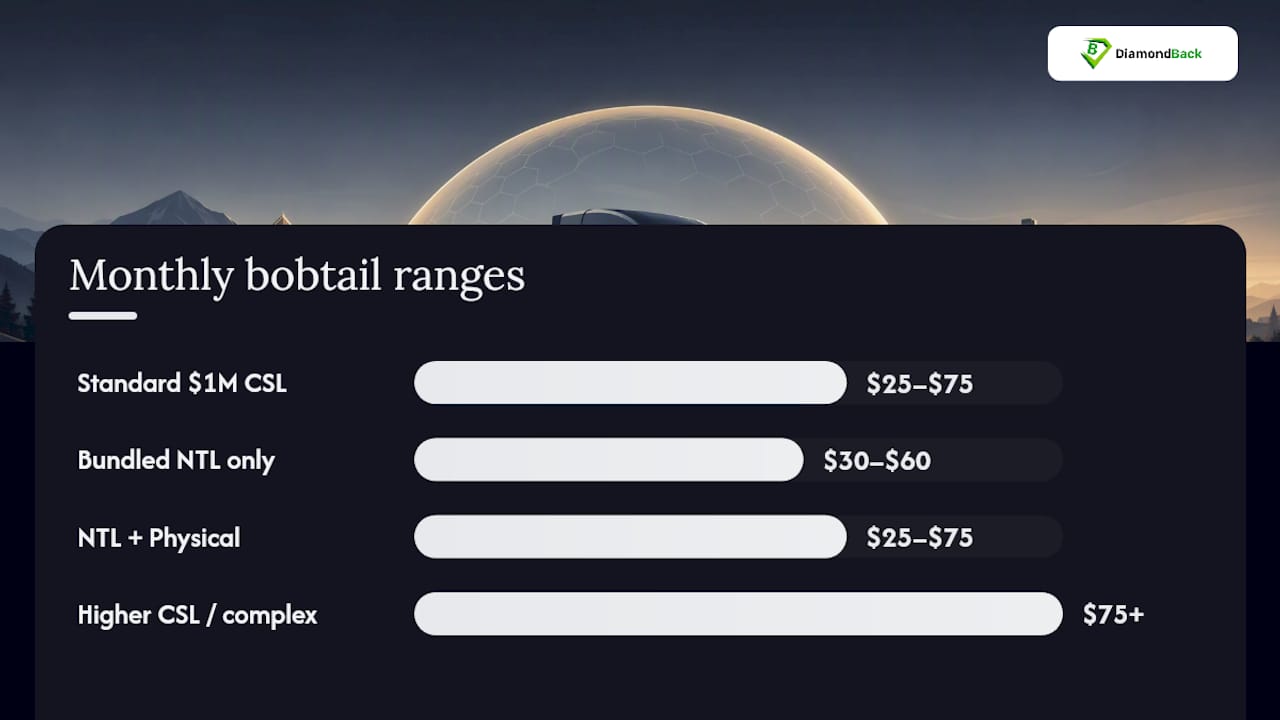
Market analysis puts the common monthly bandwidth at $30 to $60 for standard profiles, with higher bands reserved for elevated liability limits or more complicated leasing arrangements. Bundle bobtail with non-trucking liability and physical damage, and the combined annual cost typically runs $400 to $1,200 depending on your risk profile.
Here’s how those bands typically break down:
| Scenario | Monthly Range | Annual Range |
|---|---|---|
| Standard $1M CSL, clean record | $25–$75 | $300–$900 |
| Bobtail bundled with NTL only | $30–$60 | $300–$900 |
| Bobtail + NTL + physical damage | $25–$75 | $400–$1,200 |
| Higher CSL or complex trip-lease | $75 and up | $900 and up |
A few things push a quote to the high end of these ranges. Major violations on your MVR, such as a DUI or a string of moving violations, can double your premium regardless of how many years you’ve held a CDL. Trip-leasing to multiple carriers instead of running under one permanent lease also raises your rate, since insurers have a harder time underwriting exposure that shifts month to month, as shown in this case study on broker performance and underwriting improvements.
- Standard profile, clean record: expect a relatively lower premium within typical ranges.
- One or two minor violations: premiums generally increase to a mid-range level.
- Recent major violation or trip-leasing to several carriers: premiums may rise above the common range.
How Insurers Price Bobtail Coverage
Your premium isn’t a flat number pulled from a chart. Underwriters weigh a handful of factors, and understanding them helps you predict where you’ll land before you ever request a quote.
- Driving record and CDL experience. A clean MVR and several years behind the wheel are the single biggest levers you control. FMCSA crash data shows how heavily exposure and driver history factor into large-truck risk, which is exactly why underwriters lean on your record so hard.
- Garaging state and ZIP code. Where your truck sleeps at night matters more than where you drive during the day.
- Lease type. Permanent-leased operators generally see steadier, lower pricing than trip-leased drivers, whose shifting carrier relationships make losses harder to predict.
- Liability limit and deductible. Raising your CSL pushes premium up; choosing a higher deductible tends to pull it down.
- Bundling. Pairing bobtail with NTL or physical damage on one carrier often unlocks a better blended rate than buying each policy separately.
New CDL holders and drivers who trip-lease across several carriers consistently pay more than stable, permanent-leased operators with a few years of clean history. If you fall into that first group, expect quotes toward the upper half of the ranges above until your record and tenure catch up.
Bobtail vs. Non-Trucking Liability vs. Deadhead Coverage
These three terms get used loosely on the road, but they trigger under different circumstances, and mixing them up can leave you exposed.
Bobtail insurance covers your tractor when you’re driving it without a trailer attached, but you’re still under dispatch or otherwise operating for business purposes between loads. Non-trucking liability (NTL) covers the truck when you’re off dispatch entirely. Personal errands, heading home after dropping a trailer, or driving to get fuel on your own time all fall under NTL rather than bobtail. Deadhead or unladen coverage typically refers to driving with an empty trailer still attached. That scenario is usually covered under your regular motor carrier policy, not bobtail or NTL at all.
- Driving to pick up your next load under dispatch: bobtail applies.
- Driving home after your shift ends with no trailer: NTL applies.
- Pulling an empty trailer between stops: your motor carrier policy applies.
Getting this wrong on your lease paperwork doesn’t just risk a coverage gap. It can also mean paying for a policy you don’t actually need, since bobtail often runs slightly higher than NTL because of its business-use trigger.
Does Your Garaging State Change What You Pay?
Yes, and the swing can be significant. Insurers price bobtail coverage partly on where your truck is garaged overnight, because litigation environment and traffic density in that area drive claims severity. States with dense urban corridors and higher litigation rates tend to push quotes toward the top of the ranges outlined earlier, while rural, lower-litigation states often land near the bottom.
Underwriters weigh your garaging ZIP code more heavily than your operating territory. You might run freight coast to coast, but if your truck parks overnight in a high-cost metro area, that address is what drives your rate. This catches some owner-operators off guard, especially those who moved or changed their home base without updating it on their policy.
- Confirm your garaging ZIP code is accurate at quote time. An outdated address can quietly inflate or misstate your premium.
- If you have flexibility in where you’re domiciled, ask your agent whether a nearby ZIP code carries a meaningfully different rate tier.
- Expect renewal surprises if you relocate mid-policy term without notifying your carrier.
Practical Ways to Lower Your Bobtail Premium
You have more control over this number than most drivers realize. A few adjustments, made before you bind a policy, can meaningfully change your annual spend without cutting corners on coverage.
- Pay annually instead of monthly. Switching off a monthly billing cycle removes recurring administrative fees, trimming your total cost by roughly 5% to 10%.
- Raise your deductible if you can absorb the risk. A $1,000 to $2,500 deductible is one of the faster ways experienced drivers bring down monthly premium, though it does shift more short-term risk onto you.
- Ask about group or lease-program pricing. Some carriers extend negotiated rates to drivers leased to a specific motor carrier or affiliated with a buying group.
- Confirm every discount before you sign. Clean-record credits, multi-policy discounts, and payment-frequency discounts don’t always apply automatically. Ask.
Pro Tip: Before you accept any quote, ask the agent to itemize which discounts are already baked in versus which ones require a separate request. Carriers rarely volunteer the second category.
Getting a Bobtail Quote Without Wasting Time
Insurers ask for the same core information regardless of who you call, so gathering it upfront speeds up every quote you request and keeps your comparisons honest.
- Gather your documents. Have your VIN, garaging ZIP code, CDL issue date, MVR, current lease agreement, and prior carrier history ready before you start.
- Request quotes from at least three sources. Feeding identical information to each one removes the variance that comes from inconsistent inputs.
- Compare endorsements and exclusions, not just the headline price. Two quotes at the same monthly rate can carry very different coverage once you read the fine print.
- Choose your payment cadence. Decide between monthly and annual billing based on the savings outlined above and your cash flow.
An instant-quote platform can shorten this whole process from days to minutes, since it pulls the same data points from multiple carriers at once instead of making you call each one individually.
What These Numbers Mean for Your Decision
The benchmarks in this guide come from aggregated market data, not a single carrier’s rate sheet, which is why they’re useful as a starting point rather than a promise. A $40 monthly difference between two quotes sounds trivial until you multiply it across a year and compare it against what a single denied claim would cost you. Match your coverage to your actual lease wording first. Chase the lowest premium second, not the other way around.
— Vladimir
Compare Bobtail Quotes Without the Phone Tag
Some online platforms can get you real bobtail pricing from multiple carriers in one pass, so you’re not calling around and repeating the same MVR and lease details multiple times. These platforms can pull quotes side by side, which means you can see how a bundled bobtail and NTL policy compares to standalone coverage before you commit to either one.
You’ll need the same basics covered earlier: your VIN, garaging ZIP code, CDL history, and current lease terms. Enter them once, and online platforms return tailored quotes in minutes rather than days. Before you bind anything, verify the carrier’s financial strength and read the policy wording closely, since two quotes at the same price can cover very different scenarios. If you’re ready to see where your own numbers land, get your truck insurance quote today and compare it against the benchmarks in this guide.
Where These Benchmarks Come From
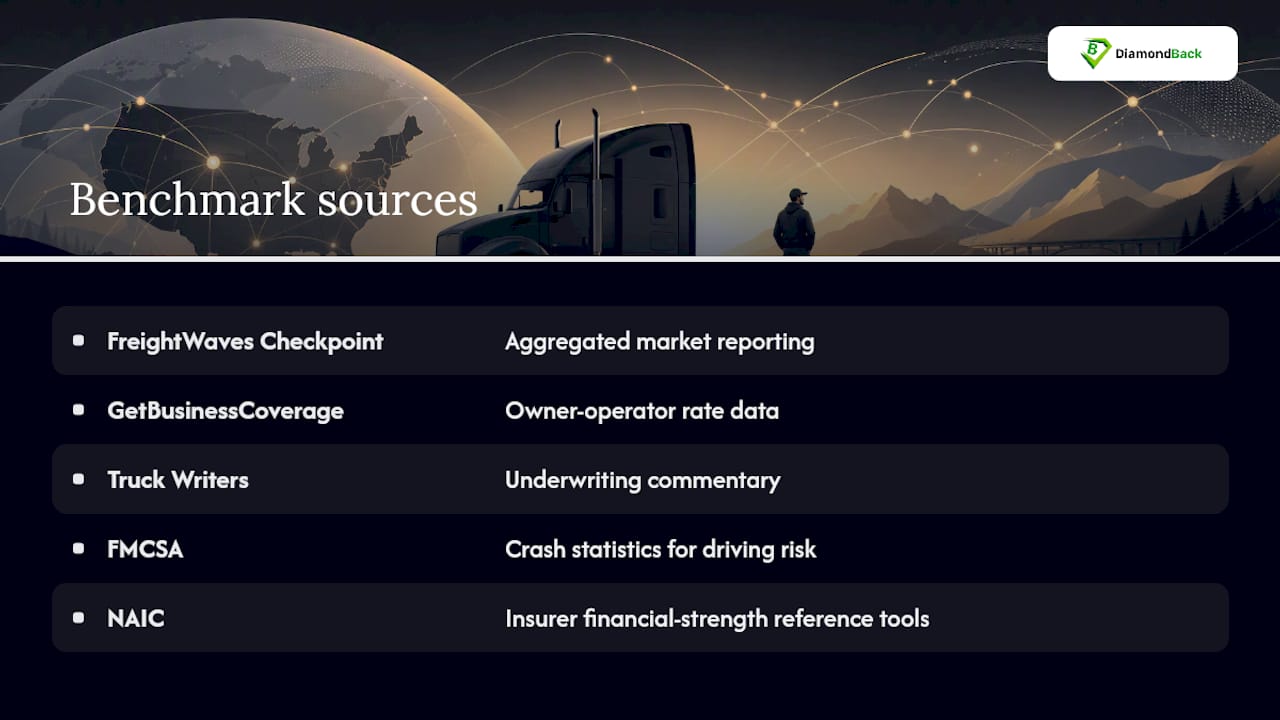
The pricing ranges in this guide draw on aggregated market reporting from FreightWaves Checkpoint and GetBusinessCoverage’s owner-operator rate data, alongside underwriting commentary from Truck Writers. Driving-record risk factors reference FMCSA crash statistics. For insurer financial-strength checks before you bind a policy, the NAIC’s public reference tools are worth a look.
This article is general information, not a substitute for advice from a qualified financial advisor. Consult a qualified financial professional about your own circumstances before acting on anything here.
Sources
- How Much Does Bobtail Insurance Cost? — FreightWaves Checkpoint
- Bobtail Insurance Guide for Owner-Operators (2026) — GetBusinessCoverage
- Large Truck and Bus Crash Facts — FMCSA