
Most private yachts cost roughly 0.5% to 2% of their insured value to insure each year, with well-managed superyachts sometimes landing lower. A $500,000 yacht might run $2,500 to $10,000 annually, but your state, cruising area, and coverage choices swing that number significantly. Before you accept any quote, get two or three like-for-like bids and confirm the agreed value figure matches across all of them.
TL;DR:
- States with high storm risk, like Florida, can cause yacht insurance premiums to more than double compared to low-risk inland areas.
- Yachts over 40 feet or valued above $500,000 typically face annual insurance costs between $4,000 and $12,000 or more, depending on coverage and cruising area.
- Using agreed value coverage increases upfront costs but ensures full payout without depreciation in case of total loss, unlike actual cash value policies.
- Insurance costs are heavily influenced by cruising area, vessel age, claims history, and crew credentials, which can significantly lower or raise premiums.
- Comparing multiple quotes with identical coverage terms helps avoid hidden gaps, especially when cheap quotes may omit key endorsements like storm coverage or navigation limits.
Table of Contents
- Yacht Insurance Cost by State: Why Florida Isn’t the Same as Michigan
- What Yacht Insurance Actually Costs by Size and Value
- The Underwriting Factors That Actually Move Your Premium
- Getting Quotes You Can Actually Compare
- How Diamondback Helps You Compare Real Numbers
- When Paying More for Coverage Is the Right Call
- Get Comparable Yacht Insurance Quotes Without the Back and Forth
- Sources
- FAQ
Yacht Insurance Cost by State: Why Florida Isn’t the Same as Michigan
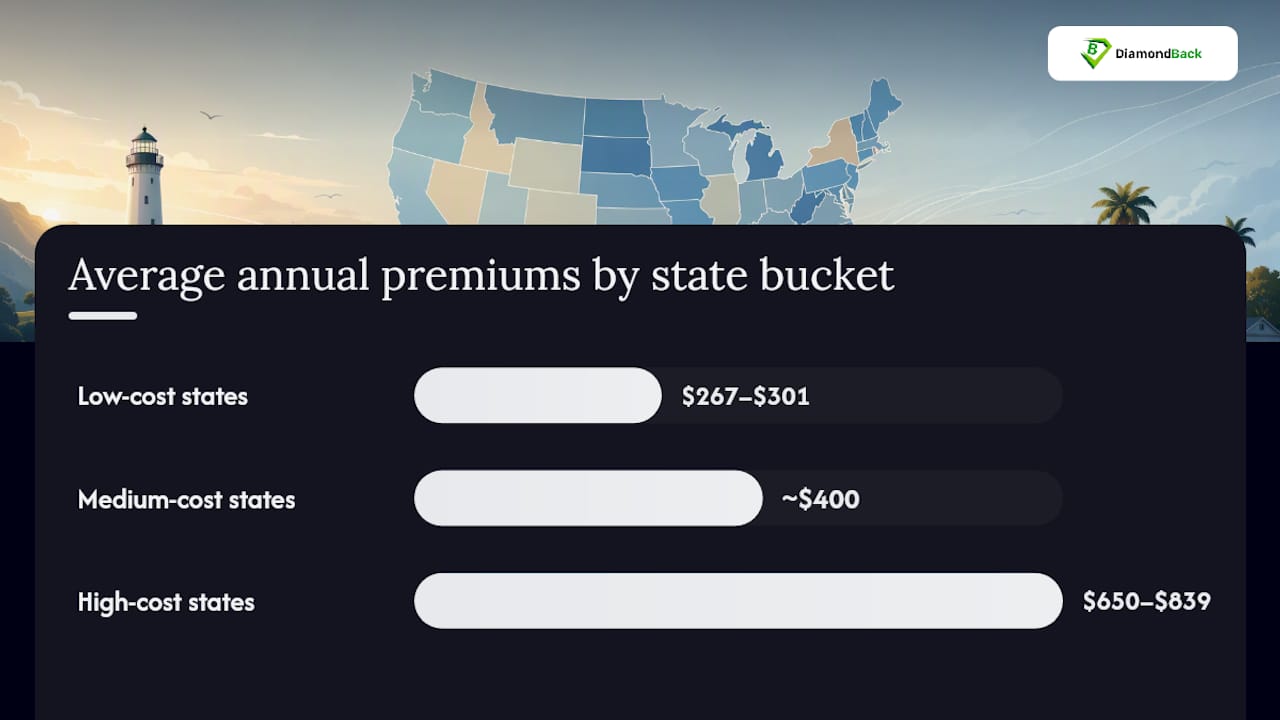
Where you dock and cruise your yacht changes your premium more than almost any other factor. Insurers sort states into low, medium, and high cost buckets, and the spread between them is wide. Progressive’s published averages put low-bucket states around $267 to $301 a year for general boat policies, medium states near $400, and high-cost states between $650 and $839. Yachts scale those numbers up substantially, but the ranking of states stays consistent.
Florida and the Gulf Coast sit at the top of nearly every insurer’s risk table. Hurricane exposure drives that placement, and it shows up in named-storm deductibles that can run 5% to 10% of the vessel’s insured value on top of your standard deductible. Coastal Northeast states carry moderate risk from seasonal storms and ice, while inland lake states like Michigan or Minnesota typically land in the lower buckets since hurricane and named-storm exposure simply doesn’t apply.
A few things worth checking before you assume your state’s average applies to you:
- Confirm your policy’s navigation limits match where you actually cruise, since going outside them can void coverage entirely
- Ask whether your marina’s security, hurricane hauling plan, or hard-tie procedures qualify for a discount
- Review the named-storm season dates in your policy, since some run June through November and others follow a different window
Statistic Callout: Storm-exposed states can carry averages more than double the low-bucket states, and that gap tends to widen further for yachts over 40 feet, where hull replacement costs are higher.
What Yacht Insurance Actually Costs by Size and Value
Dollar figures help more than percentages when you’re trying to sanity-check a quote. The following bands assume agreed value coverage, private (non-charter) use, no recent claims, and a moderate cruising area such as the East Coast or Gulf Coast, based on industry cost benchmarks:
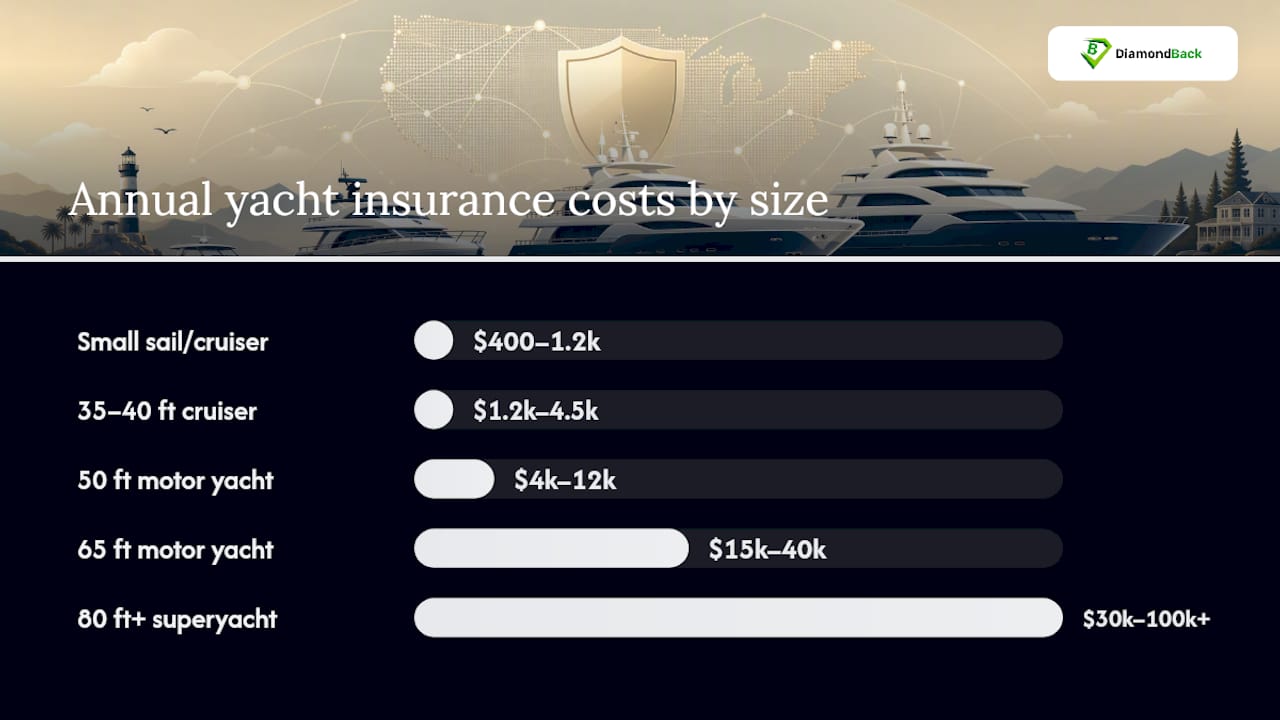
- Small sailboat or cruiser (under $50,000 value): roughly $400 to $1,200 per year
- 35 to 40 foot cruiser ($150,000 to $300,000 value): roughly $1,200 to $4,500 per year
- 50 foot motor yacht ($500,000 to $800,000 value): roughly $4,000 to $12,000 per year
- 65 foot motor yacht ($1.5 million to $2.5 million value): roughly $15,000 to $40,000 per year
- 80 foot and larger superyacht ($5 million and up): roughly $30,000 to $100,000+ per year, often priced below the 1% mark by specialist underwriters
These bands shift the moment charter or commercial use enters the picture. A yacht carrying paying passengers needs protection and indemnity coverage layered on top of standard hull and machinery, and insurers price that risk separately. Ancillary lines like P&I, war risk, and loss-of-hire can add tens of thousands of dollars annually on larger vessels, particularly when the yacht cruises into higher-risk waters or operates a charter program.
If you’re trying to place your own vessel inside these ranges, our comprehensive breakdown of cost drivers walks through how insured value, deductible, and cruising area interact.
The Underwriting Factors That Actually Move Your Premium
Underwriters don’t price every yacht the same way, even at identical values. A handful of factors do most of the work in setting your rate, and understanding them tells you where you have real leverage.
- Cruising area and navigation limits. Coverage restricted to the Intracoastal Waterway costs less than an open-ocean policy that includes Bahamas or Caribbean crossings.
- Vessel age and condition. Older hulls, outdated wiring, or a lapsed survey push premiums up, sometimes sharply.
- Claims history. A clean five-year record is one of the strongest discounts you can carry into a renewal.
- Crew and captain experience. Licensed, credentialed captains reduce perceived risk, especially on vessels over 50 feet.
- Storage and mooring. A hurricane-rated marina slip or dry storage often earns a rate reduction over open mooring.
- Hull construction and use. Private pleasure use costs less than charter or commercial operation, which carries separate liability exposure.
- Deductible level. Raising your deductible lowers your premium, though it raises your out-of-pocket cost at claim time.
One distinction matters more than the rest: agreed value versus actual cash value. Agreed value costs more upfront, but it pays the pre-negotiated amount on a total loss, no depreciation argument, no appraisal fight. Actual cash value is cheaper monthly but pays only the depreciated market price when your yacht is destroyed, which can leave a real gap between what you collect and what a replacement costs.
Age, hull type, and location are largely fixed. Deductible, storage, and crew credentials are the levers you can actually pull.
Pro Tip: Owner and crew experience carries more underwriting weight than most buyers expect. A licensed captain’s certifications can shift your rate more than a modest deductible increase, so document them before requesting quotes. Our guide on experience requirements for yacht insurance covers what underwriters actually check.
Getting Quotes You Can Actually Compare
Two quotes for the “same” yacht can differ by thousands of dollars simply because the coverage isn’t identical. Before comparing prices, confirm every quote uses the same agreed value, the same navigation limits, the same deductible, and the same endorsements. A cheaper quote that quietly drops named-storm coverage or narrows your cruising area isn’t actually cheaper.
Speed up accurate quoting by having these ready:
- A recent marine survey, ideally within the last three years
- Maintenance records and any recent refit documentation
- Crew or captain certifications
- Five years of claims history
For savings that don’t compromise coverage, ask about higher deductibles, lay-up credits for seasonal storage, and marina security discounts. Regular detailing and maintenance also reduce claims risk over time, and a service like routine boat detailing can catch small issues before they become claims.
Pro Tip: If a quote comes back noticeably cheaper than the others, check the agreed value language first. A lowball number often means the insurer quietly reduced your total-loss payout, not that they found you a better deal.
How Diamondback Helps You Compare Real Numbers
Diamondback Insurance’s instant online quote platform pulls offers from multiple insurers so you can compare coverage terms side by side, not just headline price. Expect to provide your hull value, a recent survey, and your typical cruising area. That’s the same information underwriters use to set your rate, so having it ready shortens the process considerably.
When Paying More for Coverage Is the Right Call
Higher premiums make sense for high-replacement-cost vessels, frequent offshore cruising, or any charter operation. Ask yourself what a total loss would actually cost you to replace, then decide whether agreed value and broader limits are worth the extra premium. Verify that agreed-value language before you sign.
— Vladimir
Get Comparable Yacht Insurance Quotes Without the Back and Forth
Online quote platforms give you a faster way to see what real coverage actually costs, without calling three separate brokers and comparing apples to oranges. These platforms let you compare agreed value, deductibles, and navigation limits side by side, in one place, so the cheapest number on screen isn’t hiding a coverage gap.
Gather your hull value, a recent survey if you have one, and your typical cruising area, then head to the boat insurance quote page to see real offers rather than rough estimates. If your insurance needs extend beyond your yacht, from home and auto to business coverage, the main quote platform covers those too. Either way, the next step is the same: request your quotes now and compare the actual terms, not just the sticker price.
Sources
For deeper research, see OwlMar’s cost guide, BoatUS on agreed hull value, and Progressive’s boat insurance averages.
This article is general information, not a substitute for advice from a qualified financial advisor. Consult a qualified financial professional about your own circumstances before acting on anything here.
FAQ
How Much Is Boat Insurance for a $30,000 Boat?
For a $30,000 boat, expect roughly $150 to $600 a year using the 0.5% to 2% industry benchmark, with the exact figure depending on your state, navigation area, and claims history. Coastal, storm-exposed states push toward the higher end.
How Much Is Insurance on a $2 Million Boat?
A $2 million yacht typically runs $10,000 to $40,000 annually under an agreed value policy, though charter use or offshore cruising can raise that further once ancillary coverage like P&I is added. Private use in a moderate risk area tends to land closer to the lower end.
How Much Does a $1 Million Liability Policy Cost?
Liability limits are usually priced as a smaller add on to your hull and machinery premium rather than as a standalone cost, so a $1 million liability limit might add a few hundred dollars a year depending on vessel size and use. The exact figure varies by insurer, cruising area, and whether the yacht carries passengers commercially.
Why Is Boat Insurance So High in Certain States?
Storm exposure is the main driver. States like Florida see averages that run well above low-risk states because hurricane season brings a real chance of total loss, and insurers price that risk into every policy written in the region.
Does Diamondback Offer Yacht Insurance Quotes?
Yes, Diamondback provides instant online quotes for boat and yacht coverage by comparing offers from multiple insurers. Current pricing depends on your specific vessel and is available once you submit your details on the site.