
Most box truck operators in the United States pay between $250 and $950 per month for coverage, or roughly $3,000 to $12,000 a year, depending on how the truck gets used. Operating radius and contract requirements drive most of that spread, not the truck itself. A local delivery operator with a clean record sits near the bottom of that range; a contracted driver hauling for a broker that demands $1 million in liability sits well above it. Everything below explains why, and what you can do about it.
TL;DR:
- Local operators with a clean record typically pay $250 to $500 per month for coverage, significantly less than contracted drivers hauling for high-liability clients.
- Long-haul and interstate operations incur higher premiums due to increased exposure, with long-distance driving and higher cargo values pushing rates upwards.
- Operators requiring $1 million liability coverage or specialized cargo often see costs rise by hundreds of dollars monthly, especially when mandatory by brokers or shippers.
- Using telematics, increasing deductibles, and ensuring secure parking can help lower insurance premiums over time.
- Instant online quotes allow for faster comparison across multiple providers, helping operators identify outliers and optimize costs before committing.
Table of Contents
- What Drives Average Box Truck Insurance Cost by Operator Type
- What Factors Actually Move Your Box Truck Insurance Rates?
- How Much Does Each Coverage Line Actually Cost?
- What Do Real Box Truck Insurance Costs Look Like by Scenario?
- What Federal Rules Affect Box Truck Insurance Requirements?
- How Can You Lower Your Box Truck Insurance Premium?
- Why Instant Quotes Change How You Shop for Coverage
- Get an Instant Box Truck Insurance Quote
- Sources
- FAQ
What Drives Average Box Truck Insurance Cost by Operator Type
The single biggest factor in your quote isn’t your truck’s age or even your driving record. It’s how far you drive and who you’re hauling for. A box truck that never leaves a 50-mile radius carries a fundamentally different risk profile than one running interstate lanes for a national retailer, and underwriters price that difference aggressively.
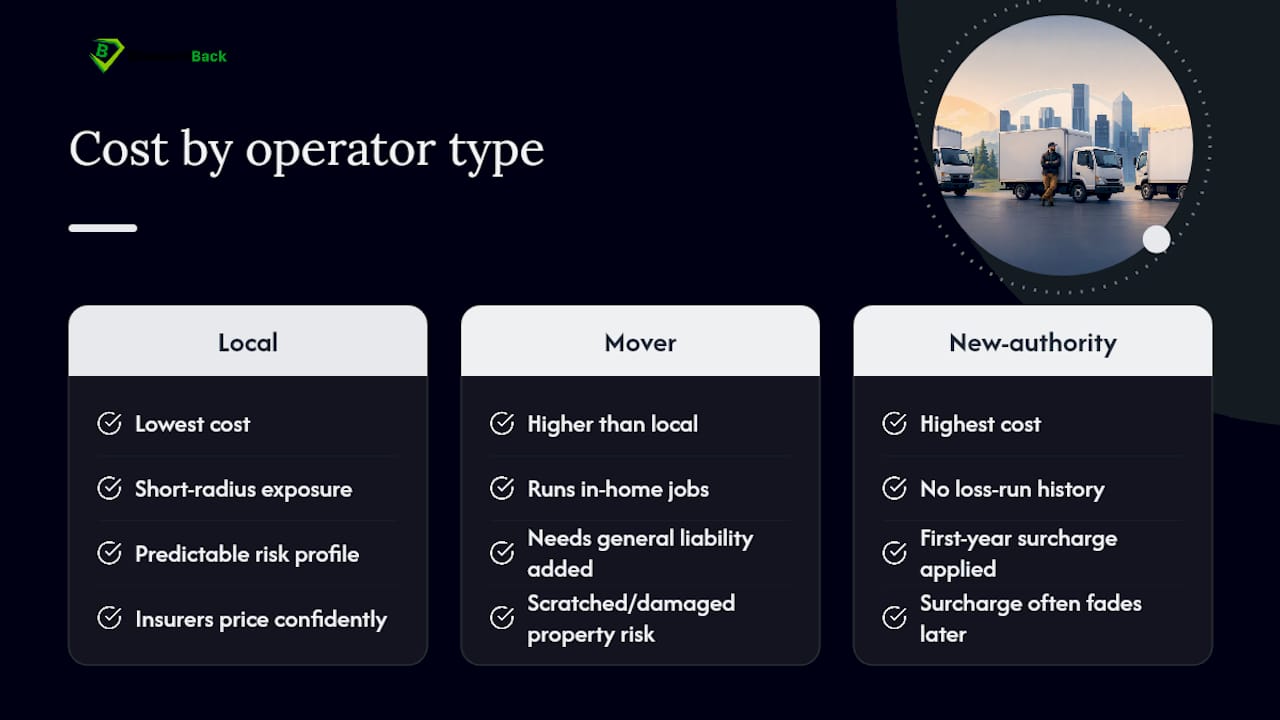
Here’s how the numbers typically break down by operator profile:
An established local operator sits at the low end because insurers can price a predictable, short-radius exposure with confidence. A moving company running in-home work needs general liability layered on top of auto and cargo coverage, since a scratched hardwood floor or a shattered heirloom becomes a liability claim, not just a cargo claim. New-authority carriers pay the most, and it isn’t personal. Industry cost guides consistently show that insurers simply have no loss-run history to underwrite against, so they price in a first-year surcharge that typically fades once you build a documented clean record.
Freight market conditions play a quieter role too. When freight rates tighten, carriers sometimes shift toward higher-paying contracted work that comes with stiffer insurance requirements from brokers, which nudges the insurance line item up even when the truck and driver haven’t changed at all.
What Factors Actually Move Your Box Truck Insurance Rates?
Underwriters build your premium from a specific set of inputs, and understanding them lets you predict roughly where your quote will land before you ever request one.
- Operating radius and mileage bands. Local (under 50 miles), intermediate (50 to 200 miles), and long-haul operations each sit in a separate pricing tier, with long-haul carrying meaningfully higher rates due to increased highway exposure.
- Cargo type and value. Hauling electronics or pharmaceuticals costs more to insure than hauling furniture pads or paper goods, because motor truck cargo coverage prices to the value and theft appeal of what’s inside the box.
- Truck specs. Gross vehicle weight rating, model year, and add-on equipment like a liftgate or refrigeration unit all raise the insurable value and therefore the physical damage premium.
- Driver record and CDL status. A driver with a clean Motor Vehicle Record and no SAFER/DOT violations gets meaningfully better pricing than one with recent moving violations or a spotty inspection history.
- Garaging ZIP code and state. Where the truck sleeps at night matters because litigation environment, theft rates, and state minimum requirements vary sharply by state and even by metro area.
- Fleet size and business age. A single truck with two years of clean history usually prices better per unit than a brand-new one-truck operation, since fleet discounts and tenure both factor into underwriting.
Pro Tip: Ask every quoting carrier to show you the exact radius and cargo classification they used to price your policy. A misclassified radius (say, “intermediate” instead of “local”) can add hundreds of dollars a year for no real reason.
Getting a clearer read on how these variables interact is worth the time. Diamondbackins breaks down the top factors affecting truck insurance rates in more depth if you want to see how carriers weigh each one against the others.
How Much Does Each Coverage Line Actually Cost?
Your total premium isn’t one number. It’s a stack of separate coverage lines, each priced independently, and knowing the typical range for each helps you spot an outlier quote before you sign anything.
- Commercial auto liability. Most contracts and brokers expect a $1 million combined single limit as the baseline, which commonly runs $3,500 to $7,000 a year on its own for a single box truck.
- Physical damage (comprehensive and collision). This line scales directly with your truck’s value and the deductible you choose, typically adding $1,200 to $3,500 annually for a mid-value box truck.
- Motor truck cargo. Cargo limits of $100,000 to $250,000 are common baseline expectations for general freight, usually costing $600 to $2,000 a year depending on the limit and commodity class.
- General liability. Often runs $500 to $1,200 annually, and it becomes non-negotiable the moment your business does in-home or on-premises work, like moving companies.
- Workers’ compensation. Required in nearly every state once you have employees, with cost driven heavily by payroll and job classification rather than the truck itself.
- Contract add-ons. Additional insured endorsements and waivers of subrogation, both common shipper demands, typically add a modest flat fee rather than a percentage increase.
Diamondbackins covers the full breakdown of these lines, including how comp and collision interact with truck value, in its complete box truck coverage guide.
What Do Real Box Truck Insurance Costs Look Like by Scenario?
Numbers land differently depending on which bucket you fall into. Here’s how four common operator profiles typically shake out once every coverage line is added together.
-
Established local operator, single truck, clean record. Running a 40-mile delivery radius with a three-year-old box truck and no claims, this operator typically lands near $350 to $500 a month once liability, physical damage, and a modest cargo limit are combined.
-
Relay or contracted driver under a shipper’s $1 million requirement. The broker mandates a $1 million CSL and a $100,000 cargo minimum before they’ll dispatch a load. That contract requirement alone can push the same truck from the $400 range into $700 to $900 a month.
-
Moving company doing in-home work. Add general liability for property damage inside a client’s home, plus workers’ compensation for two employees, and a single-truck moving operation often totals $800 to $1,100 a month once every line is stacked.
-
New-authority operator in year one. With no loss-run history to show underwriters, this same truck and driver combination can realistically see $900 to $1,300 a month, with the expectation that a clean first year brings renewal pricing down substantially.
For a deeper look at how these totals scale across a full year, Diamondbackins has published a breakdown of U.S. trucking insurance costs and per-mile impact that’s worth reviewing before you budget.
What Federal Rules Affect Box Truck Insurance Requirements?
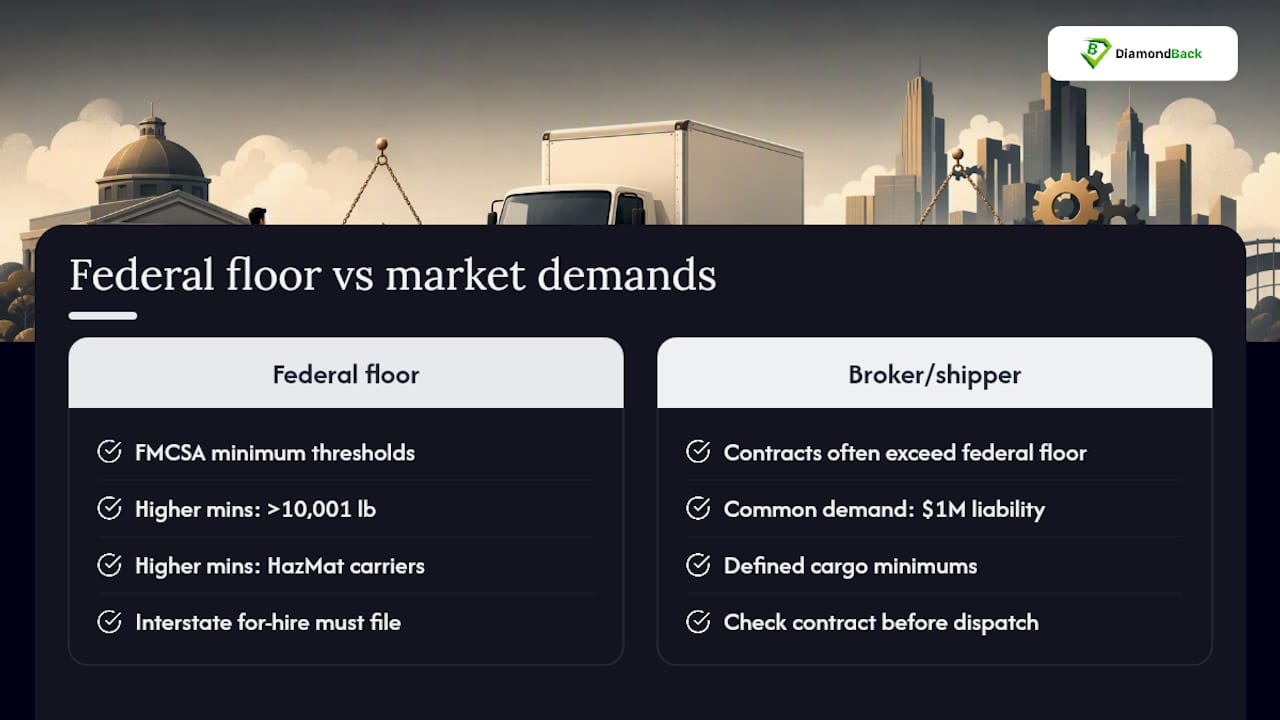
Federal financial responsibility rules set the floor, not the ceiling, on how much liability coverage you’re required to carry. The FMCSA’s insurance filing requirements set minimum liability thresholds that vary by vehicle weight and the type of cargo hauled, with higher minimums applying to trucks over 10,001 pounds and to hazardous materials carriers.
Carriers operating under interstate for-hire authority typically need to file proof of insurance directly with FMCSA, sometimes through an MCS-90 endorsement, which guarantees payment to injured third parties even if the policy has gaps or exclusions. Whether you need this filing at all depends on whether you’re operating under interstate operating authority, a distinction that trips up a lot of new operators who assume federal rules don’t apply to them.
Here’s the part that surprises most new operators: brokers and large shippers almost always require limits well above the federal minimum, commonly $1 million in liability and a defined cargo minimum, because their own contracts and risk tolerance demand it. Check your specific contract language before assuming your federal minimum will actually get you dispatched.
How Can You Lower Your Box Truck Insurance Premium?
Cost isn’t fixed once you get your first quote. Several levers move the number meaningfully, and shopping smart matters just as much as the coverage itself.
-
Raise your deductible where it makes sense. Moving from a $500 to a $1,000 deductible on physical damage can meaningfully reduce your annual premium, provided you can comfortably cover the higher out-of-pocket cost if a claim happens.
-
Invest in driver training and telematics. Telematics and driver coaching are among the most effective ways fleets lower premiums over time, since they give underwriters hard data showing improved safety metrics rather than just a promise.
-
Secure your truck when it’s parked. A truck parked in a gated lot overnight prices differently than one left on a street in a high-theft ZIP code, and documenting secure parking can shave real dollars off physical damage coverage.
-
Shop multiple carriers every renewal, not just the first year. Rates vary meaningfully between carriers for the identical risk, and an instant-quote comparison makes it realistic to check several options without spending an afternoon on the phone.
-
Match coverage to your actual contract needs. Don’t buy a $2 million liability limit if your broker only requires $1 million. Overbuying padding you don’t need is one of the most common ways operators overpay.
Pro Tip: Request your loss runs at least 60 days before renewal and bring them to every carrier you quote with. A clean loss-run history is the single strongest negotiating tool you have at renewal time.
Why Instant Quotes Change How You Shop for Coverage
Shopping for box truck coverage used to mean phone calls, faxed applications, and waiting days for a callback. Diamondbackins built its platform around instant, tailored trucking quotes precisely because that old process wastes time you don’t have when a load is waiting.
That speed matters directly for the shopping advice above. Comparing multiple carriers only helps if comparing them doesn’t cost you a week, and rapid quote turnaround means you can check your renewal against fresh market pricing every year instead of just accepting whatever your current carrier proposes. One caveat worth repeating: always confirm your contract-specific limits with your broker or shipper before you bind a policy, since an instant quote is only as good as the coverage numbers you feed into it.
— Vladimir
Get an Instant Box Truck Insurance Quote
This platform offers a practical alternative to waiting on a broker callback by allowing you to compare tailored options from multiple insurers in one sitting, entirely online. That matters most for box truck operators juggling contract deadlines, since a delayed quote can mean a missed load.

Start at the trucking insurance instant quote page if you’re ready to see real numbers for your truck. Have your VIN, GVWR, driver’s MVR, typical operating radius, and cargo type ready before you begin. Those five details are what let the platform return an accurate quote instead of a rough estimate, and if you need cargo and physical damage handled as a separate line, the trucking cargo and physical damage page covers that directly. Either way, you’ll have real pricing in minutes rather than days.
Sources
This article draws on FMCSA’s insurance filing requirements and operating authority guidance for regulatory accuracy, along with the American Transportation Research Institute’s 2025 operational cost analysis and Geotab’s fleet insurance research for cost benchmarks and telematics savings data.
This article is general information, not a substitute for advice from a qualified financial advisor. Consult a qualified financial professional about your own circumstances before acting on anything here.
- FMCSA — Insurance filing requirements
- Geotab — Commercial truck insurance cost: Rates, factors and how to save
FAQ
How much is commercial insurance for a 26-foot box truck?
A 26-foot box truck typically insures for $350 to $900 a month depending on radius, cargo, and driver history, with local operators at the low end and contracted or new-authority operators toward the high end.
How much is $1 million in liability insurance a month?
A $1 million combined single limit commercial auto liability policy for a single box truck commonly costs $290 to $580 a month, or roughly $3,500 to $7,000 annually, depending on radius and driving record.
How much does $100,000 in cargo insurance cost?
A $100,000 motor truck cargo limit typically adds $50 to $170 a month to your premium, varying by the type of freight and how theft-prone that cargo class is.
What are box truck insurance rates per mile?
Box truck insurance doesn’t price directly per mile, but operators can estimate it by dividing their annual premium by expected mileage. A $6,000 annual policy on a truck running 60,000 miles works out to about $0.10 per mile in insurance cost alone.
Does Diamondbackins offer box truck insurance quotes?
Yes. The platform provides instant, tailored trucking insurance quotes online, letting you compare options from multiple insurers for box truck liability, cargo, and physical damage coverage in one sitting.