
Form E is the insurer-filed certificate proving you carry the bodily injury and property damage liability coverage your operating authority requires. Confirm the action now: call your insurer or broker, give them your MC or authority number, and ask for written proof the filing is active. Federal Motor Carrier Safety Administration rules govern this process, and a platform like Diamondback Insurance can help you get compliant coverage and filing support without the runaround.
TL;DR:
- Most Form E filings depend on insurers being properly registered with FMCSA, which can delay filings if insurers are newly registered or switching providers.
- Confirm that your insurer has submitted a valid Form E filing by checking FMCSA’s system directly, as verbal assurances are not proof of active compliance.
- Failing to overlap policy coverage and Form E filings during insurer switches risks creating gaps that can suspend your operating authority.
- Insurance companies file Form E, not carriers, and non-registration or delays in submission can cause compliance issues, especially close to renewal dates.
- Keeping all confirmation records, including screenshots and communication, is essential for proving active liability coverage during regulatory checks or audits.
Table of Contents
- What Is Form E Insurance Filing and When Do You Need It?
- Who Files Form E and How Do Insurers Register With FMCSA?
- How to Request and Confirm a Form E Filing (Step by Step)
- Why ‘Continuous Until Cancelled’ Status Can Still Leave You Exposed
- How Do You Confirm Your Form E Filing Is Active?
- Common Form E Filing Mistakes That Create Coverage Gaps
- How Diamondback Insurance Simplifies Compliance for Fleets
- Get an Instant Trucking Insurance Quote and Filing Support
- Where to Verify Form E Rules and Filing Status
- Sources
- FAQ
What Is Form E Insurance Filing and When Do You Need It?
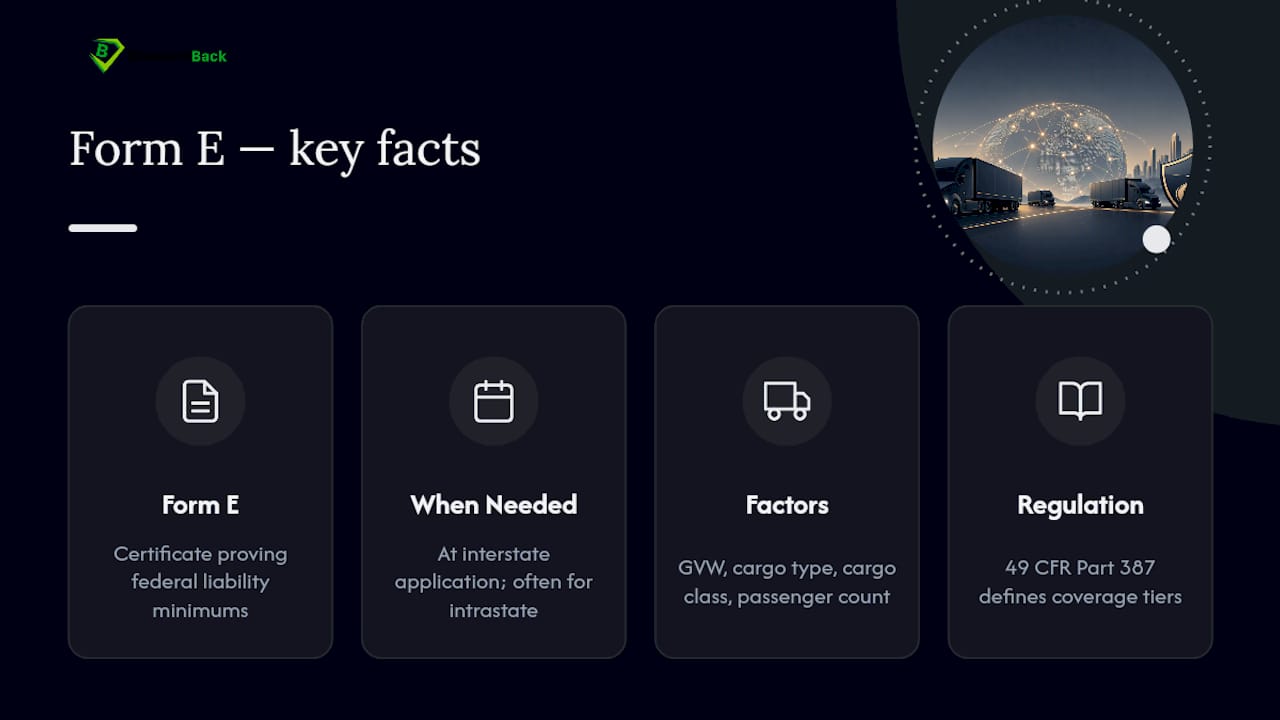
The official name is the Uniform Motor Carrier Bodily Injury and Property Damage Liability Certificate of Insurance, but almost everyone in trucking just calls it Form E. It exists to prove, on paper and on file with regulators, that your liability coverage meets federal minimums before you’re allowed to haul freight under your own operating authority.
You need it the moment you apply for interstate operating authority, and in many states, for intrastate authority too. The exact coverage tier depends on what you haul and what you drive. A carrier running general freight in a standard tractor-trailer faces different minimums than one hauling hazardous materials or operating a passenger-carrying vehicle. Gross vehicle weight, cargo classification, and passenger count all shift the required limit up or down.
The FMCSA’s insurance filing requirements lay out these tiers under 49 CFR Part 387, and it’s worth reading the chart yourself rather than trusting a broker’s summary. If you’re unsure which tier applies to your operation, a resource like Diamondbackins’ breakdown of trucking insurance minimums walks through how carrier type and cargo affect the number you actually need.
Who Files Form E and How Do Insurers Register With FMCSA?
Your insurance company files Form E, not you. This trips up a lot of new operators who assume the paperwork is theirs to submit. In practice, the filing has to come from a registered financial responsibility filer, meaning your insurer, or in some cases a qualifying surety or financial institution, has already gone through FMCSA’s own registration process before they can submit anything on your behalf.
That registration runs through FMCSA’s Motus system, with the older FMCSA Portal still active while Motus rolls out fully in 2026. Filers need identifiers like their NAIC number, state license information, and in some cases FDIC or NCUA numbers on file before FMCSA will accept their submissions.
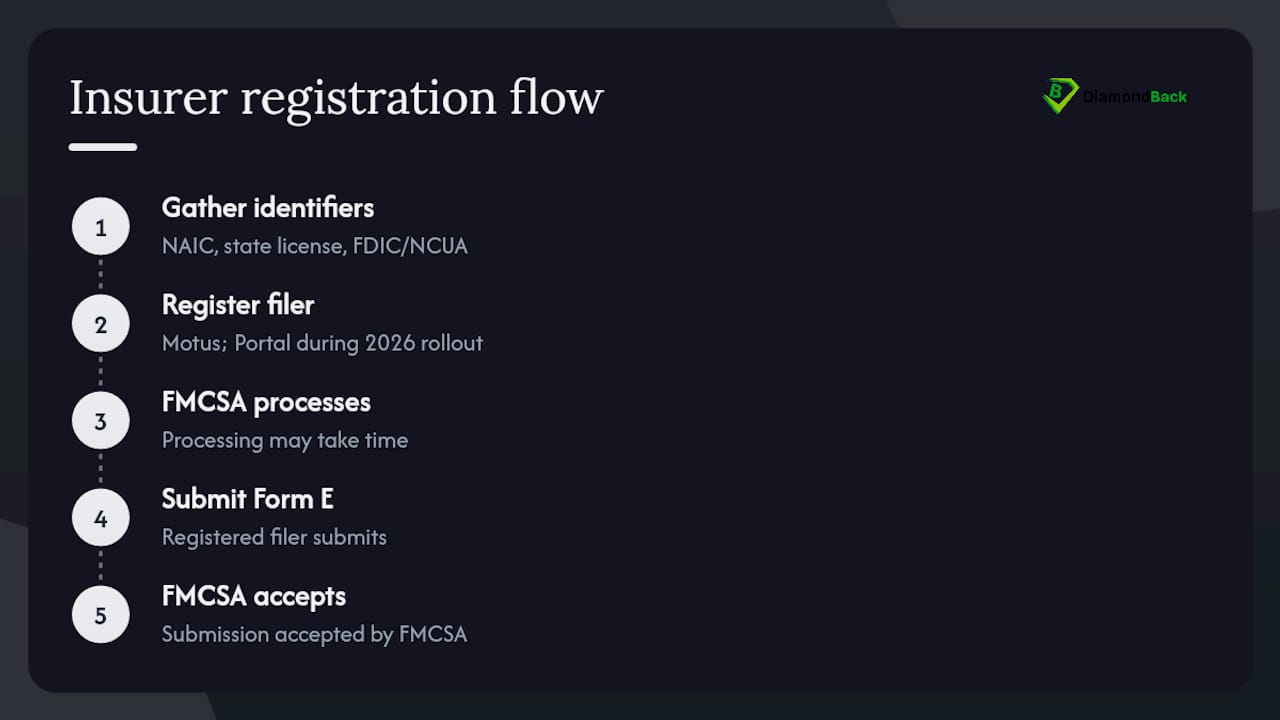
New filer accounts can take some time to process, which matters if you’re switching insurers close to a renewal date. If your current insurer isn’t already registered, or if you’re working with a smaller regional carrier you haven’t used before, ask directly whether they’re an active FMCSA filer. Don’t assume. A licensed agent who sells commercial policies doesn’t automatically have filer status. That’s a separate registration, and a separate step, from selling you the policy itself.
How to Request and Confirm a Form E Filing (Step by Step)
Getting Form E filed correctly comes down to giving your insurer complete information and then following up in writing. Here’s the order that works:
- Gather your carrier details first. You’ll need your legal business name exactly as it appears with FMCSA, your MC, FF, or MX number, your DOT number, and your mailing address.
- List your vehicle and cargo specifics. Note vehicle weight class, whether you carry hazardous materials, and any passenger-carrying endorsements that affect your coverage tier.
- Confirm policy dates and limits. Effective date, expiration date, and the exact bodily injury and property damage limits should match what your operating authority requires.
- Instruct your insurer in writing. Send a dated email or message stating clearly: “Please file Form E with FMCSA (and with [state agency] if intrastate authority applies) using MC number [your number], effective 2026, and confirm the filing in writing once complete.”
- Request proof, not a promise. Ask for a filing confirmation number or a screenshot from the FMCSA system showing your authority as active.
- Time it before your policy start date. Request the filing several business days ahead of your effective date, especially when switching insurers, so there’s no gap between when one filing cancels and the next takes effect.
Pro Tip: Save every filing confirmation in the same digital folder as your vehicle registration and insurance card. If FMCSA or a state trooper ever questions your authority status, you want that proof one click away, not buried in an old email thread.
Why ‘Continuous Until Cancelled’ Status Can Still Leave You Exposed
Form E filings don’t expire on a calendar date. They stay continuous until cancelled, which sounds reassuring until you realize what it actually means: your insurer, not you, controls when that filing disappears.
When you switch providers or let a policy lapse, your old insurer submits a cancellation notice. That notice removes your Form E from FMCSA’s records immediately, regardless of what your policy documents say about coverage dates.
- FMCSA compliance checks look at whether a filing is on record, not whether you believe you’re insured.
- A cancellation filed even a day before your new insurer’s filing takes effect creates a real gap.
- New authority applicants who don’t have required filings in place can face dismissal notices, often tied to a 20-day publication window and a 60-day remedy period before authority is revoked.
A single missing Form E can trigger an operating-authority suspension even when you have an active policy in hand. That gap between “insured” and “on file” is where most compliance trouble starts, and it’s entirely avoidable with a few days of overlap built into every insurer switch.
How Do You Confirm Your Form E Filing Is Active?
Don’t take your insurer’s word for it. Check FMCSA’s own system directly using your MC or authority number to see whether your Form E filing shows as active. If you hold intrastate authority, check with your state’s Public Utilities Commission or Department of Transportation as well, since state-level filing requirements sometimes run separately from federal ones.
Keep a simple records folder with these items:
- Your policy declarations page showing coverage limits and dates.
- Written filing confirmations from your insurer, including any filing ID numbers or system screenshots.
- Dated emails documenting when you requested the filing and when it was confirmed.
If you check and the filing isn’t there, act immediately. Contact your insurer first and get a timeline in writing. If they’re unresponsive, escalate to your broker or to a platform that can help troubleshoot, and ask whether a temporary bridge policy is needed while the filing catches up.
Common Form E Filing Mistakes That Create Coverage Gaps
Most Form E problems trace back to the same handful of errors, and nearly all of them are preventable with better habits rather than more paperwork.
- Assuming the filing happens automatically once you buy a policy, when it actually requires an explicit request to your insurer.
- Never confirming filer registration, especially with a newer or smaller insurance company that may not be set up with FMCSA yet.
- Failing to keep confirmation records, leaving you with nothing to show if a filing gets challenged or lost.
- Not overlapping policy dates when switching providers, which opens the exact gap that “continuous until cancelled” status can expose.
Red flags worth acting on immediately: a insurer that’s slow to respond about filing status, any paperwork missing your MC number, or a cancellation notice you didn’t expect. Assign one person on your team as the compliance owner, keep a renewal calendar, and treat filing confirmation as a contractual requirement, not a courtesy.
Pro Tip: If you manage multiple trucks under one authority, review your renewal calendar monthly for the fleet. It’s far easier than a rolling renewal audit recovering a suspended authority after the fact.
How Diamondback Insurance Simplifies Compliance for Fleets
Getting an instant trucking insurance quote through Diamondbackins is only half the job. The other half is making sure the paperwork that keeps you legally operating actually gets filed. Some platforms work with carriers to guide them through the documentation a Form E filing requires, from gathering the right MC and DOT identifiers to flagging what an insurer needs to submit the certificate correctly.
Practically, that means fewer surprises at renewal and fewer gaps when switching providers. The onboarding process is built to capture the details filers actually ask for, so confirmation requests don’t stall on missing information.
— Vladimir
Get an Instant Trucking Insurance Quote and Filing Support
This service provides trucking policies that meet FMCSA minimums and helps you keep the paperwork straight, without the back-and-forth of a traditional broker relationship.
Instead of waiting days for a callback to find out if your insurer qualifies as an FMCSA filer, you can get an instant quote, choose a policy that fits your operation, and get guidance on requesting Form E confirmation during the coverage binding process. That’s a real difference from the slower quote-and-wait cycle most regional agents still run on.
If you’re comparing providers before a renewal or setting up new authority, start with Diamondbackins’ trucking insurance quote page to see coverage options that match your MC number and cargo type. Need cargo endorsements or higher liability limits for specialized freight? Check trucking cargo and primary liability coverage while you’re setting up your policy so the filing request covers everything in one pass.
Where to Verify Form E Rules and Filing Status
Regulatory text changes less often than broker summaries do, so go to the source when you need certainty.
- FMCSA’s insurance filing requirements cover coverage minimums, filer registration, and Motus system access.
- 49 CFR Part 387 spells out the “continuous until cancelled” status and minimum security requirements.
- Your state’s PUC or DOT website will list any additional intrastate Form E procedures.
Keep every insurer confirmation you receive. It’s your primary proof if a filing question ever comes up.
This article is general information, not a substitute for advice from a qualified financial advisor. Consult a qualified financial professional about your own circumstances before acting on anything here.
Sources
- Insurance Filing Requirements | FMCSA
- 49 CFR Part 387 – Minimum security requirements for motor carriers | FMCSA
FAQ
What Is Form E Insurance Filing?
Form E is the Uniform Motor Carrier Bodily Injury and Property Damage Liability Certificate of Insurance, filed by your insurer to prove you carry the liability coverage your operating authority requires.
Who Is Responsible for Filing Form E?
Your insurance company or a registered financial responsibility filer submits Form E on your behalf. Carriers do not file it themselves, though you should always request written confirmation once it’s done.
How Long Does It Take to File Form E?
Filing itself can happen quickly once your insurer is registered with FMCSA, but new filer accounts can take up to two weeks to process if your insurer isn’t already set up.
Does Form E Expire Like a Regular Policy?
No. Form E stays continuous until cancelled, meaning it remains on file even past your policy’s renewal date unless your insurer submits a cancellation notice.
How Much Does Diamondbackins Charge for a Trucking Policy?
Pricing depends on your fleet size, cargo type, and coverage limits, so current quotes are available directly on the Diamondbackins trucking insurance page.
What Happens if My Form E Filing Lapses?
A lapsed filing can trigger suspension of your operating authority even if you technically hold an active insurance policy, since FMCSA checks are based on filing records, not policy paperwork.