
A workers’ comp class code is a four-digit job classification that directly sets the base rate your insurer charges per $100 of payroll. Every employee’s duties get mapped to one of these codes, which vary by state and by rating bureau, and the code you’re assigned drives your entire premium calculation. Get it wrong and you either overpay every renewal or invite an audit that reclassifies your business retroactively.
TL;DR:
- Verifying your class code with NCCI’s lookup tool or your state’s bureau ensures accurate classification and helps prevent overpayment or audit issues.
- Splitting payroll for standard exceptions like clerical work and outside sales can lower your premium, but requires proper documentation and job descriptions.
- Misclassifying work to a lower-risk code or having a ghost policy without supporting documentation may trigger audits and potential fraud investigation.
- Updating your class codes yearly and confirming changes at each renewal can avoid being rated under outdated or incorrect classifications.
- Properly classified claims data directly influences your experience modification factor, affecting future premiums and billing accuracy.
Table of Contents
- What Are Workers Comp Class Codes and Who Assigns Them?
- How Do You Find and Verify Your Class Code?
- How Do Class Codes Actually Drive Your Premium?
- What Pitfalls Trigger a Workers Comp Audit?
- What’s a Practical Checklist for Managing Class Code Costs?
- Diamondback’s Workers’ Comp Resources
- How Often Do Class Codes Get Updated?
- What Do Real Class Code Examples Look Like?
- How Do You Dispute a Class Code Assignment?
- How Do Class Codes Affect Claims and Your Experience Rating?
- A Few Priorities Worth Repeating
- Get an Accurate Workers Comp Quote After Verifying Your Codes
- Where to Verify Your Class Code
- Sources
- FAQ
What Are Workers Comp Class Codes and Who Assigns Them?
The National Council on Compensation Insurance (NCCI) maintains the four-digit classification system that most states rely on, pairing each code with a phraseology description tied to the actual work performed, not the company’s industry label. A roofing contractor and a roofing supply distributor get different codes even if they share a name on the door.
But NCCI isn’t universal. Several states run their own independent rating bureaus instead of adopting NCCI’s system outright:
- WCIRB handles California, one of the largest workers’ comp markets in the country.
- PCRB governs Pennsylvania’s classifications and loss costs.
- NYCIRB sets New York’s rating structure separately from NCCI.
Roughly 36 jurisdictions use NCCI’s classification system, while 11 states operate their own bureaus, and a handful run exclusive state funds. The same four-digit code can carry a materially different loss cost in Texas than it does in Ohio, so the practical takeaway is simple: always verify the code for the specific state where the work happens, not just the code your carrier used last year.
How Do You Find and Verify Your Class Code?
Guessing at a class code, or trusting whatever a previous agent typed into an application years ago, is how businesses end up misclassified. Here’s the sequence that actually protects you:
- Start with NCCI’s Class Look-Up tool. The NCCI Class Look-Up database gives you code phraseology, state-specific descriptions, five years of rate history, and cross-references by schedule and group, and it’s searchable by keyword or code number.
- Cross-check discontinued or state-special codes. The NCCI Classification Codes and Statistical Codes Manual lists effective and termination dates, which matters if you’re comparing a policy written a few years ago against current classifications.
- Save your snapshot. Download the lookup result with the date attached, since phraseology and effective dates change, and you want a record of what applied when your policy was written.
- Confirm with your carrier before binding. Your declarations page should match what you found, and if it doesn’t, ask why before you sign anything.
- Split by state for multi-location work. If your crews cross state lines, assign codes based on where the work is physically performed, not your home office address.
How Do Class Codes Actually Drive Your Premium?
Every class code carries a base rate, or state-filed loss cost, expressed as dollars per $100 of payroll. Multiply your payroll in that classification by the rate, apply your experience modification factor, and you land close to your manual premium before credits or debits.
A few mechanics matter more than owners realize:
- Payroll splitting is legal and often lucrative. Clerical staff (commonly code 8810), outside sales (8742), and drivers (7380) are standard exceptions that get pulled out and reported separately at their own, usually lower, rates.
- One governing code doesn’t mean one code for everyone. If your office manager never touches the shop floor, their payroll shouldn’t be lumped into your highest-risk classification.
- Minimum premiums apply even at zero payroll. A sole proprietor with no employees can still owe a carrier-set minimum, commonly in the $750 to $1,400 range depending on state and code.
Pro Tip: Pull your payroll register once a year and match every job title against the class code it’s currently reporting under. A five minute review can catch a misallocated employee before an auditor does it for you, and less generously.
Adding an owner to coverage, rather than excluding them, materially raises the premium on what would otherwise be a minimal ghost policy, since the carrier is now pricing in an actual injury exposure.
What Pitfalls Trigger a Workers Comp Audit?
Auditors don’t guess. They compare your declared class codes against actual job duties, payroll records, and subcontractor agreements, and gaps between what you reported and what your business actually does are the single most common source of premium disputes.
A few patterns raise flags every time:
- Misclassifying work to a lower-risk code to save money. This isn’t a gray area. Auditors and carriers treat deliberate underclassification as insurance fraud, and it usually surfaces during a routine payroll audit.
- Unusually cheap “ghost policy” premiums with no documentation. A zero-payroll workers comp ghost policy is a legitimate way to get a certificate of insurance, but if it looks too cheap to be real, an underwriter will eventually ask questions.
- Missing job descriptions or unsigned subcontractor certificates of insurance. Without paperwork proving a sub carried their own coverage, their payroll can get folded into yours at audit time.
Keep signed job descriptions, payroll registers by class code, subcontractor agreements, and current certificates of insurance on file for at least the length of your policy period, plus one audit cycle beyond it.
What’s a Practical Checklist for Managing Class Code Costs?
You don’t need a compliance department to stay ahead of this. A small, consistent routine each renewal cycle covers most of the risk:
- Run a class-code lookup for every distinct payroll category you report, and save the source and date.
- Split payroll accurately between governing codes and standard exceptions like clerical or outside sales, backed by signed job descriptions.
- Ask your agent or carrier for your rate history and how your experience modification factor is trending, not just this year’s quote.
- Once your codes and payroll are verified as accurate, shop your policy. A correctly classified business is in a much stronger position to compare quotes without surprises at binding.
Diamondback’s Workers’ Comp Resources
Diamondbackins publishes guides on workers’ compensation insurance and what drives cost per employee, built specifically for owners trying to make sense of class codes before they buy. Once you’ve confirmed your codes and payroll splits, Diamondbackins can help you compare quotes across carriers so you know whether your current premium actually reflects accurate classification, or whether it’s time for a policy review.
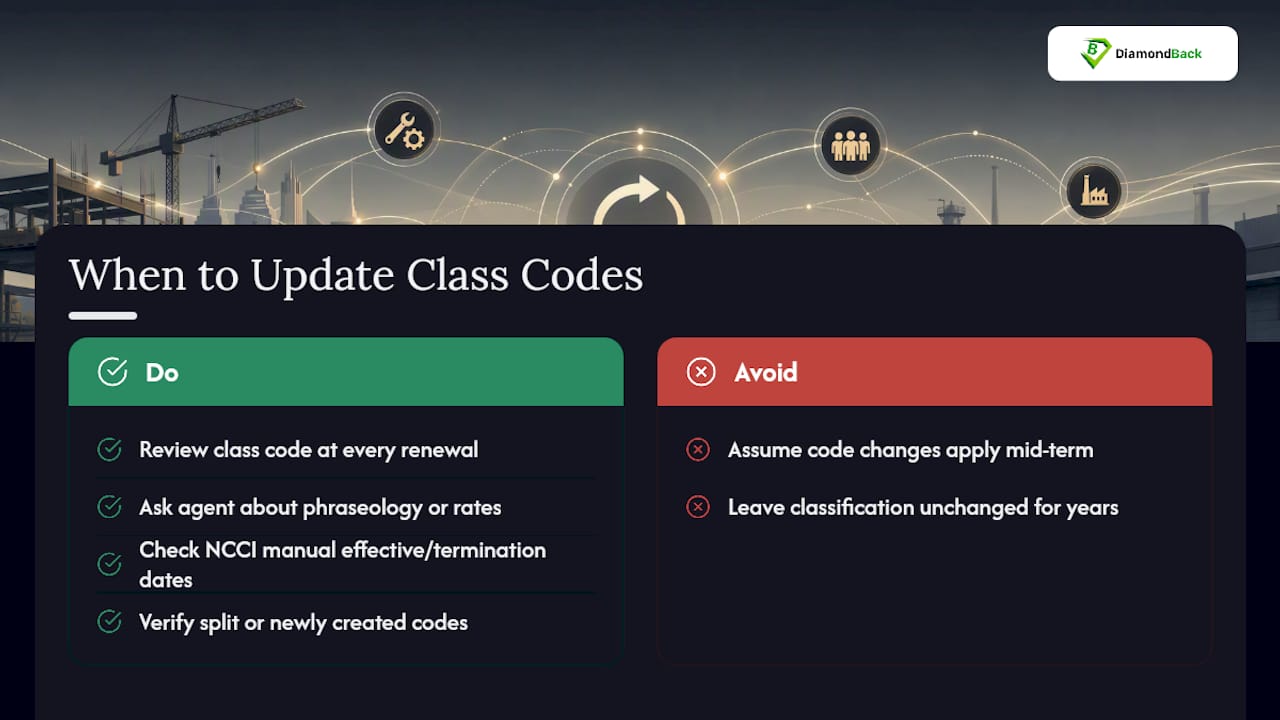
How Often Do Class Codes Get Updated?
NCCI and the independent state bureaus revise classifications on an ongoing basis, not on a fixed annual calendar. Codes get retired when an industry disappears or consolidates, new codes get introduced for emerging trades, and phraseology descriptions get rewritten for clarity. The NCCI Classification Codes and Statistical Codes Manual tracks effective and termination dates for exactly this reason.
Here is what most business owners miss: a code revision doesn’t automatically follow your business into its next renewal. If your code gets discontinued mid-term, your current policy typically runs to its expiration under the original classification, and the update applies at your next renewal, when your carrier reassigns you to the current equivalent code.
This is where staying passive costs money. If you haven’t touched your classification in three or four renewal cycles, there’s a real chance you’re still being rated under phraseology that no longer matches how your industry bureau describes the work, or worse, a code that was quietly split into two more specific ones with different rates. Loss costs get refiled annually even when the code number itself doesn’t change, so the dollar amount attached to your classification can shift year over year without any new code showing up on your declarations page.
The practical move is to treat your class code assignment as something worth revisiting at every renewal, not a one-time decision made when you first bought the policy. Ask your agent directly whether your code has had a phraseology or rate update since last year. Most won’t volunteer that information unless you ask.
What Do Real Class Code Examples Look Like?
Class codes cluster by risk exposure, and the rate differences between them can be significant even within the same general industry. A few examples illustrate the range:
Clerical office employees (code 8810) carry one of the lowest rates in the entire system, because the exposure is largely limited to slip-and-fall or repetitive strain injuries. This code is why splitting out your bookkeeper or dispatcher from a higher-risk governing classification matters so much on your bottom line.
Outside sales (code 8742) sits in a similarly low band, covering employees who travel for client meetings but don’t perform physical labor. Driving exposure is generally covered under this code up to a point, but regular delivery driving usually needs its own classification.
Truck drivers (code 7380) occupy a much higher risk tier, reflecting the realities of over-the-road exposure, loading and unloading injuries, and vehicle-related claims. Trucking employers often carry this as a standalone code even when the rest of their operation is rated under a different governing classification, and it’s one of the more heavily scrutinized codes during a trucking workers comp audit given how much loss data feeds into it.
Contractor trades like roofing, electrical work, and general carpentry each carry their own codes with rates that can run several multiples higher than clerical work, because the injury severity potential is fundamentally different. A logistics or warehouse operation classifying general labor can find useful context on how transportation-adjacent work gets categorized through resources like AMB Moving & Storage’s industry blog, which touches on how moving and freight-handling roles get evaluated for risk.
The pattern across all of these: rate follows exposure, not job title, and two businesses in the “same industry” can carry very different classifications depending on what employees actually do day to day.

How Do You Dispute a Class Code Assignment?
If you believe your carrier or rating bureau assigned the wrong code, you have a legitimate path to challenge it, and the process starts with documentation, not a phone call demanding a change.
First, gather evidence that your actual job duties don’t match the assigned phraseology. Detailed, signed job descriptions, time studies showing how hours split across tasks, and payroll records by function all strengthen your case. Compare your documentation against the exact phraseology language in the NCCI Classification Codes and Statistical Codes Manual or your state bureau’s equivalent, since disputes often hinge on whether your business matches the described duties, not the industry name.
Second, raise the issue with your carrier’s underwriting department in writing before your renewal, referencing the specific code and the phraseology you believe applies instead. Most disputes get resolved at this level once an underwriter reviews real documentation.
If your carrier won’t budge and you believe the assignment is genuinely wrong, you can escalate to the rating bureau itself, NCCI, or the applicable state bureau like WCIRB or PCRB, depending on where your policy is filed. Some states also allow appeals through the state’s department of insurance if you believe the bureau’s own guidance was misapplied. This process takes time, so start it well before renewal rather than after you’ve already received a bill reflecting the disputed code.
How Do Class Codes Affect Claims and Your Experience Rating?
Your class code doesn’t just set your starting rate. It also determines which loss data pool your claims history feeds into for experience modification rating (EMR) purposes.
Here’s the mechanic that matters: your EMR compares your actual claims history against the expected losses for businesses in your same classification. If you’re misclassified into a lower-risk code, a single serious claim looks disproportionately bad against that code’s expected loss data, potentially spiking your modifier higher than it would under accurate classification. Conversely, correct classification into a higher-risk code with more claims history behind it can actually soften the impact of an isolated incident, because the expected loss baseline is calibrated to that reality.
Claims handling itself ties back to classification too. When an injury occurs, the adjuster reviews the employee’s actual duties at the time of injury against the class code they were reported under. A mismatch here, say, an employee coded as clerical but injured while operating equipment, can complicate both the claim resolution and your next audit, since it exposes the same documentation gap auditors already watch for.
The bigger picture: accurate classification protects you on both ends. It keeps your current premium fair, and it keeps your experience modification factor an honest reflection of your actual risk rather than an artifact of bad coding.
A Few Priorities Worth Repeating
Getting your class codes right isn’t about squeezing out the lowest possible premium. It’s about accuracy that holds up under audit. Verify every code against NCCI or your state’s bureau, document job duties before a carrier or auditor asks you to, and when a classification is genuinely ambiguous, lean conservative rather than aggressive. If you’re unsure whether a correction would meaningfully change your costs, running an updated quote is the fastest way to find out.
— Vladimir
Get an Accurate Workers Comp Quote After Verifying Your Codes
You can use an online comparison platform that pulls quotes from multiple top insurers side by side after confirming your class codes and payroll splits, allowing you to see whether your current premium reflects accurate classification or if you may be overpaying for a code that no longer fits your operation.

That comparison matters most for trucking and transportation employers, where a single misapplied driver code can swing premium by thousands of dollars a year. If you run commercial vehicles alongside your workers’ comp exposure, it’s worth reviewing both together. You can request an instant quote on commercial coverage in the same sitting, so your entire risk picture, payroll classification and vehicle exposure, gets priced with the same up-to-date numbers instead of stale renewal figures from an older policy.
Where to Verify Your Class Code
- Use NCCI’s Class Look-Up for phraseology, rate history, and downloadable exports.
- Check your state’s independent rating bureau, such as WCIRB or PCRB, if your state doesn’t use NCCI.
- Save a dated snapshot of every lookup result and confirm the final assignment against your policy declarations page before binding.
This article is general information, not a substitute for advice from a qualified financial advisor. Consult a qualified financial professional about your own circumstances before acting on anything here.
Sources
- NCCI — Class Look-Up
- NCCI — Classification Codes and Statistical Codes
- WorkersCompCost — Workers’ Comp Class Codes (NCCI, WCIRB & PCRB Lookup)
FAQ
What Is a Workers Comp Class Code?
It’s a four-digit classification assigned to a specific job function that sets the base rate an insurer charges per $100 of payroll for that work.
Does Every State Use the Same Class Code System?
No. Most states use NCCI’s classification system, but California (WCIRB), Pennsylvania (PCRB), and a handful of other states run independent rating bureaus with their own codes and rates.
How Do I Look Up My Correct Class Code?
Search NCCI’s Class Look-Up tool or your state bureau’s equivalent, then confirm the result against your carrier’s declarations page before your policy binds.
What Is a Workers Comp Ghost Policy?
A ghost policy is a zero-payroll workers’ comp policy, often used by sole proprietors to obtain a certificate of insurance, carrying a carrier minimum premium commonly between $750 and $1,400.
Can I Dispute My Assigned Class Code?
Yes. Gather documented job descriptions and payroll records showing your duties don’t match the assigned phraseology, then raise it with your carrier’s underwriting department or escalate to the rating bureau if needed.
Recommended
- Decoding Workers’ Comp Insurance Costs: How It’s Calculated and Simplified with Instant Online Solutions
- When is Workers’ Compensation Insurance Mandatory? Understanding the Legal Requirements and Simplifying Compliance
- Understanding Workers Compensation Insurance Requirements by State A Guide from DiamondBack Insurance
- Understanding Workers’ Compensation Insurance A Comprehensive Guide by DiamondBack Insurance