
Most small businesses pay between around $400 and over $6,000 a year for a Business Owner’s Policy, with typical monthly costs ranging from about $83 to $147, depending on the benchmark used. Insureon’s small-business median sits at $83 monthly, while MoneyGeek’s broader industry analysis puts the average closer to $147. Your actual premium depends heavily on your industry and state, so treat these figures as a starting point and get quotes to confirm your number.
TL;DR:
- Small business BOP premiums vary greatly by industry and location, with typical costs ranging from $83 to over $1,346 monthly depending on risk factors.
- Factors such as industry classification, property value, liability limits, and claims history significantly influence your specific premium, making quotes essential.
- Shopping around, raising deductibles, and documenting safety measures can help reduce premiums, but coverage limits must align with your actual risk exposure.
- BOP approval can be instant for simple businesses but may take up to two weeks for complex operations with prior claims or unique exposures.
Table of Contents
- Understanding Average BOP Insurance Cost Benchmarks
- What Drives Your Business Owners Policy Cost
- BOP Coverage Rates by Industry and State
- How to Lower Your BOP Insurance Pricing
- Does Your Business Actually Need a BOP?
- Does Revenue Affect Your BOP Premium?
- Hidden Fees and Surcharges That Add to Your BOP Cost
- How Long It Takes to Get BOP Coverage Active
- Why Published BOP Averages Rarely Match What You’ll Actually Pay
- Get an Instant BOP Quote Through Diamondback Insurance
- Sources
- FAQ
Understanding Average BOP Insurance Cost Benchmarks
Ask three sources what the average BOP insurance cost is, and you’ll get three different answers. That’s not a red flag. It’s a reflection of who each company insures.
Insureon reports a median cost of $83 per month for its small-business customers, with annual premiums ranging from around $400 to over $6,000. Most of those customers carry $1M/$2M liability limits and an average deductible of $500. Insureon’s number skews low because it reflects a marketplace of smaller, lower-risk businesses shopping online.
Compare that to insurer-reported averages. The Hartford publishes a customer average around $141 per month, and Progressive Commercial reports new customers pay an average of $127 monthly. These figures run higher because they represent each carrier’s actual book of business, which includes a wider mix of industries and risk profiles than a broker’s median customer.
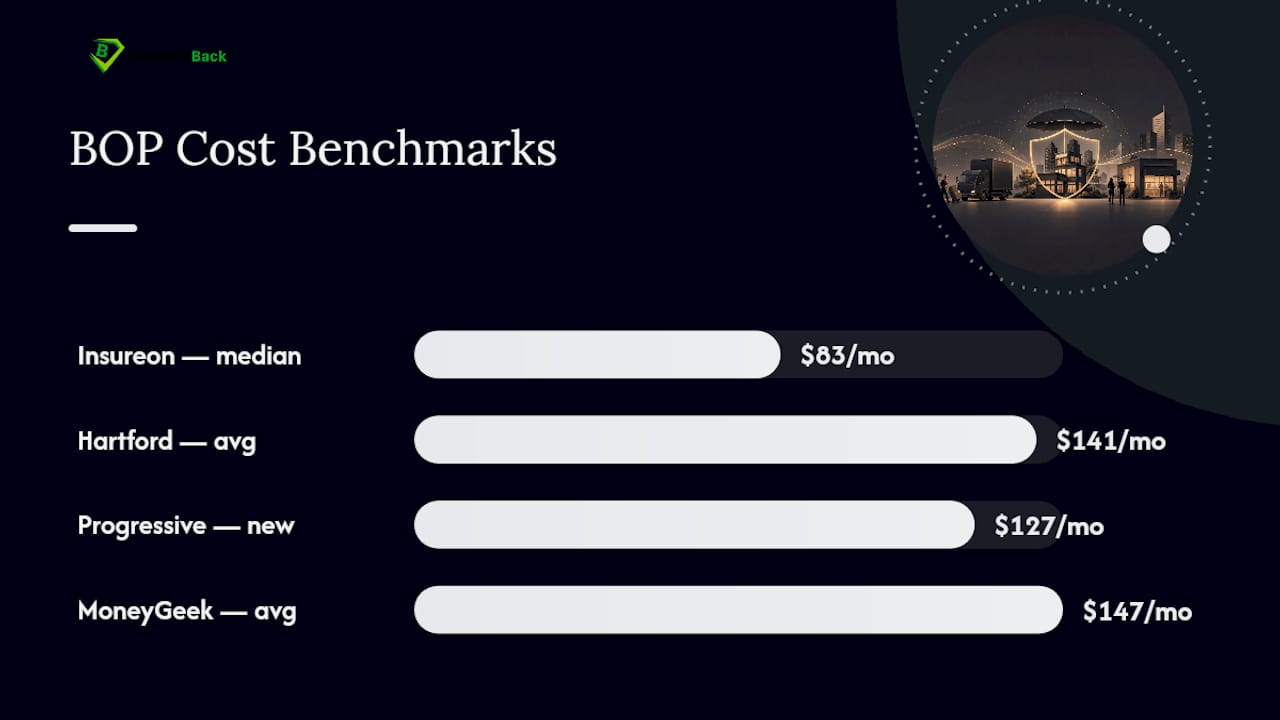
Then there’s MoneyGeek’s analysis, which pulls from 79 industries across all 50 states and lands on an average of $147 per month, or about $1,767 a year. Industry extremes on that dataset run from roughly $25 a month for drone operators to $1,346 a month for pressure washing businesses.
Here’s why the spread matters for your budgeting:
- Median figures (like Insureon’s $83) show what a “typical” small business pays, but a median can be skewed by a large cluster of very low-risk businesses.
- Average figures (like MoneyGeek’s $147 or Progressive’s $127) capture more industry variety, including high-exposure trades that pull the number upward.
- Your own quote will land somewhere on this spectrum based on your specific industry, location, and coverage choices, not on any published number.
Statistic to remember: if your business resembles a low-risk consulting or service operation, budget closer to Insureon’s $83 median. If you run anything involving physical labor, equipment, or customer foot traffic, plan closer to the $147 industry average and confirm with quotes.
What Drives Your Business Owners Policy Cost
Underwriters price a BOP by weighing a handful of factors, and some move the needle far more than others. Knowing which ones carry the most weight helps you spot where you actually have room to negotiate.
- Industry and class code. Insurers classify your business by NAIC or ISO class codes tied to claims data for that trade. A bookkeeping firm and a commercial bakery might both be “small businesses,” but the bakery’s fire and equipment risk puts it in a completely different pricing tier.
- Location and state. Litigation climate, local building costs, and catastrophe exposure (hurricanes, wildfires, flooding) all shift base rates. A shop in a coastal state with frequent storm claims will generally see higher state-level averages than one inland.
- Property value and valuation method. Insuring your building and contents at replacement cost costs more upfront than actual cash value, but it pays out the full rebuild cost after a loss instead of a depreciated amount.
- Coverage limits and deductible. Higher liability limits and lower deductibles both raise your premium. Insureon found 79% of its customers choose $1M/$2M liability limits with a $500 deductible, which is a reasonable starting benchmark for most small operations.
- Payroll and employee count. More employees generally means more foot traffic, more liability exposure, and a larger payroll base for underwriters to price against.
- Claims history and experience. A clean loss history and several years in business typically earn you a better rate than a newer company or one with recent claims.
- Payment frequency. Paying annually instead of monthly often avoids installment fees and sometimes earns a small discount.
Pro Tip: Ask your agent or the platform quoting you for the exact class code they’re using. A miscoded business (say, “general contractor” instead of “handyman services”) can inflate your premium for no real reason.
BOP Coverage Rates by Industry and State
Two businesses with identical revenue can pay wildly different premiums once you factor in what they actually do and where they’re located. The numbers below give you a rough anchor point.
| Business Type | Risk Level | Estimated Monthly Cost | Estimated Annual Cost |
|---|---|---|---|
| Drone/aerial services | Low | ~$25 | ~$400 |
| Consulting or professional services | Low | ~$70–$83 | ~$83–$147 |
| Retail shop | Moderate | ~$105–$127 | ~$1,260–$1,524 |
| Restaurant | Moderate to high | ~$147–$200 | ~$1,767–~$2,400 |
| Pressure washing | High | ~$1,346 | ~$16,152 |
These figures come from MoneyGeek’s industry analysis and Insureon’s state-level data, which shows meaningful swings even within the same industry:
- Virginia businesses average around $70 a month on Insureon’s platform.
- Florida businesses average closer to $105 a month, largely due to hurricane exposure.
- State medians nationwide range roughly from $128 to $171 a month depending on litigation and catastrophe risk.
Find the row that most closely matches your trade, then treat that number as a floor, not a ceiling. Pressure washing sits at the extreme high end because of the equipment damage and property liability involved, while service-based businesses with little physical risk stay near the bottom. Once you’ve identified your rough category, request quotes to see where your specific business actually falls.
How to Lower Your BOP Insurance Pricing
You have more control over your premium than most owners realize. A few adjustments can meaningfully change your rate before you ever sign anything.
- Get quotes from multiple carriers. Rates for the same business can vary by hundreds of dollars a year between insurers, so comparing offers side by side is the single fastest way to confirm you’re not overpaying.
- Raise your deductible if you can absorb the risk. Moving from a $250 to a $1,000 deductible often lowers your premium noticeably, especially on the property portion of the policy.
- Bundle additional lines. Adding workers’ compensation or commercial auto to the same carrier frequently unlocks a multi-policy discount.
- Document your risk controls. Fire suppression systems, security alarms, and written safety programs can all qualify you for underwriting credits.
- Pay annually instead of monthly. Installment fees add up, and some insurers offer a discount for paying the full premium upfront.
- Double-check your class code and loss runs. An outdated or incorrect classification, or a messy loss run that doesn’t reflect your true claims history, can quietly inflate your rate.
Pro Tip: Don’t chase the lowest premium blindly. If cutting your liability limit from $2M to $1M saves you $15 a month but leaves you exposed on a six-figure lawsuit, that’s not a discount. That’s a gamble.
Does Your Business Actually Need a BOP?
A Business Owner’s Policy bundles general liability and commercial property coverage into one policy, often with business interruption coverage included. Most brick-and-mortar retailers, offices, and small service businesses with a physical location qualify, and bundling typically costs less than buying general liability and property coverage separately.
A BOP won’t cover everything, though. Standard exclusions usually include commercial auto, professional errors and omissions, liquor liability, and employment practices liability. If your business relies on a vehicle fleet, offers professional advice (consulting, accounting, design), serves alcohol, or has a larger HR footprint, you likely need separate or added coverage on top of the base policy.
Before you buy, ask your agent these five questions:
- Does this policy cover my specific equipment and inventory value?
- Is business interruption coverage included or an add-on?
- Am I excluded from coverage for any of my core services?
- Do I need commercial auto or workers’ compensation added separately?
- What’s my liability limit, and is it enough for my industry’s typical claim size?
Does Revenue Affect Your BOP Premium?
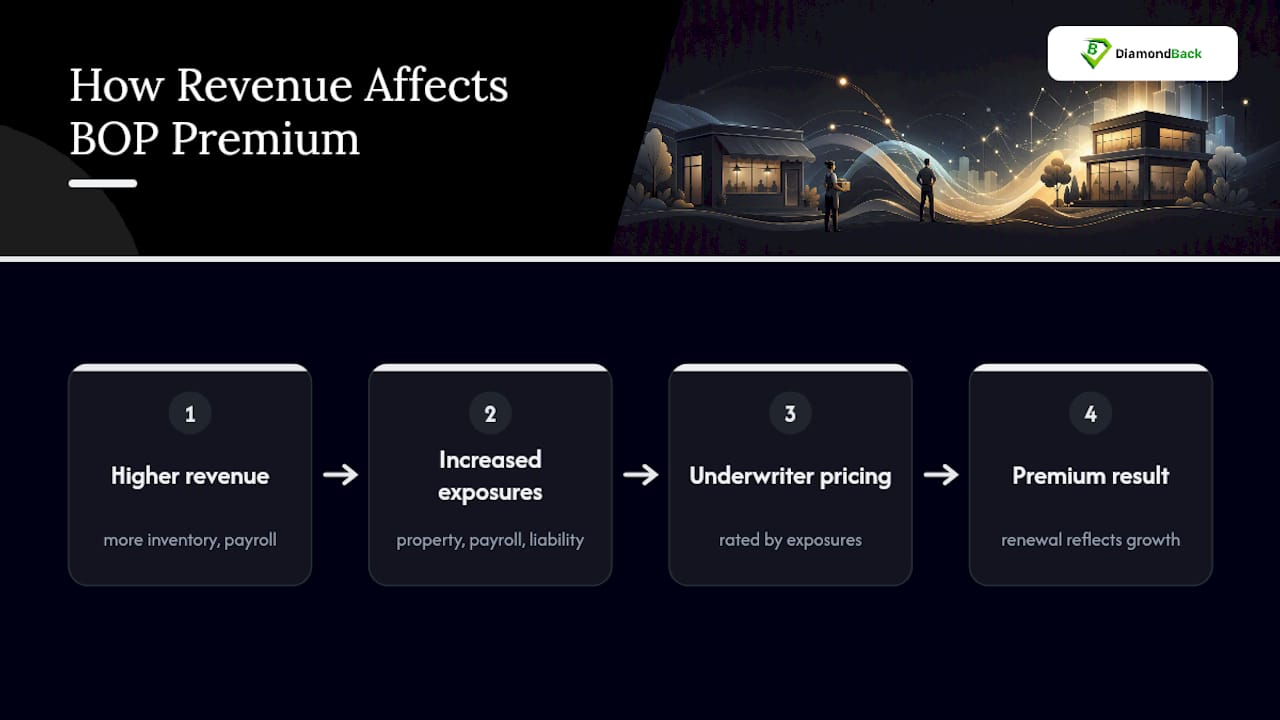
Revenue itself isn’t a line item on most BOP rating worksheets, but it shapes your premium indirectly through the metrics underwriters actually use. Higher revenue businesses tend to carry more inventory, more equipment, more foot traffic, and larger payrolls, all of which push the price up.
A $200,000-revenue consulting firm with two employees and no physical inventory will pay far less than a $2 million-revenue retail store with fifteen employees and a warehouse full of stock, even though both fall under “small business.” The retailer’s higher property values, larger payroll, and greater liability exposure all get priced in separately, and revenue happens to correlate with all three.
Sales volume also matters if your policy uses gross receipts as a rating basis, which some liability endorsements do, particularly for retail and hospitality. If your revenue grows significantly year over year, expect your renewal premium to reflect that growth even if nothing else about your operation changed. This is one reason it pays to review your policy annually rather than letting it auto-renew: a business that doubled its sales without updating its coverage limits could be underinsured relative to its actual exposure, while one that reports outdated high figures could be overpaying for coverage it doesn’t need.
If your revenue fluctuates seasonally or unpredictably, ask your agent whether your policy allows a mid-term adjustment. Locking in a rate based on last year’s numbers when this year looks very different can leave money on the table in either direction.
Hidden Fees and Surcharges That Add to Your BOP Cost
The quoted premium isn’t always the final number on your invoice. Several fees commonly get added on top, and they can catch first-time buyers off guard.
Policy fees are the most common. Many carriers tack on a flat administrative charge, often somewhere between $25 and $100, just for issuing the policy. Installment fees apply if you pay monthly or quarterly instead of annually. These are typically small individually, a few dollars per payment, but they add up over a twelve-month term.
State-mandated surcharges show up in several markets. Some states levy a surplus lines tax if your policy is written through a non-admitted carrier, and others charge a fire marshal tax or similar assessment tied to property coverage. These are set by state law, not by your insurer, so they’ll appear regardless of which carrier you choose within that state.
Endorsement costs are another factor. Adding equipment breakdown coverage, cyber liability, or a higher business interruption limit each adds its own line item to the base premium. Mid-term policy changes, like adding a location or increasing payroll, can also trigger a short-rate adjustment fee if the carrier has to recalculate your premium before renewal.
Ask for an itemized breakdown before you bind coverage. A quote that looks $10 a month cheaper on the surface can end up costing more once fees and surcharges are factored in, especially if one insurer bundles fees into the premium and another lists them separately.
How Long It Takes to Get BOP Coverage Active
Getting a Business Owner’s Policy in place typically takes anywhere from same-day to about two weeks, depending on how straightforward your business is to underwrite.
Low-risk, straightforward businesses, think a consulting firm or a small retail shop with no unusual exposures, can often get instant or same-day approval through an online quoting platform. You answer a set of standard questions about your industry, location, payroll, and property values, and the system returns a bindable quote in minutes.
Higher-risk or more complex operations take longer because an underwriter needs to review the application manually. This applies to businesses with prior claims, unusual property features, higher revenue thresholds, or industries that fall outside a carrier’s automated underwriting appetite. In these cases, expect anywhere from three days to two weeks while the insurer requests loss runs, verifies property details, or asks clarifying questions about your operations.
The fastest path through either scenario is showing up prepared. Have your prior loss runs, an accurate payroll figure, and a clear description of what your business actually does ready before you start. Missing documentation is the single biggest cause of delayed activation, far more than the complexity of the coverage itself.
Why Published BOP Averages Rarely Match What You’ll Actually Pay
The gap between a $83 median and a $1,346 pressure-washing premium isn’t a contradiction. It’s the entire point. Every published average is a snapshot of a specific customer pool, and no small business owner fits neatly into someone else’s dataset.
What gets underweighted in most cost guides is how much control you actually have over your own number. Deductible choice, class code accuracy, and documented risk controls move your premium more than most owners assume, yet they get far less attention than the industry benchmarks themselves. A restaurant owner who assumes their premium is fixed because “restaurants are expensive to insure” is leaving savings on the table that a retail shop owner down the street already claimed by asking for a higher deductible.
The other overlooked piece is timing. Businesses that shop their BOP annually, rather than auto-renewing out of habit, consistently find better rates as their claims history improves and as carriers adjust their underwriting appetite. Loyalty doesn’t earn a discount in commercial insurance the way it sometimes does in other purchases. Comparison shopping does.
— Vladimir
Get an Instant BOP Quote Through Diamondback Insurance
Some online insurance platforms give you a faster way to see where your business actually lands on the cost spectrum, without waiting days for a callback from a broker. Instead of guessing whether your quote matches Insureon’s $83 median or MoneyGeek’s $147 average, you get tailored numbers pulled from multiple top insurers in one pass.
Before you start, have your prior loss runs, current payroll figures, and an estimate of your property or equipment values on hand. That information is what speeds up an accurate quote and helps the platform match you to the right class code the first time, rather than a generic estimate that gets corrected later. If your business also runs vehicles for deliveries or service calls, it’s worth reviewing your commercial auto needs alongside your BOP, since the two policies often need to work together rather than overlap. Ready to see your real number instead of a published average? Start your instant quote and compare options in minutes.
Sources
Figures and coverage definitions in this article draw from Insureon’s BOP cost data, MoneyGeek’s industry cost analysis, and the Insurance Information Institute’s coverage explainer. Additional pricing context came from The Hartford and Progressive Commercial.
This article is general information, not a substitute for advice from a qualified financial advisor. Consult a qualified financial professional about your own circumstances before acting on anything here.
FAQ
How much does BOP insurance cost per month?
Most small businesses pay between $83 and $147 a month, based on Insureon’s small-business median and MoneyGeek’s broader industry average, though high-risk trades like pressure washing can exceed $1,346 a month.
What is included in BOP insurance?
A standard BOP bundles general liability and commercial property coverage, often with business interruption included, but it excludes commercial auto, professional errors and omissions, and liquor liability.
What should a $1,000,000 umbrella policy cost?
Umbrella policy pricing depends heavily on your underlying BOP and auto limits, industry risk, and claims history, so it’s best confirmed through a direct quote rather than a generic estimate.
How much does a $500,000 general liability policy cost?
Liability coverage costs scale with your limit, industry, and location, and most small businesses bundling $1M/$2M limits into a BOP already pay the median rates covered above; lower limits typically cost less but vary by carrier.
How long does it take to get BOP coverage active?
Straightforward small businesses can often get same-day or instant approval through online quoting, while more complex operations with prior claims or unusual exposures may take one to two weeks for manual underwriting review.