
Every U.S. contractor needs three baseline policies: Commercial General Liability, Workers’ Compensation once you hire employees, and Commercial Auto if vehicles are part of the job. Exact minimums vary by state and contract, and most owners demand higher limits and specific endorsements than the law requires. Your two immediate moves: check your state licensing board or DOI for the statutory floor, then pull out the contract’s insurance attachment and read every line before you sign or bid.
TL;DR:
- Most construction contracts demand $1 million per occurrence and $2 million in total liability coverage, often requiring specific endorsements like Additional Insured and Waiver of Subrogation.
- State licensing boards set minimum GL limits, but contracts usually specify higher limits and detailed endorsement requirements, making careful review essential before bidding.
- Correctly matching insurance endorsements, especially those covering completed operations and adding owners or GCs as additional insured, is crucial to avoid claim denials and contract breaches.
- Workers’ compensation is mandatory in almost every state once employees are hired, but sole proprietors and owners can often exempt themselves, which may or may not satisfy contract conditions.
- Price for standard contractor insurance packages typically ranges from $1,800 to $8,500 annually, driven mainly by payroll size, claims history, and subcontractor use.
Table of Contents
- What Coverage Does a Contractor’s Insurance Stack Actually Include?
- What Endorsements Do Owners and GCs Commonly Require?
- How Do You Check State-Specific Insurance and Licensing Rules?
- What Limits and Premiums Should You Budget For?
- How Do You Verify a Certificate of Insurance Is Actually Valid?
- How Should Prime Contractors Manage Subcontractor Insurance?
- When Should You Use an Online Quote Platform Versus a Broker?
- Why the Endorsement Gap Trips Up Even Careful Contractors
- Get Compliant Contractor Coverage Without the Broker Runaround
- Where to Verify Your Own State’s Requirements
- Sources
- FAQ
What Coverage Does a Contractor’s Insurance Stack Actually Include?
Contractors rarely carry one policy. You carry a stack, and each layer answers a different question about what could go wrong on a job site.
Commercial General Liability (GL) covers third-party bodily injury, property damage, and completed-operations claims. If a client trips over your extension cord or a wall you framed collapses six months after the job, GL responds. It’s the policy every contract attachment asks for first, and it’s the one NerdWallet’s contractor insurance guide lists as foundational alongside workers’ comp and inland marine.
Workers’ Compensation becomes a legal mandate in almost every state the moment you hire your first employee, covering medical costs and lost wages after an on-the-job injury. Solo operators without employees often skip it voluntarily, though some states (and some GCs) require a sole-proprietor exemption certificate on file regardless.
Commercial Auto liability kicks in when a vehicle, owned or leased, is used for business purposes. Hauling materials in your personal truck on the weekend is one thing; using that same truck to run supplies to a job site five days a week is a different exposure your personal auto policy will not cover.
Inland Marine protects tools and equipment in transit or stored off-site. A stolen $4,000 laser level or a generator that falls off a trailer is an inland marine claim, not a GL claim.
Builders’ Risk covers a structure under construction against fire, weather, theft, and vandalism until the project is complete. Owners on new-build and major renovation contracts almost always require it, and it’s usually written per-project rather than as an annual policy.
Professional Liability / Errors & Omissions applies to contractors who provide design, engineering, or specification work alongside construction. A design-build electrician or a contractor who signs off on structural plans carries different exposure than a framing crew running someone else’s blueprints.
Umbrella or Excess Liability sits on top of your GL, auto, and employer’s liability limits, adding an extra layer of protection when a claim blows past your primary limits. Public and larger commercial contracts increasingly ask for it.
Bonds — license bonds, payment bonds, performance bonds — aren’t insurance at all; they’re a financial guarantee to a state or project owner that you’ll perform the work or pay your subs and suppliers. A typical solo contractor with no employees still often needs GL, commercial auto if vehicles are involved, inland marine for tools, and a state license bond, even before workers’ comp enters the picture.
Which of these are legally mandated versus contract-driven depends entirely on your trade and your state. Workers’ comp and license bonds are usually statutory. GL limits above the state minimum, Builders’ Risk, and most endorsements are almost always contract-driven, meaning the owner or GC sets the bar, not the state.
What Endorsements Do Owners and GCs Commonly Require?
A policy that meets your state’s minimum won’t automatically satisfy a contract. Most construction contracts layer specific endorsements on top of your base coverage, and missing one is the single most common reason a certificate of insurance gets bounced back.
- Additional Insured (AI) status adds the project owner or GC to your GL policy so they’re protected under your coverage, not just their own. The scope matters: an endorsement covering ongoing operations (commonly written on forms similar to CG 20 10) is narrower than one that extends to completed operations (similar to CG 20 37), and owners increasingly ask for both.
- Primary and Noncontributory language confirms your policy pays first, before the owner’s own insurance is touched, and won’t be prorated alongside it.
- Waiver of Subrogation stops your insurer from coming after the owner or GC to recover a claim payout, even if that party contributed to the loss.
- Notice of Cancellation provisions require your carrier to notify the owner (typically 30 days, sometimes less for nonpayment) before your coverage lapses mid-project.
Public and institutional contracts spell this out in detail. New York’s Office of General Services, for example, publishes an insurance requirements attachment that specifies required limits, endorsement forms, insurer rating thresholds, and states plainly that failing to provide proof can be treated as a contract breach. University and institutional contracts follow a similar pattern, often requiring continuous coverage and proof for the full contract term, not just at signing.
Pro Tip: Ask your broker for this exact phrasing when requesting a certificate: “Please issue AI status for ongoing and completed operations, primary and noncontributory, with waiver of subrogation, per the attached contract requirements.” Brokers process specific requests faster than vague ones like “add my client as additional insured.”
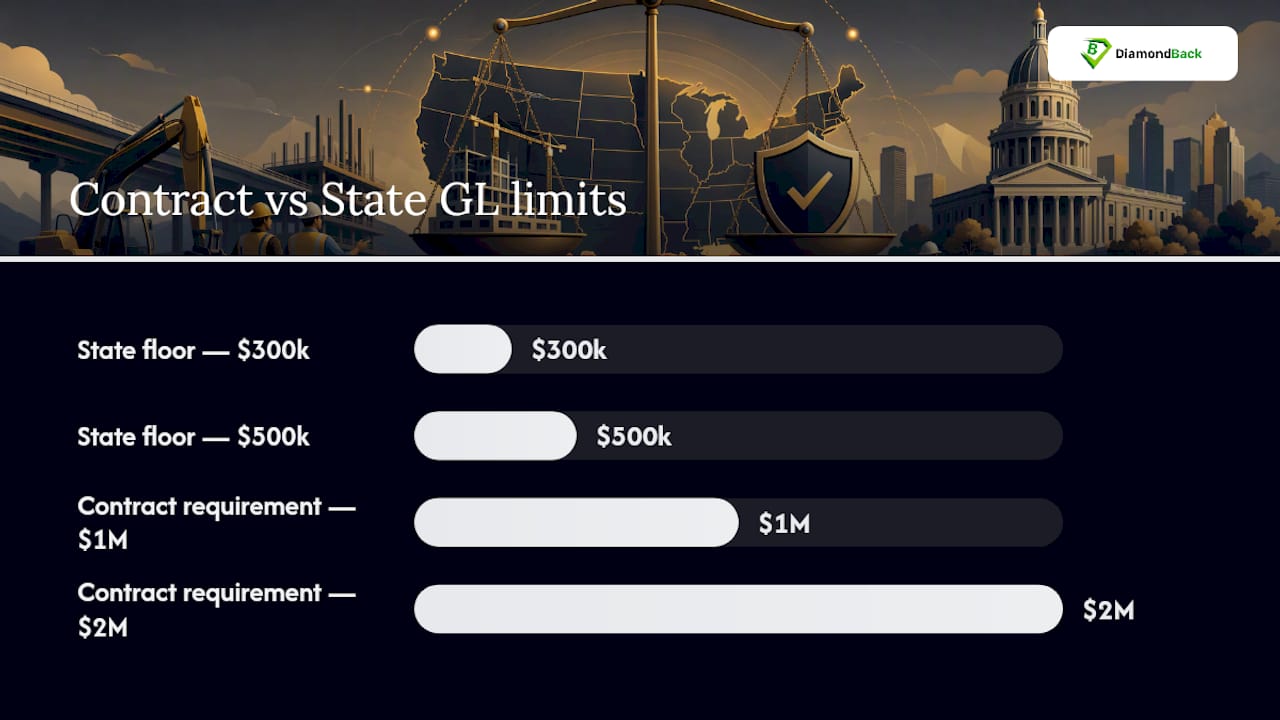
State licensing boards may set a $300,000 or $500,000 GL floor, but the contract itself frequently requires $1 million or $2 million with these exact endorsements attached. Read the insurance attachment before you bid, not after you win the job.
How Do You Check State-Specific Insurance and Licensing Rules?
There’s no single national rulebook here. Every state runs its own contractor licensing board, its own workers’ comp system, and its own DOI filings, and the requirements rarely match from state to state.
Start with your state contractor licensing board. Most publish minimum GL limits and bonding requirements by license class directly on their websites; some tie renewal to proof of continuous coverage. A general contractor’s license in one state might require a $12,000 bond, while a specialty trade license in a neighboring state requires none at all.
Check your state Department of Insurance (DOI) next. The DOI regulates which carriers can legally write policies in your state and at what solvency standard, which matters when a contract specifies a minimum A.M. Best rating.
Then confirm your workers’ comp obligations through your state’s workers’ comp board or fund. This is where contractors get tripped up most often:
- New York requires most businesses to carry both workers’ comp and Disability Benefits (DBL) coverage, a combination contractors moving from other states frequently miss.
- Sole proprietors and partners in many states can legally exempt themselves from workers’ comp, but a GC’s contract may still require them to carry it anyway or produce a signed exemption form.
- Owner-officers of corporations face different exemption rules than sole proprietors in most states, and the threshold for “employee” can include part-time and seasonal labor.
If you’re bidding on a public works project, add one more layer: the Miller Act requires payment and performance bonds on most federal construction contracts above a set dollar threshold, and most states run a parallel “Little Miller Act” applying the same logic to state and municipal projects. These bonding rules sit alongside, not instead of, your standard insurance requirements.
Build a simple record for every contract you bid: a screenshot or PDF of the state licensing board’s minimum requirements, the DOI bulletin or carrier license lookup confirming your insurer is authorized in that state, and a saved copy of the contract’s insurance attachment itself. When a dispute over compliance surfaces eighteen months into a project, and it does happen, that folder is what protects you.
What Limits and Premiums Should You Budget For?
$1 million per occurrence and $2 million aggregate is the most common GL limit written into commercial construction contracts. Larger commercial projects or anything involving a public entity frequently pushes that to $2 million per occurrence, sometimes with a separate project-specific aggregate that resets for each job rather than sharing limits across your whole book of business.
Commercial auto typically carries a $1 million combined single limit (CSL), and umbrella policies stack in layers of $1 million or $2 million on top of your primary GL, auto, and employer’s liability.
Typical small-contractor insurance stacks run $1,800 to $8,500 per year for the combined GL, workers’ comp, and commercial auto package, according to industry cost breakdowns by trade. Roofers and excavation contractors sit at the high end; low-exposure trades like painting or handyman work sit closer to the floor.
What actually moves your premium:
- Payroll size and trade classification drive workers’ comp rates more than almost anything else, since the rate is expressed per $100 of payroll and varies sharply by classification code.
- Claims history over the past three to five years affects both your premium and, in some cases, whether a carrier will write you at all.
- Revenue and subcontractor usage affect GL premium, since a contractor who subs out 80% of the work carries different liability than one running an all-employee crew.
- Bond costs run roughly 0.5% to 3% of the bond’s face value depending on your credit and financial statements, and bonds are priced and underwritten separately from your insurance program.
- Builders’ Risk pricing depends heavily on project value, construction type, and location, particularly flood and wildfire exposure.
Adding endorsements rarely changes your premium dramatically on their own, but some carriers require underwriting approval before issuing Additional Insured status for completed operations, especially on large commercial jobs. Ask your broker to flag this early. A carrier that balks at a specific endorsement mid-bid can cost you the job if you find out too late.
How Do You Verify a Certificate of Insurance Is Actually Valid?
A certificate of insurance (ACORD form) is a summary, not a guarantee. It tells an owner what coverage supposedly exists on the date it’s issued, but it carries no binding contractual weight on its own. Endorsement pages and the policy’s actual declarations are what confirm additional insured status really applies, which is why sophisticated GCs ask for both.
Run every COI you receive through this checklist:
- Effective and expiration dates cover the full contract period, with no gap between the current policy term and the next renewal.
- Policy numbers match across the GL, auto, and workers’ comp lines listed, not copied and pasted from an expired policy.
- Additional insured language references the correct endorsement, and ideally a copy of that endorsement page accompanies the COI rather than just a checkbox.
- Waiver of subrogation and primary/noncontributory wording appears explicitly, not implied.
- Cancellation notice language matches what your contract requires, typically 30 days.
Check the carrier’s A.M. Best rating against whatever threshold the contract specifies. Public contracts frequently require A minus, Class VII or better, and some attachments require you to replace the policy at renewal if the carrier’s rating drops below that floor mid-term.
Pro Tip: Set a calendar reminder 45 days before every policy expiration, not 30. That extra two-week buffer gives you room to fix a lapsed endorsement or a missed COI update before it becomes a stop-work issue on-site.
How Should Prime Contractors Manage Subcontractor Insurance?
If you’re the prime contractor, your subs’ insurance gaps become your liability the moment something goes wrong on a job you’re responsible for. Most owner contracts require you to flow down the same limits and endorsements you carry to every sub on the project, not just match them loosely.
Build this into your subcontractor onboarding, not your punch list:
- Require a COI before the sub sets foot on site, not after the first invoice.
- Confirm the sub’s GL limits match or exceed what your prime contract requires, and that Additional Insured status names both you and the owner where required.
- Request the actual endorsement page for any sub working on a project with completed-operations exposure, since a bounced COI months later is far harder to fix than one caught at intake.
- If a sub can’t produce required coverage, options include withholding payment until proof arrives, requiring them to purchase coverage through your broker at their cost, or replacing them before the schedule tightens.
Track expirations in a simple spreadsheet or your project management software, sorted by renewal date. A sub whose GL lapses mid-project without your knowledge is the scenario that turns a minor site injury into a coverage dispute nobody wins.
When Should You Use an Online Quote Platform Versus a Broker?
You have three real paths to buy contractor coverage: go direct to a single insurer, work with a broker who shops multiple carriers on your behalf, or use an online aggregator that compares quotes across carriers in one place.
Direct-to-carrier works if you already know exactly which insurer and product you need and want to skip the comparison step. A traditional broker earns their fee on complex placements: high-limit umbrella layers, unusual endorsement negotiations, or public bids where the insurance attachment runs eight pages and needs a human reading it against your existing policies.
For standard coverages, GL, workers’ comp, and commercial auto, an aggregator like Diamondback Insurance speeds up the comparison step considerably, since you’re seeing multiple carriers’ quotes side by side instead of calling each one individually. That matters most when a bid deadline is close and you need a certificate of insurance turned around fast.
- Complex, high-limit, or project-specific endorsement requests still generally benefit from broker involvement.
- Standard GL/WC/Auto quoting and COI issuance is where online comparison tools save the most time.
- Either path still requires you to read the contract’s insurance attachment yourself before assuming any quote satisfies it.
Why the Endorsement Gap Trips Up Even Careful Contractors
The most damaging mistake I see contractors make isn’t carrying too little insurance. It’s carrying the right limits with the wrong endorsement, and not finding out until a claim gets denied because the Additional Insured language didn’t extend to completed operations. That single form distinction between ongoing and completed operations coverage has sunk more contractor relationships with GCs than underinsurance ever has, because it looks fine on the COI right up until it matters.
Read the contract’s insurance attachment before you submit a bid, not after you win the job. If one clause in that document confuses you, that’s the clause worth a five-minute call to your broker, because it’s usually the one that decides whether your coverage actually protects you when something goes wrong.
— Vladimir
Get Compliant Contractor Coverage Without the Broker Runaround
Comparing GL, workers’ comp, and commercial auto quotes one carrier at a time eats hours you don’t have during bid season. An online insurance platform is a faster route to compliant coverage for contractors who need standard policies and a usable certificate of insurance without the back-and-forth of a traditional agency relationship. The platform pulls quotes from multiple carriers at once, so you can compare limits and pricing for the coverages most contracts actually demand, then move straight to purchase online.
If your project involves company vehicles, whether that’s a single service truck or a small fleet running material to multiple sites, start with understanding the importance of DOT-compliant conspicuity tape to enhance vehicle safety and meet regulatory requirements. Complex public bids with unusual endorsement demands or high-limit umbrella layers still call for a broker’s direct negotiation with the carrier. For everything else, from a routine renewal to a bid deadline three days out, get an instant online quote and see your options before you commit to a single carrier.
Where to Verify Your Own State’s Requirements
Save these directly to your contract files: the Loyola University risk management contractor requirements page shows how institutional contracts phrase continuous-coverage demands, and the NY OGS insurance requirements attachment is a real example of public-contract limits, ratings, and endorsement language. Cross-check your own state licensing board and DOI site before every bid.
Sources
- Insurance Requirements for Contractors
- General Liability Insurance Requirements for Contractors
- Contractor Insurance Guide: Cost by Trade (2026)
- Attachment: Insurance Requirements (NY Office of General Services)
- Contractor insurance: Best companies, cost and coverage – NerdWallet
FAQ
What insurance do contractors need to have?
Every contractor needs Commercial General Liability at minimum, Workers’ Compensation once you have employees, and Commercial Auto if vehicles are used for the business. Most contracts add Inland Marine, Builders’ Risk, and specific endorsements like Additional Insured on top of that baseline.
How much does $1,000,000 in contractor insurance cost?
A $1 million GL policy is typically bundled into a broader stack rather than priced alone; small contractor packages combining GL, workers’ comp, and commercial auto commonly run $1,800 to $8,500 per year depending on trade and payroll.
How much insurance should a general contractor have?
Most commercial contracts require $1 million per occurrence and $2 million aggregate GL, with larger or public projects sometimes pushing to $2 million per occurrence plus an umbrella layer. State licensing minimums are usually far lower than what contracts actually require.
What happens if a contractor does not have insurance?
Working without required coverage can void your license, expose your personal assets to a lawsuit, and breach the contract outright, since most owner agreements treat missing or lapsed insurance as a material breach that can trigger stop-work orders or withheld payment.
Recommended
- DiamondBack Insurance: Tailored General Liability Coverage for Contractors
- Understanding Workers Compensation Insurance Requirements by State A Guide from DiamondBack Insurance
- Navigating Workers’ Compensation Insurance by State with DiamondBack Insurance
- Navigating Workers’ Compensation Insurance for Independent Contractors A DiamondBack Insurance Guide