
A named insured owns and controls a policy. An additional insured is a third party added by endorsement who gets limited coverage tied to the named insured’s operations, not their own separate policy. If you’re a small business owner asked to add someone, or asked to be added, the endorsement wording decides how much protection actually exists. A certificate of insurance alone proves nothing.
TL;DR:
- Adding a party as an additional insured shares the same policy limits as the named insured, meaning no new coverage capacity is created.
- The coverage for an additional insured only protects against liabilities arising from the named insured’s ongoing or completed work, not unrelated negligence.
- Specific endorsement forms like CG 20 10 and CG 20 37 define the scope of coverage, with courts increasingly enforcing their exact language over insurer interpretations.
- A certificate of insurance alone does not prove coverage; the actual endorsement is required, and verifying its existence and precise wording is critical.
- Relying on additional insured status is suitable for short-term projects but should be supplemented with a dedicated policy if ongoing operations or legal risks are high.
Table of Contents
- Additional Insured vs Named Insured: A Side-by-Side Comparison
- What Additional Insured Coverage Actually Covers, and Where It Stops
- The Endorsement Forms You Should Ask For by Name
- Why a Certificate of Insurance Isn’t Proof of Coverage
- How to Request and Verify Additional Insured Coverage in a Contract
- State Court Trends That Change How Much Protection You Actually Get
- Choosing Between Relying on Additional Insured Status and Buying Your Own Policy
- If You Need Coverage Now: Comparing Carriers That Get the Endorsement Right
- Where to Verify Endorsement Language and Court Rulings
- Sources
- FAQ
Additional Insured vs Named Insured: A Side-by-Side Comparison
The named insured is listed right on the declarations page, and that placement is not a formality. Being on the declarations page means you carry the policy rights and obligations — you can request changes, you’re notified of cancellation, and you’re on the hook for premium payments. An additional insured never appears on the declarations page. They exist only because a separate document, the endorsement, attaches them to someone else’s policy.
That structural difference drives everything else about how the two statuses behave in practice.
- Where status lives: named insured on the declarations page; additional insured on a policy endorsement.
- Who controls the policy: the first named insured handles renewals, cancellation notices, and any requested changes; an additional insured has no say in any of it.
- Cancellation notice: the named insured always gets notified; an additional insured often does not, unless a specific endorsement requires it.
- Premium responsibility: the named insured pays; an additional insured pays nothing and typically has no idea what the policy costs.
- Limits: the named insured’s full policy limits back their own exposure; an additional insured shares those same limits with everyone else covered under the policy.
This last point trips up a lot of contractors and landlords. Adding a party as an additional insured does not create new capacity. If the named insured’s policy carries a specified per occurrence limit, that amount gets divided among every claim and every party pulling from it, including the additional insured. A policy with three simultaneous claimants and a $1 million limit doesn’t stretch to cover all three in full.
Defense and indemnity work differently too. The named insured’s insurer generally owes them a duty to defend under the broadest reading of the policy. An additional insured’s right to defense is narrower and depends entirely on what the endorsement says about the relationship between the two parties. Some endorsements tie defense obligations to specific operations; others extend more broadly. The Menlo Insurance Services guide on named versus additional insured status notes that additional insured endorsements typically share the named insured’s per-occurrence and aggregate limits rather than adding fresh capacity.
What Additional Insured Coverage Actually Covers, and Where It Stops
Additional insured status protects against liability arising out of the named insured’s work, not against every risk the additional insured might face. That distinction matters because a lot of business owners assume being added to a contractor’s policy means they’re fully covered for anything that happens on a job site. They aren’t.
Here’s how the coverage typically breaks down in practice:
- Defense costs get paid by the named insured’s carrier, but only for claims connected to the named insured’s operations, and usually within the same limits everyone else draws from.
- Indemnity works the same way. If a court finds the additional insured solely negligent, with no contribution from the named insured’s work, many endorsements won’t respond at all.
- Ongoing operations coverage protects the additional insured only while the named insured is actively performing work under the contract.
- Completed operations coverage, when included, extends protection after the job wraps, which matters enormously for construction and installation work where defects surface months or years later.
- Exclusions in the underlying policy still apply to the additional insured. If pollution, professional liability, or certain contractual risks are excluded for the named insured, they’re excluded for the additional insured too.
The gap that catches people off guard most often is sole negligence. A property owner added as an additional insured on a subcontractor’s policy might assume they’re protected if a worker gets hurt. But if the injury traces back entirely to the property owner’s own negligence, unrelated to the subcontractor’s work, the endorsement may not respond at all. Coverage is tied to a relationship, not a blanket promise.
Pro Tip: Ask specifically whether defense costs erode the liability limit or sit outside it. Some policies pay defense costs separately; many general liability forms do not, which means a long legal fight can quietly shrink the money left over to pay an actual claim.
The Endorsement Forms You Should Ask For by Name
Vague language like “additional insured as required by contract” on a certificate means almost nothing. What matters is the specific ISO endorsement form attached to the policy, because each one covers different situations.
- CG 20 10: covers ongoing operations and is the form most commonly requested on active construction or service contracts. Its key phrase, “caused, in whole or in part by,” determines how broadly courts read the coverage.
- CG 20 37: extends protection to completed operations, meaning claims that arise after the work is finished. If you’re a general contractor relying only on CG 20 10, you have no protection once the subcontractor walks off the job and a defect surfaces later.
- CG 20 38: a blanket-style endorsement that can extend additional insured status upstream through the contract chain, but it comes with real traps if the underlying agreement doesn’t clearly define who qualifies.
- Blanket endorsements generally: convenient, but they vary widely by carrier and by edition date, and coverage can quietly narrow depending on how the form defines “written contract.”
The exact wording controls the outcome far more than the form number does. Legal analysis of the CG 20 10 endorsement and recent construction litigation shows courts increasingly enforcing the precise language rather than deferring to what an insurer argues the endorsement was meant to do. That’s good news for policyholders, but only if the endorsement was drafted correctly in the first place. Practical guidance from Katten on additional insured coverage gaps recommends asking for the endorsement by its form name and edition date, since two policies both claiming to offer “blanket additional insured” coverage can behave very differently in a claim.
Why a Certificate of Insurance Isn’t Proof of Coverage
A certificate of insurance is a summary document, not a contract. Every standard ACORD certificate carries language stating explicitly that it confers no rights on the certificate holder and does not amend, extend, or alter the coverage the policy provides. That disclaimer exists precisely because so many businesses treat a COI as a binding guarantee, and it isn’t one.
The only thing that actually creates additional insured status is the endorsement itself or specific policy language naming the party. A COI can list you as a certificate holder while you have zero actual coverage rights, because certificate holder and additional insured are two different things entirely. A certificate holder simply receives a copy of the certificate. An additional insured has been added to the policy through an endorsement.
- Request a copy of the actual endorsement, not just the certificate.
- Confirm the endorsement names your business specifically, or check that the blanket language in the underlying contract clearly qualifies you.
- Watch for certificates that list “additional insured” in a memo field with no corresponding endorsement number, which is a common and easy-to-miss red flag.
Guidance from the IRIC risk management manual is blunt on this point: certificates of insurance are informational only, and businesses relying on them without the underlying endorsement are operating on a false sense of security. If you want a deeper walkthrough of certificate holder mechanics, the difference between certificate holder and additional insured status is worth a closer look before you sign anything.
How to Request and Verify Additional Insured Coverage in a Contract
Getting this right at the contract stage saves you from discovering the gap after a claim, when it’s too late to fix.
- Name the exact endorsement in the contract. Don’t write “additional insured as required by contract.” Specify CG 20 10 for ongoing operations and CG 20 37 for completed operations, or the carrier’s equivalent forms.
- Require primary and non-contributory language. Without it, the additional insured’s own policy could be forced to share defense costs alongside the named insured’s coverage, defeating the purpose of the endorsement.
- Ask for a waiver of subrogation if you want to prevent the insurer from later pursuing the additional insured to recover what it paid out.
- Collect three documents, not one: the certificate of insurance, a copy of the actual endorsement, and written confirmation of primary and non-contributory status.
- Watch for red flags: vague blanket language with no form number, missing completed operations coverage on a project with long-term liability exposure, or a certificate issued days before a contract signing with no endorsement attached yet.
For fleet operators and transportation businesses, this checklist applies just as directly. A shipper or broker asking to be added to a carrier’s policy should specify the endorsement form, and carriers reviewing freight and shipping coverage requests should confirm the same documentation before signing off.
Pro Tip: When the stakes are high enough, cancellation notice is worth fighting for separately. Many carriers resist adding a notice-of-cancellation obligation for additional insureds, so on large or long-term projects, consider requiring a project-specific policy instead of relying on someone else’s endorsement.
Know when to insist versus when to walk away and buy your own coverage. If a counterparty won’t produce the endorsement, won’t name the specific form, or keeps offering a certificate as the final answer, that’s your signal to either require a project-specific policy or secure the coverage independently.
State Court Trends That Change How Much Protection You Actually Get
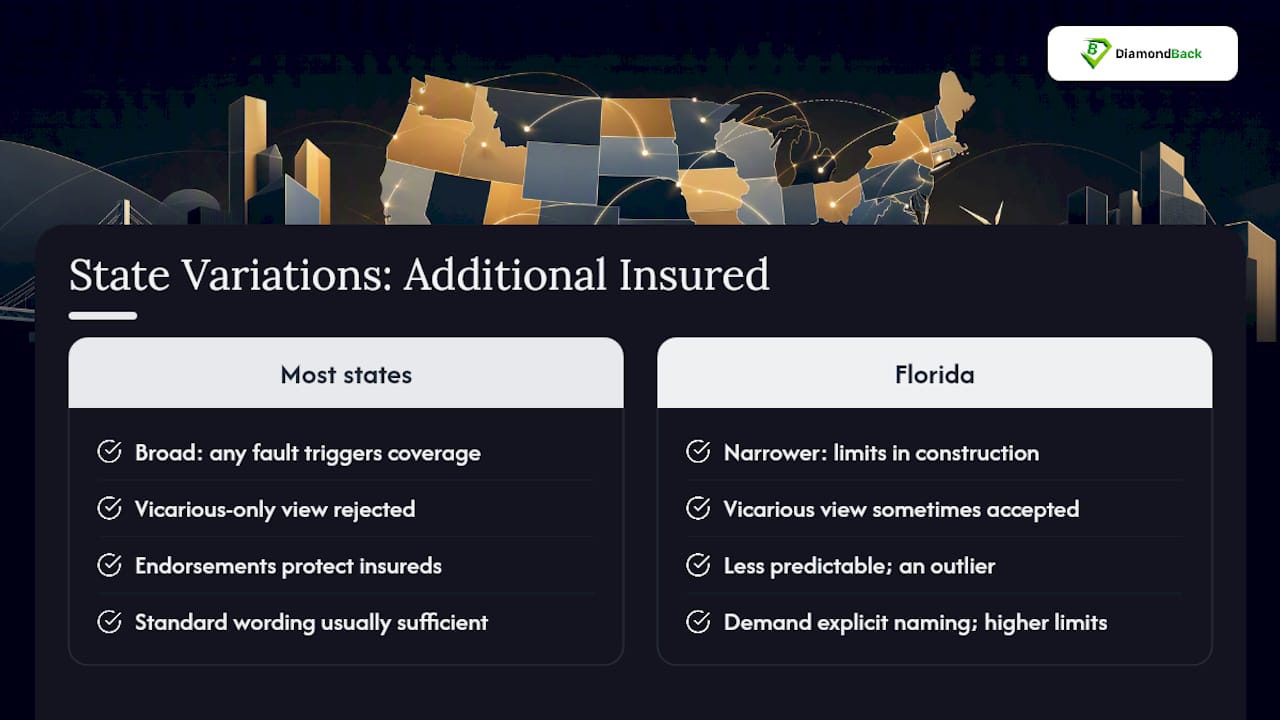
The phrase “caused, in whole or in part by” inside a CG 20 10 endorsement has become the single most litigated clause in additional insured law over the past two years. Most jurisdictions read that phrase broadly: coverage triggers whenever the named insured bears any fault at all, even a small percentage. That’s a policyholder-friendly reading, and it’s now the national consensus.
Florida breaks from that consensus. Florida courts and legislation have carved out exceptions that narrow how “in whole or in part” gets applied, particularly in construction disputes, making the state a genuine outlier rather than a minor variation. The McGuireWoods analysis of CG 20 10 litigation documents insurers repeatedly trying to argue that additional insured coverage should apply only to vicarious liability, and courts in most states rejecting that narrow reading. Florida is one of the few places where that argument still gains traction.
What this means practically: if your contract involves a Florida job site, or your choice-of-law provision points to Florida law, don’t assume the same endorsement language that protects you in Georgia or Virginia will behave identically there. Large projects, multi-state operations, or any contract where the stakes are high enough to matter warrant a second look at the governing law clause. When in doubt, demand explicit naming in the endorsement rather than relying on blanket language, and consider whether higher limits are worth negotiating given the jurisdiction’s track record.
Choosing Between Relying on Additional Insured Status and Buying Your Own Policy
Relying on additional insured status makes sense for short-term projects where the cost savings are real and your exposure is limited to that one job. It stops making sense the moment your involvement becomes ongoing. If you’re managing recurring operations, carrying primary exposure, or working in a state with unpredictable court trends, being a named insured on your own policy gives you control the endorsement never will. Weigh the premium cost against what a coverage gap could cost you, and if you decide you need your own protection, comparing carrier options is worth the hour it takes.
— Vladimir
If You Need Coverage Now: Comparing Carriers That Get the Endorsement Right
Our platform is designed for the moment you decide relying on someone else’s endorsement isn’t enough. Instead of calling broker after broker to find a carrier willing to add the right endorsement language, you can compare multiple carrier quotes in one place and see which ones will attach primary and non-contributory wording, waivers of subrogation, or the specific CG forms your contract requires.

For fleet managers and trucking businesses especially, endorsement requirements come up constantly with shippers, brokers, and landlords who all want to be named. Rather than guessing which carrier will accommodate that request, get an instant online quote and compare terms side by side before you commit. If you’re deciding between fleet-wide coverage and a single-truck policy, comparing trucking insurance quotes across carriers shows you which insurers are set up to handle these requests without friction. Start your comparison today and find out which carrier actually says yes to the endorsement your contract demands.
Where to Verify Endorsement Language and Court Rulings
For the endorsement forms themselves, review the IRIC risk management manual for cancellation and primary/non-contributory guidance. For contract drafting language, the Reed Smith practical guide to additional insured requirements walks through common contract pitfalls in plain terms.
This article is general information, not a substitute for advice from a qualified financial advisor. Consult a qualified financial professional about your own circumstances before acting on anything here.
Sources
- McGuireWoods blog — the CG 20 10 endorsement and recent case law
- Katten — Are you really covered as an additional insured?
- Reed Smith — navigating additional insured requirements
FAQ
Is a named insured the same as an additional insured?
No. A named insured appears on the declarations page and controls the policy; an additional insured is added later by endorsement with narrower, contract-tied coverage and no control over the policy itself.
Why would someone want to be listed as an additional insured?
Being listed as an additional insured extends liability protection from another party’s policy without the cost of a separate policy, which is common on construction projects, leases, and vendor contracts where one party’s work creates risk for another.
Who needs to be listed as an additional insured?
Anyone whose liability exposure is tied to another party’s operations typically needs this status, including property owners on contractor policies, general contractors on subcontractor policies, and businesses on their vendors’ or shippers’ policies.
Why do landlords want to be listed as additional insured?
Landlords request additional insured status so a tenant’s or contractor’s liability policy responds to claims arising from that tenant’s or contractor’s activity on the property, reducing the chance the landlord’s own policy has to absorb the loss.