
A small US gym typically pays a few hundred dollars a month for a core insurance package, with many owners paying around $120 to $150 monthly for combined liability and property coverage. General liability, a business owner’s policy, and workers’ compensation cover the bulk of that spend. Actual pricing swings on payroll, class types, and the limits your lease or landlord requires, which the sections below break down in detail.
TL;DR:
- Premiums for small gyms typically range from $120 to $150 monthly for liability and property coverage, with higher costs for larger or higher-risk facilities.
- Policy limits tend to increase premiums modestly, with most gyms aiming for the common $1 million/$2 million coverage to meet landlord requirements.
- Underwriters base prices on revenue, payroll, class types, location, and safety measures, so operational choices can significantly impact costs.
- Coverage differences include exclusions on high-risk activities, with general liability covering bodily injury and property damage, and optional add-ons like cybersecurity and auto insurance.
- Comparing quotes requires consistent limit structures and full understanding of ancillary fees such as policy fees, inspections, endorsements, and potential audit charges.
Table of Contents
- How Much Does Gym Insurance Cost by Policy Type?
- What Affects Your Gym Insurance Premium?
- What Does Each Gym Insurance Policy Actually Cover?
- How Do You Get and Compare Gym Insurance Quotes?
- Why Trust These Gym Insurance Cost Estimates?
- What Fees Hide Behind the Premium Number?
- Does Membership Type Change Your Insurance Cost?
- Three Priorities for Budgeting Gym Insurance
- Get an Instant Gym Insurance Quote Through Diamondbackins
- Sources
How Much Does Gym Insurance Cost by Policy Type?
Insurance carriers price each policy separately, and your total premium is really a stack of smaller decisions. Here’s what typical small gyms and studios pay, broken out by coverage.
These are medians, not floors. A single-instructor yoga studio and a 24/7 franchise gym with a dozen employees will land on opposite ends of every row. Industry benchmarks put typical small-gym monthly premiums around $120 to $150 for a standard general liability and property combination, while sample quotes for small fitness centers show general liability alone running $500 to $2,000 a year depending on square footage and class mix.
Policy limits move these numbers more than most owners expect. Bumping general liability from a $500,000/$1,000,000 limit to $1,000,000/$2,000,000, the industry-standard combination most landlords require, usually adds a modest amount to your annual premium rather than doubling it. Raising your deductible from $500 to $1,000 typically shaves a small percentage off the premium, which matters more for cash-flow planning than for the bottom-line total.
Pro Tip: Ask every quote for the same limit structure ($1M/$2M is the most common lease requirement) so you’re comparing apples to apples instead of chasing the lowest number on mismatched paperwork.
What Affects Your Gym Insurance Premium?
Underwriters build your price from a specific set of inputs, and knowing them in advance means fewer surprises when a quote comes back higher than you budgeted.
- Annual revenue and gross receipts. Many carriers price general liability as a rate per $1,000 of sales, so a gym doing $400,000 a year pays more than one doing $150,000, even with identical square footage.
- Payroll and class codes. Workers’ comp is calculated directly from payroll dollars multiplied by a class-code rate, which is why staffing model matters as much as headcount.
- Square footage and facility type. More space means more property exposure and often a higher liability estimate.
- Type of training offered. High-contact classes like boxing, wrestling, or CrossFit carry higher injury rates than yoga or Pilates, and national occupational injury data is part of how carriers justify that gap.
- Hours of operation. Unstaffed 24/7 access frequently triggers a surcharge or a special endorsement requirement, since no one is on-site if something goes wrong overnight.
- Employees versus independent contractors. Reclassifying a contractor as a W-2 trainer changes your payroll base and can shift your workers’ compensation premium noticeably.
- Equipment value. Higher-end cardio and strength equipment raises your property and inland marine exposure.
- State and location. Workers’ comp rates vary widely by state, and urban locations often see higher liability pricing than rural ones.
- Claims history. A single slip-and-fall claim can follow your loss history for several renewal cycles.
- Security and risk controls. Cameras, signed waivers, and posted equipment instructions all signal lower risk to an underwriter.
Small operational changes tend to pay off here. Documented waiver procedures, visible signage near free weights, and a written incident-reporting process are inexpensive to implement and are exactly the kind of risk controls underwriters reward with better pricing at renewal.
What Does Each Gym Insurance Policy Actually Cover?
Every gym policy has a specific job, and reading past the premium number to the actual contract terms is where owners avoid coverage gaps.
- General liability covers third-party bodily injury and property damage, the classic slip-and-fall or dropped-weight scenario. Standard limits run $1 million per occurrence and $2 million aggregate. Watch for exclusions around specific high-risk activities like Olympic lifting or gymnastics, which some carriers carve out unless you buy an endorsement. Comparing general liability against professional liability helps clarify which risks each policy actually picks up.
- Business owner’s policy (BOP) bundles general liability with commercial property and often business interruption coverage into one discounted package. It’s usually the most cost-effective starting point for a single-location gym under a certain revenue threshold.
- Professional liability (errors and omissions) protects against claims that a trainer gave bad advice or a program caused injury through negligent instruction, distinct from a pure accident claim. Independent trainers and instructors often need their own E&O policy even if the gym carries one, especially if they’re contractors rather than employees.
- Workers’ compensation pays medical costs and lost wages for injured employees and is priced almost entirely from payroll and class code. State rules on minimum coverage and experience modification factors vary enough that two gyms with identical staffing can see very different bills.
- Commercial property and equipment coverage protects the building and its contents. Confirm whether your policy pays replacement cost or actual cash value (ACV), since ACV factors in depreciation and can leave you underfunded after a loss. Portable equipment used off-site for competitions or outdoor classes usually needs an inland marine floater, and insuring it at full replacement cost avoids co-insurance penalties if a claim comes in.
- Cyber liability covers breach response and notification costs when member payment data or personal information is exposed. Given that gyms routinely process recurring billing through third-party processors, cyber exposure is a real consideration for small operators, not just large chains.
- Commercial auto only matters if the gym owns a shuttle van or sends staff to run errands in a company vehicle. If employees occasionally use personal cars for gym business, hired and non-owned auto coverage closes that gap cheaply.
How Do You Get and Compare Gym Insurance Quotes?
Getting comparable numbers starts with having the right figures ready before you call anyone. Underwriters ask for the same handful of details every time, so gathering them up front speeds the whole process.
Before requesting quotes, pull together:
- Annual revenue and a payroll breakdown by role
- Total square footage and a list of classes or services offered
- Current equipment value, including any owned off-site gear
- Your lease’s insurance requirements (limits, additional insured language)
- Prior claims history for the past three to five years
From there, the shopping process is straightforward:
- Set your target limits based on lease and vendor contract requirements, since those often set the real minimum you must buy regardless of price.
- Collect at least three quotes using identical limits and deductibles.
- Compare not just premium but endorsements, exclusions, and aggregate limits.
- Confirm additional insured status and waiver of subrogation if your lease demands them.
- Check for gaps, especially around high-contact classes or 24/7 access.
Most gyms can get comparable quotes within a day or two and bind coverage within a week, assuming payroll and revenue figures are ready to submit. Watch for lease language requiring specific insurer ratings or occurrence versus claims-made policy forms, since those details can quietly disqualify an otherwise cheap quote.
Why Trust These Gym Insurance Cost Estimates?
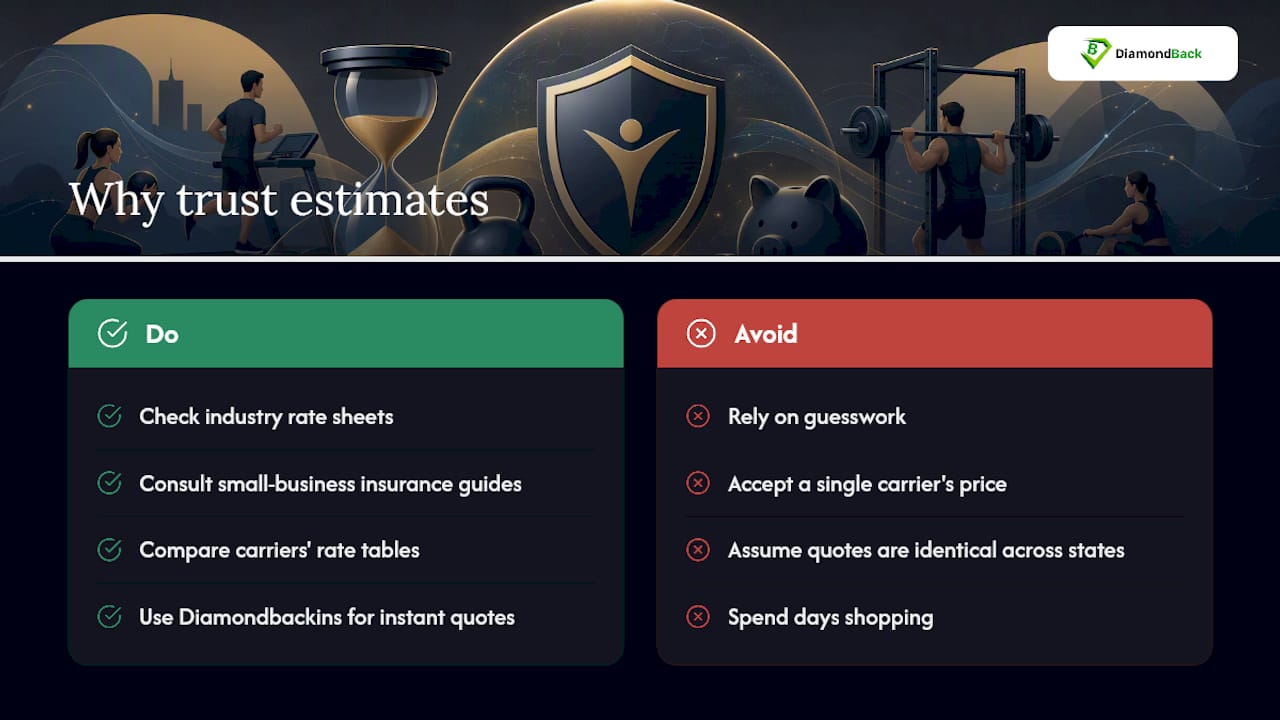
These ranges come from industry rate sheets, published small-business insurance guides, and program rate tables that carriers use to price health-club risk, not guesswork. Every figure has a documented source, and actual quotes still vary by state and gym profile. Diamondbackins pulls tailored quotes from multiple carriers in one pass, which typically compresses a multi-day shopping process into minutes for gym owners comparing coverage.
What Fees Hide Behind the Premium Number?
The quoted premium is rarely your entire bill. Insurers routinely tack on policy fees, ranging from a small flat charge to a few percent of premium, that cover administrative processing and aren’t always itemized clearly upfront. Ask for the total invoiced amount, not just the base premium, before comparing two quotes side by side.
Inspection fees show up when a carrier requires an on-site risk assessment, common for gyms with pools, climbing walls, or heavy free-weight areas. These typically run a flat fee and get billed separately from the policy itself. Endorsements, the add-on forms that modify your base coverage, each carry their own cost. Adding liquor liability for a juice bar, extending coverage to outdoor bootcamp classes, or adding an equipment floater for off-site gear all show up as line items beyond the headline premium.
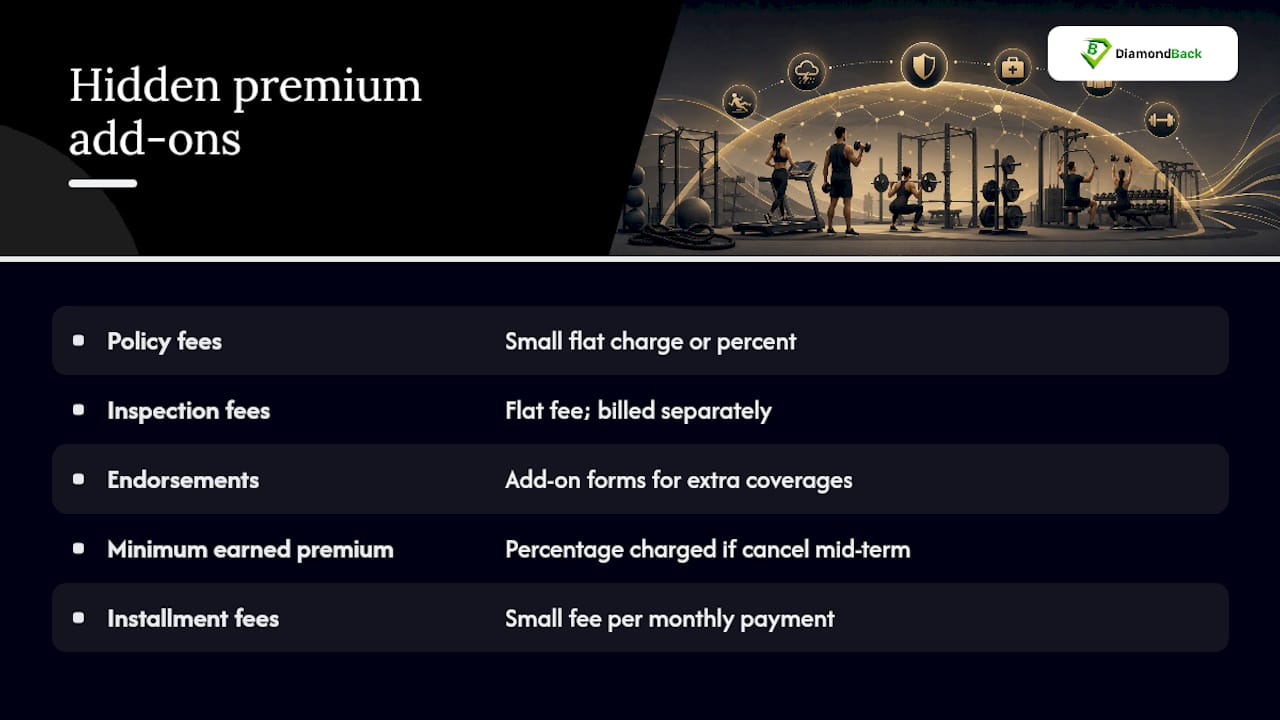
Minimum earned premium clauses matter if you cancel mid-term. Many carriers charge a percentage of the annual premium regardless of how many months you actually used, so canceling in month three doesn’t mean paying only for three months. Audit premiums are another wrinkle for workers’ comp specifically. Since it’s priced on estimated payroll, insurers often conduct a year-end audit and bill the difference if your actual payroll ran higher than projected.
Finally, budgeting in monthly installments instead of paying annually usually adds a small installment fee per payment. Paying the full annual premium upfront, when cash flow allows, is typically the cheaper path over twelve months.
Does Membership Type Change Your Insurance Cost?
Yes, and the effect is bigger than most new owners expect. A 24/7 unstaffed access model changes your risk profile fundamentally, since no employee is present if a member gets injured overnight. Carriers frequently respond with a surcharge or require a specific endorsement covering unsupervised hours, and some programs simply won’t write unstaffed facilities without it.
Class mix matters just as much. A studio built entirely around yoga, Pilates, or barre sits at the low end of the pricing spectrum because injury frequency and severity are both modest. Add HIIT, CrossFit, boxing, or youth gymnastics, and premiums climb, reflecting the same higher-contact injury patterns that show up in national sports injury data. A gym running a single format pays a more predictable rate than one offering a dozen class types, since underwriters have to account for the riskiest activity on your schedule, not the average one.
Membership structure plays a role too. A gym with month-to-month, no-commitment memberships and no signed waiver process presents more litigation risk than one requiring signed liability waivers at sign-up. If your facility offers open gym time alongside instructor-led classes, expect the underwriter to price for the open-gym exposure since there’s less supervision during that window.
Three Priorities for Budgeting Gym Insurance
Buy to your lease’s required limits first, then layer in coverage that matches your actual loss exposure, not just the contract minimum. Staffing and documented safety protocols do more to control long-term costs than shopping alone ever will. Re-quote every year and read the policy language itself, since a cheaper renewal sometimes trades away an endorsement you actually need.
— Vladimir
Get an Instant Gym Insurance Quote Through Diamondbackins
There are online platforms that allow you to submit your gym’s details once and see tailored quotes from multiple top insurers side by side. Some platforms aggregate offers, let you compare coverage and pricing directly, and allow you to purchase a policy online without waiting on callbacks.

Expect to provide the same figures underwriters always ask for: revenue, payroll, square footage, and your class offerings, then receive comparable quotes back in minutes rather than days. If your lease requires a $1 million/$2 million liability limit or you’re simply trying to find out where your gym actually falls on the cost spectrum, get your instant online quote today and compare real numbers before your next renewal.
This article is general information, not a substitute for advice from a qualified financial advisor. Consult a qualified financial professional about your own circumstances before acting on anything here.
Sources
- Bureau of Labor Statistics — Occupational Injuries and Illnesses news release
- How Much Does Gym Insurance Cost? 2026 Rates from $24/mo — GymInsurance
- Gym insurance: Cost, coverage & best providers in 2026 — FitSmallBusiness
- Basic service health club rate sheet — K&K Insurance (PDF)