

Expect to pay roughly $7,000 to $18,000 per year for a full commercial insurance package on a single heavy tractor, or about $421 a month on average for $1 million in liability coverage alone. Your exact number swings on truck type, how long you’ve held operating authority, what you haul, and where you’re garaged. FMCSA sets the legal floor at $750,000 in liability for general freight, but most brokers and shippers will push you toward $1 million before they hand you freight.
TL;DR:
- New owner-operators typically pay between $12,000 and $18,000 annually for full coverage, dropping to $8,000 to $12,000 with a clean three-year record.
- Leasing onto a carrier reduces insurance costs for drivers, who mainly pay for physical damage and non-trucking liability, often totaling $2,000 to $5,000 annually.
- Insurance premiums are heavily influenced by authority age, driving record, operating radius, cargo type, and truck value, with new authority and violations raising costs.
- Garaging location impacts rates significantly, with urban areas increasing premiums by 15 to 25 percent compared to rural yards.
- Proper risk management through telematics, clean loss history, higher deductibles, safety programs, and regular rate shopping can lower overall insurance expenses.
Table of Contents
- How Much Is Trucking Insurance? National Averages by Business Model
- What Drives Semi Truck Insurance Rates by Coverage Type and Vehicle Class
- The Underwriting Factors That Move Your Premium the Most
- How Your State and Garaging Location Change What You Pay
- Practical Ways to Lower Your Commercial Truck Insurance Cost
- How to Estimate Your Own Trucking Insurance Cost: Three Scenarios
- FMCSA Minimums and What Brokers Actually Require
- Why Your Credit Score Affects Your Insurance Premium
- Discounts You Might Be Missing Beyond Telematics
- How a Single Claim Can Follow You for Years
- What to Expect When You Request Trucking Insurance Quotes
- Fees and Surcharges That Show Up Beyond the Base Premium
- Why Diamondback Insurance Focuses on Speed and Transparency
- Get an Instant Trucking Insurance Quote and Compare Your Options
- Where to Verify These Numbers Yourself
- Sources
How Much Is Trucking Insurance? National Averages by Business Model
Your business model changes the math more than almost any other single factor. Whether you run under your own authority, lease onto a carrier, or manage a small fleet, the cost structure looks different at every level.
Owner-operators with their own authority face the highest premiums because they’re carrying the full liability weight themselves. A full coverage package for a solo owner-operator running under a fresh MC number typically lands between $12,000 and $18,000 per year, which breaks down to roughly $1,000 to $1,500 a month. That range covers primary liability, physical damage, cargo, and the smaller add-ons like bobtail coverage. Once you clear three years with a clean loss history, that same operator often drops into the $8,000 to $12,000 annual range, since insurers finally have enough data to price you as a known quantity instead of a guess.
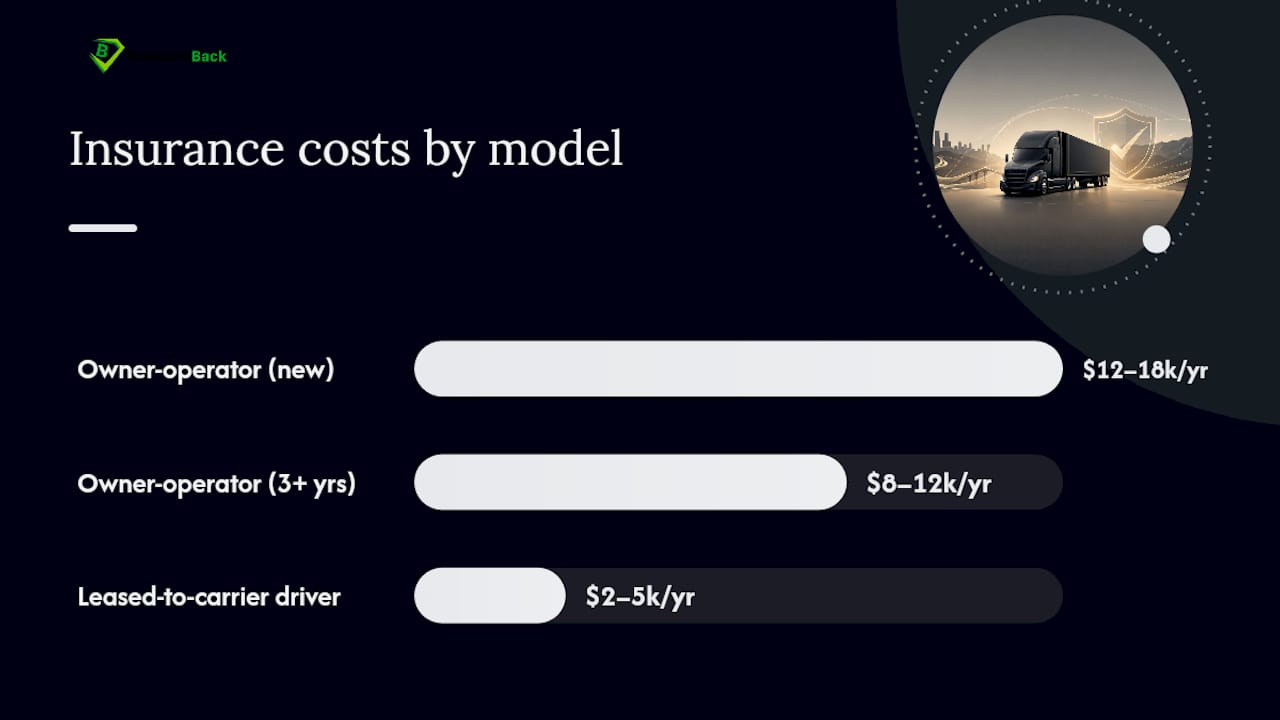
Leased-to-carrier drivers carry a lighter insurance burden because the carrier’s policy handles primary liability while the truck is dispatched. Leased drivers typically pay out of pocket for physical damage, bobtail/non-trucking liability, and sometimes occupational accident coverage, with costs varying by truck value and lease terms but generally in the lower thousands of dollars annually. Some carriers deduct a flat weekly insurance fee directly from settlements instead of billing separately.
Small fleets benefit from spreading fixed underwriting costs across multiple units, but each additional truck still adds its own liability and physical damage line. A three-truck fleet with clean records often sees a lower per-unit cost than a single owner-operator, since insurers reward volume and view fleets with documented safety programs as lower risk.
New authority carries one more upfront cost that catches people off guard: most insurers require a deposit of two to three months’ premium at the time you bind coverage. Budget for that separately from your monthly operating cash.
- Owner-operator with own authority (new): $12,000–$18,000/year
- Owner-operator with own authority (3+ years, clean record): $8,000–$12,000/year
- Leased driver, out-of-pocket costs: $2,000–$5,000/year
- Deposit due at bind: 2–3 months of annual premium
What Drives Semi Truck Insurance Rates by Coverage Type and Vehicle Class
Your total premium is really a stack of separate policies bundled together, and each one prices differently based on what it protects. Understanding the pieces helps you spot where your money is actually going.
Primary liability covers bodily injury and property damage you cause to others. This is the coverage FMCSA mandates and the one that eats the largest share of your premium, since it carries the highest payout exposure. Physical damage covers your own truck and trailer against collision, fire, theft, and weather. A reliable industry rule of thumb prices physical damage at 3% to 6% of your truck’s stated value annually, so a $120,000 tractor runs roughly $3,600 to $7,200 a year in physical damage premium alone. Cargo insurance protects the freight you’re hauling and usually runs a smaller flat rate tied to commodity type and declared value. Bobtail and non-trucking liability cover the truck when it’s not under dispatch, which matters most for leased operators. Pollution and HAZMAT liability apply when you haul regulated substances and typically carry a meaningful surcharge given the cleanup exposure involved.
Commercial truck insurance averages $421 per month for $1 million in liability coverage, with monthly ranges by truck type spanning roughly $388 to $1,240.
Vehicle class shifts that baseline considerably:
- Box truck (non-hazmat, local): $400–$700/month
- Dump truck: $500–$900/month
- Flatbed: $600–$1,100/month
- Dry van semi: $700–$1,300/month
- Tanker (non-hazmat liquid): $900–$1,600/month
- HAZMAT tanker or bulk carrier: $1,200–$2,000+/month
Flatbed and tanker operations run higher because of load-securement and spill exposure, while HAZMAT variants stack pollution liability on top of everything else.
The Underwriting Factors That Move Your Premium the Most
Underwriters price your policy using a handful of variables, and some matter far more than others. Knowing the hierarchy tells you where to spend your energy.
- Authority age. New operating authority triggers a surcharge of roughly 30% to 60% above what an experienced carrier pays for identical coverage, since insurers have no claims history to price against.
- Driving record and MVR. A single serious violation, like reckless driving or a DUI, can push premiums up sharply or eliminate standard-market options entirely, forcing you into a surplus lines carrier at a steeper rate.
- Operating radius and annual mileage. Long-haul, multi-state operations carry more exposure than local or regional routes running under 200 miles from base.
- Cargo class. High-value freight, refrigerated goods, and HAZMAT loads all carry rate add-ons tied to claim severity, not just frequency.
- Truck value and garaging location. A newer, higher-value tractor costs more to insure for physical damage, and where you park it overnight (urban lot versus rural yard) factors into theft and vandalism pricing.
- Loss runs and deductible choice. A documented multi-year clean loss history is one of the strongest levers you have, and choosing a higher deductible on physical damage lowers your premium in exchange for more out-of-pocket exposure on a claim.
Pro Tip: Ask every insurer you quote with for their specific new-authority surcharge percentage. It varies more between carriers than almost any other line item, and a 20-point spread on that one factor alone can be worth thousands over a year.
How Your State and Garaging Location Change What You Pay
Where you park your truck at night matters almost as much as what you haul. Insurers price geographic risk based on traffic density, theft rates, litigation trends, and weather exposure, and the spread between states can be dramatic.
Higher-cost states typically include California, Florida, New York, New Jersey, and Louisiana, where dense traffic, higher litigation payouts, and severe weather (hurricanes, flooding) push premiums up. Lower-cost regions cluster in the Plains and Midwest, where rural mileage, lower population density, and a less litigious legal climate keep base rates down. Garaging in a dense urban area can add 15% to 25% to your physical damage and liability premiums compared with the same truck garaged in a rural yard, even within the same state.
- Higher-cost states: California, Florida, New York, New Jersey, Louisiana
- Lower-cost states: much of the Midwest and Plains region (Kansas, Nebraska, Iowa, the Dakotas)
- Urban garaging uplift: 15%–25% above rural garaging for comparable coverage
- Check your state’s Department of Insurance site and FMCSA’s insurance filing requirements for state-specific filing rules
If you’re weighing where to base a new authority or relocate a yard, running quotes for both addresses before you commit can reveal a meaningful gap. Diamondbackins covers rate variation by state in more detail if you want a deeper state-by-state comparison.
Practical Ways to Lower Your Commercial Truck Insurance Cost
You have more control over your premium than most operators realize. The tactics that actually move the needle fall into five categories.
Telematics and driver coaching consistently rank as the most effective tools fleets deploy to reduce premiums, since they give underwriters hard data on braking behavior, speed, and hours-of-service compliance instead of relying on your word. Present telematics data proactively at renewal rather than waiting for the underwriter to ask.
Clean loss runs compound over time. A carrier with three consecutive claim-free years frequently moves from a restrictive market to a preferred one, and that shift in market tier often produces bigger savings than any single negotiating tactic.
Higher deductibles on physical damage lower your premium immediately, but only take this route if your cash reserves or lender terms can absorb a larger out-of-pocket hit after an accident.
Safety programs and hiring standards, including documented driver training and a written safety policy, signal lower risk to underwriters and often qualify you for program-specific discounts.
Shop your renewal every year, not just when a rate hike arrives. Rates shift constantly across the market, and a quote-comparison platform lets you check multiple carriers at once instead of calling brokers one by one.
- Install telematics/dashcams and share data with underwriters
- Maintain 3+ years of clean loss runs
- Raise deductibles where your cash position allows
- Build a documented safety and hiring program
- Re-shop rates annually, even mid-contract
Pro Tip: Diamondbackins’ risk management resources walk through how to build a safety program that underwriters actually reward at renewal, not just one that looks good on paper.
How to Estimate Your Own Trucking Insurance Cost: Three Scenarios
Real numbers land better than averages. Here’s how three different operators would likely price out, along with the formula to turn your annual premium into a per-mile cost you can build into your rate confirmations.
- New authority, dry van semi, $120,000 tractor. Liability ($1M): roughly $9,500/year. Physical damage (4% of value): $4,800/year. Cargo and bobtail combined: $1,700/year. Total: about $16,000/year, or $1,333/month, consistent with the $12,000–$18,000 range new operators typically see.
- Three-year experienced operator, same truck. Liability drops to roughly $6,500/year with a clean loss run. Physical damage stays similar at $4,600/year. Cargo and bobtail: $1,400/year. Total: about $10,500/year, or $875/month.
- Leased-to-carrier driver. Carrier handles primary liability. Driver pays physical damage ($4,200/year) and non-trucking liability ($900/year). Total out-of-pocket: about $5,100/year, or $425/month.
To convert any of these into cost-per-mile, divide your annual premium by expected annual miles. A $16,000 policy on a truck running 100,000 miles a year adds $0.16 per mile to your breakeven rate, squarely within the $0.12 to $0.18 per mile that insurance typically contributes as your second-largest fixed cost after fuel. Before requesting quotes, gather your truck’s stated value, three years of loss runs if available, projected annual mileage, and your primary commodity, since Diamondbackins’ owner-operator budgeting guide walks through exactly what underwriters ask for.
FMCSA Minimums and What Brokers Actually Require
Federal law sets your legal floor, but the freight market often sets a higher practical one. Under 49 CFR §387, FMCSA requires interstate carriers to hold $750,000 in combined single-limit liability for general freight, $1 million for non-bulk HAZMAT, and up to $5 million for certain bulk HAZMAT commodities. Carriers must also file an MCS-90 endorsement, which guarantees payment to injured third parties even if your policy has gaps or exclusions.
Here’s what catches new operators off guard: most brokers and shippers won’t tender freight to you at the $750,000 floor. They contractually require $1 million in liability regardless of what FMCSA mandates, because it’s become the de facto industry standard for broker risk management. The good news is that the cost difference between $750,000 and $1 million in coverage is usually modest, often just a few hundred dollars a year, so there’s little financial reason to carry the bare minimum and lock yourself out of broker relationships. Diamondbackins breaks down the full motor carrier insurance requirements if you’re building a compliance checklist from scratch.
Why Your Credit Score Affects Your Insurance Premium
Insurers pull your business credit and, for many owner-operators, your personal credit history as part of underwriting. A stronger credit profile signals financial stability, and insurers use that as a proxy for how likely you are to maintain coverage without lapses, pay premiums on schedule, and run a well-managed operation overall.
Operators with weak or thin credit files often get quoted higher rates or find themselves pushed into non-standard or surplus lines markets, where pricing runs noticeably higher than the standard market. This hits new authority holders especially hard, since they’re already facing a new-authority surcharge and now stack a credit-based rate increase on top of it.
The fix isn’t glamorous but it works: pay business obligations on time, keep credit utilization low on any business lines of credit, and correct errors on your credit report before you start shopping quotes. If you’re financing a truck purchase alongside your insurance application, timing matters too. Applying for insurance shortly after a major financing inquiry can temporarily dent your score right when underwriters are looking at it. Spacing out major credit applications by a few months, where your business timeline allows it, keeps your file cleaner when quotes go out. For operators who know their credit needs work, being upfront about it during the quote process and highlighting other strengths, like clean MVRs or telematics data, can help underwriters weigh the full picture instead of leaning entirely on the credit number.
Discounts You Might Be Missing Beyond Telematics
Telematics and safety programs get most of the attention, but several other discount categories can shave real money off your bill if you know to ask.
Bundled policies are the most overlooked. Carrying your liability, physical damage, cargo, and general liability with a single insurer instead of splitting them across carriers often triggers a package discount, since the insurer is capturing more of your total premium and has an incentive to keep you as a full-account client.
Multi-truck discounts kick in once you add a second or third unit to your policy. Insurers price per-unit administrative costs lower across a fleet than they do for a standalone policy, so even a small two-truck operation can see a noticeably better per-unit rate than a single-truck operator with identical driving records.
Paid-in-full discounts reward operators who pay their annual premium upfront instead of financing it monthly through a premium finance agreement, since the insurer avoids the risk and administrative cost of an installment plan.
Association and membership discounts exist through some trucking associations and owner-operator groups, which negotiate group rates with specific carriers.
Experience and tenure discounts apply once you clear certain milestones, typically one, three, and five years of continuous operating authority with no lapses in coverage. Ask every insurer you quote which of these apply, since they’re rarely advertised upfront and often require you to specifically request them.
How a Single Claim Can Follow You for Years
Your loss run is the single most influential document in your renewal file, and one bad claim year can outweigh several clean ones in how underwriters price you going forward. Most insurers pull three to five years of loss history, so a serious at-fault accident doesn’t just cost you at this renewal. It shadows your pricing for several renewal cycles afterward.
The size and frequency of claims both matter, but they matter differently. A single large claim, like a multi-vehicle accident with injury payouts, can push you into a non-standard market immediately, sometimes regardless of how clean the rest of your history looks. Frequent smaller claims, on the other hand, signal a pattern to underwriters, which is often viewed as worse than one isolated large loss, because it suggests an ongoing operational or driver-behavior issue rather than a one-time event.
The practical response is to manage claims actively rather than just reporting them and moving on. Contest claims that aren’t clearly your fault, document near-misses and corrective actions your operation takes after any incident, and request your loss runs directly from your current insurer every year, since errors and outdated entries do occur and can be corrected before they cost you at renewal. If you’re coming off a claim year, be upfront about it when requesting quotes and explain what changed operationally as a result. Underwriters respond better to a documented corrective action plan than to a loss run they discover on their own with no context attached.
What to Expect When You Request Trucking Insurance Quotes
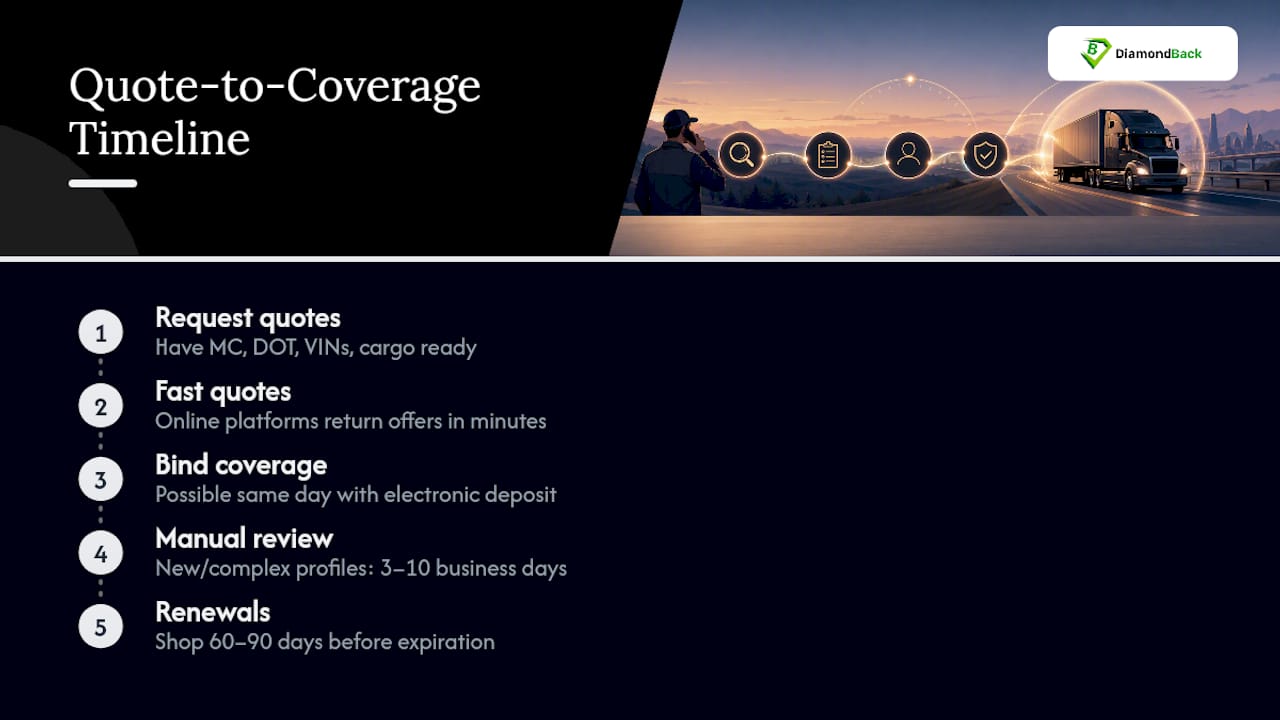
The timeline from first quote request to active coverage typically runs anywhere from a few hours to about two weeks, depending heavily on how prepared you are and how established your operation is.
For an experienced operator with clean documentation, an online quote comparison platform can return multiple carrier offers within minutes, since the underwriting algorithms process standard risk profiles almost instantly. Binding coverage after selecting a quote can happen the same day, particularly if you’re paying the deposit electronically and have your MC number, DOT number, and vehicle information ready to go.
New authority holders and operators with more complex risk profiles (HAZMAT hauling, recent claims, or credit issues) typically face a longer runway, often three to ten business days, because these applications frequently require manual underwriting review rather than automated processing. Have your loss runs (or a letter of experience if you’re new to authority), MVRs for every driver, vehicle VINs and stated values, and your intended cargo types ready before you start requesting quotes. Missing documentation is the single biggest cause of quote delays, since underwriters simply can’t finalize pricing without it.
Once you’re insured, build renewal shopping into your calendar sixty to ninety days ahead of your policy expiration date rather than waiting for the renewal notice to arrive. That window gives you enough time to gather updated loss runs and compare multiple offers without the pressure of a looming lapse in coverage.
Fees and Surcharges That Show Up Beyond the Base Premium
The quoted premium is rarely the entire bill. Several additional line items commonly appear on your invoice or financing agreement, and knowing about them ahead of time keeps your budget accurate.
Policy fees are flat administrative charges insurers add at issuance, typically ranging from $25 to $150 depending on the carrier. Filing fees apply if your insurer needs to submit an MCS-90 or state-specific filing on your behalf, usually a modest one-time charge. Installment or financing fees appear if you’re paying your premium monthly through a premium finance company rather than in full, and these can add several percentage points in effective interest over the policy term. Endorsement fees apply any time you make a mid-term change, like adding a truck, changing a driver, or adjusting coverage limits.
Non-payment reinstatement fees kick in if a payment is missed and the policy lapses before being reinstated, and these tend to be steeper than most operators expect. State-specific taxes and surcharges, including surplus lines taxes if you’re placed in the non-standard market, can add a noticeable percentage on top of your base premium. Ask for an itemized breakdown before you bind any policy, not just the headline premium number, so you can compare offers on a true total-cost basis rather than the number that looks best on the surface.
Why Diamondback Insurance Focuses on Speed and Transparency
Shopping multiple carriers used to mean days of phone calls and repeated paperwork. Diamondback Insurance built its platform around instant, tailored quotes and multi-carrier comparison specifically because fleets need to move fast when preparing loss runs, MVRs, and coverage documents for a renewal deadline. Getting real numbers quickly, not estimates, is what actually helps you plan.
— Vladimir
Get an Instant Trucking Insurance Quote and Compare Your Options
Diamondbackins is the direct alternative to calling broker after broker for quotes that take days to come back. The platform pulls tailored offers from multiple top insurers at once, so you can compare liability, physical damage, and cargo pricing side by side in minutes instead of juggling separate phone calls and email threads.
Before you request quotes, pull together your loss runs from the past three years (or a letter of experience if you’re new to authority), your drivers’ MVRs, and your truck’s VIN and stated value. Decide whether you want to carry the FMCSA floor or the broker-standard $1 million liability limit, since that decision shapes every quote you receive. Once you have those pieces ready, you can get an instant online quote and see real carrier pricing for your specific truck, cargo, and operating history without waiting on a callback.
Where to Verify These Numbers Yourself
- FMCSA insurance filing requirements for federal minimums and MCS-90 rules
- ATRI’s Operational Costs of Trucking report for state-level cost benchmarks
- Industry rate analyses from MoneyGeek and FreightWaves for truck-type and coverage-specific pricing ranges
This article is general information, not a substitute for advice from a qualified financial advisor. Consult a qualified financial professional about your own circumstances before acting on anything here.
Sources
- Average Commercial Truck Insurance Cost (2026 Rates)
- Commercial Truck Insurance Cost: Complete Guide – FreightWaves Checkpoint
- How Much Is Semi Truck Insurance? Real Costs by Coverage (2026)
- FMCSA — Insurance filing requirements