

For standard, predictable coverage, buying online usually wins on speed and price transparency. For complex, high-value, or specialty risks, an independent agent or broker earns their commission through market access and claims advocacy. The National Association of Insurance Commissioners recommends verifying carrier licensing and financial strength either way, and platforms like DiamondBack Insurance now blend both approaches into one workflow.
TL;DR:
- Online insurance purchasing offers quick quotes and slight discounts, but generally covers only standard risks from limited carriers without advocacy.
- Brokers and agents provide market access to specialty and surplus lines, advocate for claims, and bundle policies, justifying their higher premiums in complex cases.
- For high-risk or nonstandard risks, broker access to a wider range of carriers often results in better coverage options than online forms.
- A hybrid approach—using online quotes for benchmark prices and engaging a broker for complex needs—best balances speed, price, and coverage quality.
- Claims support and ongoing service from brokers significantly outweigh initial cost differences, especially for fleet or commercial operations with complex needs.
Table of Contents
- What Do “Agent,” “Broker,” and “Buying Online” Actually Mean?
- What You Gain (and Lose) Buying Insurance Online
- Why Agents and Brokers Still Earn Their Commission
- How to Decide: A Step-by-Step Checklist
- Does Buying Online Actually Save You Money?
- What Happens After You Buy: Claims and Ongoing Service
- How DiamondBack Insurance Bridges the Gap
- Is Buying Insurance Online Safe? Security and Privacy Basics
- Can You Customize Coverage the Same Way Online as With a Broker?
- My Take: Stop Treating This as Either/Or
- Get an Instant Commercial Truck Insurance Quote Right Now
- Sources
What Do “Agent,” “Broker,” and “Buying Online” Actually Mean?
A captive agent represents one insurance company and sells only that carrier’s products. An independent agent contracts with several carriers and can shop across them, though they’re still compensated by the insurer, not by you. A broker, technically, works on the buyer’s side of the transaction and owes you a duty to find suitable coverage, though in practice the terms “agent” and “broker” get used interchangeably in most states.
Buying direct online means skipping human representation entirely. You interact with a carrier’s own quoting system, or an aggregator that pulls quotes from a handful of partner insurers, and nobody is legally advocating for your specific situation. The NAIC’s consumer guidance is blunt about the homework this leaves on you: confirm the company is licensed in your state and check its financial stability rating before you sign anything, because no salesperson is doing that verification on your behalf.
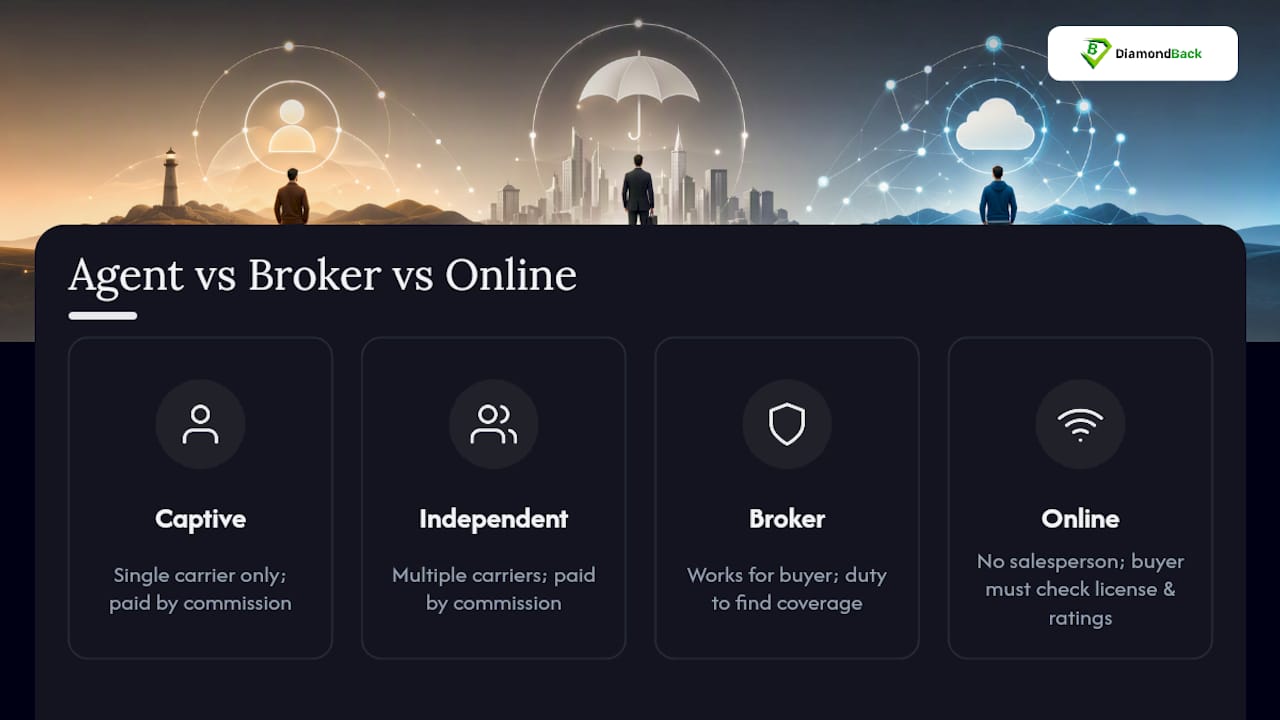
Payment structures differ too. Agents and brokers are typically paid a commission built into your premium, sometimes with an added advisory fee for complex commercial accounts. Direct online carriers fold their distribution costs into pricing algorithms instead of a person’s paycheck.
What You Gain (and Lose) Buying Insurance Online
Buying insurance online rewards you when your risk profile is unremarkable. A clean driving record, a standard single-family home, a small fleet with no prior claims, these are exactly the profiles that automated underwriting handles well, because distribution costs are lower and algorithms optimize specifically for standard risks.
The upside:
- Quotes in minutes instead of days, with no callback required
- Transparent, side-by-side pricing you control yourself
- Often a modest discount for skipping agent involvement
- Works well for auto, renters, term life, and standard commercial auto
The downside:
- You’re usually seeing quotes from one carrier or a small aggregator panel, not the whole market
- Nobody is advocating for you if a claim gets denied or underpaid
- Fine print on exclusions and endorsements is easy to miss without someone flagging it
- Nonstandard risks (prior lapses, specialty equipment, high-value cargo) often get declined or overpriced online
Online tends to win on speed. It doesn’t always win on completeness.
Why Agents and Brokers Still Earn Their Commission
Independent agents and brokers justify their cut of the premium by doing something an algorithm can’t: negotiating across markets you’d never find on your own. A broker can typically pull quotes from 10 to 30 or more carriers, including specialty and surplus lines markets closed off to consumers browsing carrier websites directly.
Where they add real value:
- Access to specialty and surplus markets for nonstandard or high-risk operations
- Bundling multiple policies (auto, general liability, workers’ comp) under one relationship for pricing leverage
- Claims advocacy when a carrier’s call center stalls or lowballs a settlement
- Hands-on help during renewals, audits, and certificate-of-insurance requests
The trade-offs:
- Slower turnaround than an instant quote page
- Limited to office hours in most independent agencies
- Commission is embedded in your premium, and some commercial accounts carry an added advisory fee
Pro Tip: Before assuming a broker costs more, ask what carriers they’re quoting. If they’re accessing surplus-lines markets you can’t reach online, their placement can beat the “discounted” direct rate even after their commission.
For a fleet operator with a prior claim or a nonstandard vehicle class, a broker’s market access can be the difference between getting coverage at all and getting declined outright.
How to Decide: A Step-by-Step Checklist
Run through this sequence before you commit to either channel:
- Rate the complexity of your risk. Standard auto, home, or renters policy? Lean online. Fleet of 15+ trucks, specialty cargo, or a business with prior losses? Lean broker.
- Check your timeline. Need coverage today to close on a deal or meet a compliance deadline? Online quoting moves faster than scheduling a call.
- Count how many policies you’re buying. Bundling auto, general liability, and workers’ comp under one broker relationship often produces better pricing than buying each separately online.
- Look at your claims and decline history. A prior lapse, DUI, or denied claim usually means you need someone who can shop specialty markets, not a standard online form.
- Get two or three online quotes anyway. Even if you ultimately use a broker, quotes give you a real benchmark for what “fair” looks like.
Before committing to a broker, ask these questions directly:
- Which carriers did you actually quote, and how many did you check?
- Do you charge an advisory fee on top of the commission?
- Who handles my claim if something goes wrong, you or the carrier?
- Can you show me a comparable account you’ve placed or a reference I can call?
If the answers are vague, that’s a signal to keep shopping. The strongest approach for most buyers, according to industry comparisons of the two channels, is hybrid: collect quotes online for a price baseline, then bring a licensed broker in to validate coverage details and handle final placement on anything complex.
Does Buying Online Actually Save You Money?
Not always, and not by as much as people assume. Online processes move faster, but they don’t automatically save more money once you’re dealing with anything beyond a standard policy.
- Direct online discounts exist but tend to be small, often reflecting saved distribution cost rather than a meaningfully cheaper policy.
- Broker commissions on property and casualty lines typically run in the 10 to 15% range, embedded in your premium either way.
- Independent agents still placed 39.5% of U.S. personal lines premium in 2025, and write the majority of commercial lines, largely because bundling and specialty placement can offset the commission cost entirely.
If you’re buying a single standard policy, online pricing is usually competitive. If you’re bundling several commercial policies, a broker’s market access can beat the direct-buy total.
What Happens After You Buy: Claims and Ongoing Service
The real test of your channel choice comes at claim time, not at purchase. The single biggest advantage agents and brokers offer is ongoing service and advocacy when something goes wrong, especially compared to navigating a mass-market carrier’s automated call center alone.
Brokers also handle the paperwork that piles up after binding: renewals, commercial policy audits, and certificate-of-insurance requests that come up constantly in trucking and fleet operations. A broker’s involvement in fleet claims and audits can shave days off a process that otherwise sits in a carrier’s queue. Partner resources like this guide to windshield claim navigation show how much easier claims move with someone who knows the process advocating for you. Hybrid platforms reduce this risk by pairing instant quotes with on-demand access to a licensed professional when a claim gets complicated.
How DiamondBack Insurance Bridges the Gap
DiamondBack Insurance was built around a simple observation: trucking and fleet operators shouldn’t have to choose between speed and market breadth. The platform delivers instant, tailored quotes by aggregating multiple top insurers at once, so a fleet manager gets the online experience without settling for a single carrier’s narrow underwriting box.
That model matters most for the buyers who get squeezed hardest by the traditional either/or choice: small trucking businesses that don’t have time to wait on broker callbacks, and fleet managers juggling multiple vehicle classes who still need carrier-by-carrier flexibility. Aggregating quotes across insurers gives you the comparison power a broker provides, delivered at online speed.
Is Buying Insurance Online Safe? Security and Privacy Basics
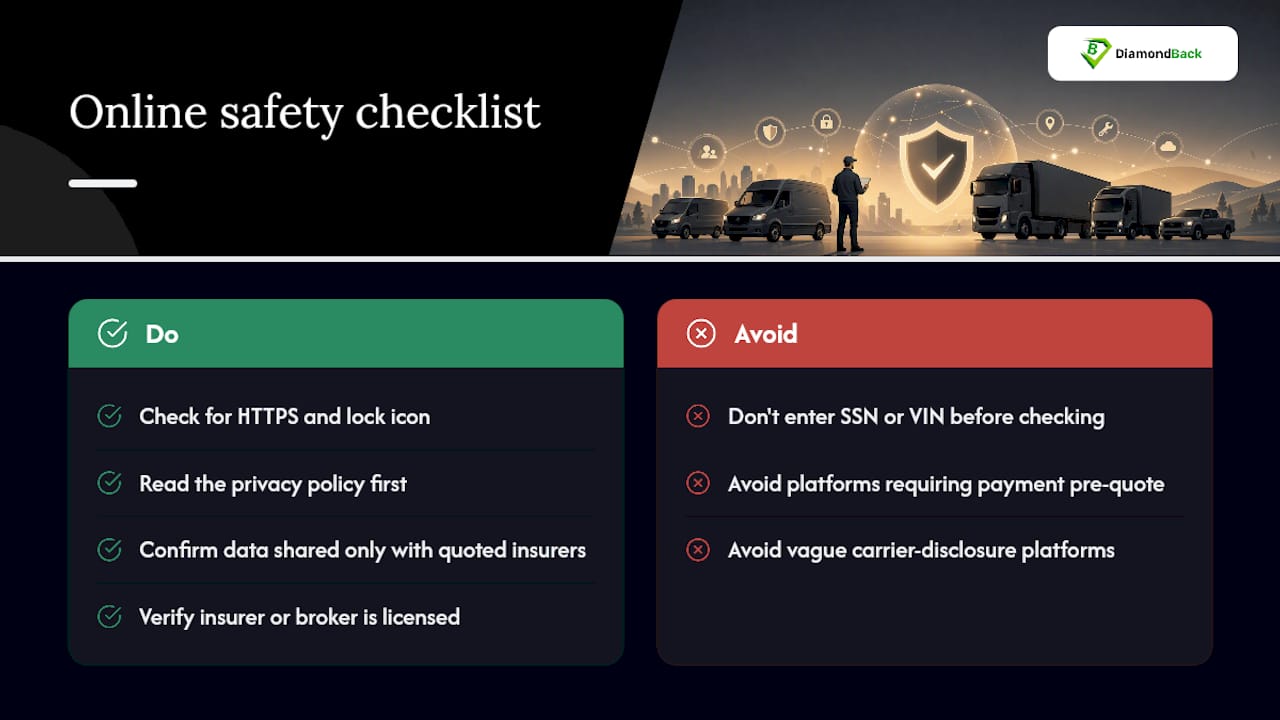
Before you enter a Social Security number or a fleet’s VIN list into any online quoting form, confirm the platform runs on an encrypted connection (look for “https” and a lock icon in your browser) and states clearly how your data gets used. Legitimate carriers and comparison platforms only share your information with insurers you’re actually being quoted by, not with unrelated third-party marketers.
Read the privacy policy before submitting anything beyond basic contact details. A platform that’s vague about which carriers see your application, or that requires full payment information before showing you a quote, is a red flag. Reputable online insurers separate quoting (which needs minimal personal data) from binding a policy (which requires full underwriting detail), and they’ll tell you which stage you’re in.
The same NAIC guidance that applies to agent selection applies here: verify the company itself is licensed and financially stable before you hand over sensitive fleet or business data, not just after you’ve already submitted an application. A broker relationship carries its own version of this risk, since you’re sharing the same data with a third party rather than directly with a carrier, but a licensed broker is bound by state regulatory oversight in a way an anonymous online form isn’t always transparent about.
Can You Customize Coverage the Same Way Online as With a Broker?
Online platforms have gotten better at letting you adjust deductibles, add endorsements, and toggle coverage limits in real time, and for standard policies that flexibility is often enough. Where the gap still shows up is in judgment calls, deciding whether a particular endorsement actually closes a coverage gap for your specific operation, versus just being available as a checkbox.
A broker customizes coverage through conversation. They ask about your specific cargo, your drivers’ safety records, or your equipment values, then structure a policy around answers a web form never prompts you for. That’s the difference between selecting options and getting advised on which options you actually need.
The strongest online platforms narrow this gap by aggregating carrier options broad enough to approximate broker-level customization. When a platform pulls quotes from multiple insurers with different underwriting appetites, you get closer to a tailored outcome than a single carrier’s rigid online form allows, even without a person on the phone. For straightforward risks, that’s usually enough. For a fleet with unusual equipment or a business entering a new state, a broker’s direct questions still catch details an interface can’t anticipate.
My Take: Stop Treating This as Either/Or
The online-versus-broker debate gets framed as a loyalty test, pick a side and defend it, when the smarter move is using both at different stages. Get instant quotes online first. That gives you a real price benchmark and shows you what standard coverage costs before anyone’s had a chance to upsell you. Then, for anything with real complexity, a fleet with mixed cargo types, a business with a prior claim, a coverage question you can’t answer confidently yourself, bring in a licensed professional to validate what you found and fill the gaps an algorithm can’t see.
What gets underestimated is how much the hybrid approach protects you from the worst outcome in either channel: overpaying a broker for a standard risk they didn’t need to place manually, or underinsuring a complex risk because an online form never asked the right question.
— Vladimir
Get an Instant Commercial Truck Insurance Quote Right Now
If you run a fleet or a trucking operation and you’re tired of waiting on callbacks to get a straight answer on pricing, DiamondBack Insurance gets you tailored quotes in minutes by checking multiple top carriers at once instead of one narrow underwriting box.
Getting a quote takes less prep than most people expect. Have your DOT number, fleet size, vehicle types, and driver safety records ready, and the platform matches that information against carriers actively competing for your risk profile rather than routing you to a single insurer’s rigid form. It works whether you’re insuring one truck or a growing fleet, and you can compare instant quotes for your trucking fleet without committing to anything until the numbers actually make sense. If your operation has grown or your risk profile has changed, this is the fastest way to find out what you should actually be paying, and to start your quote today.
This article is general information, not a substitute for advice from a qualified financial advisor. Consult a qualified financial professional about your own circumstances before acting on anything here.
Sources
- How to choose an insurance agent — NAIC consumer insight
- Should you buy insurance online or through an agent? — Farm Bureau Financial Services
- Insurance agent vs buying online — Verified Agent