
Most states never make you buy boat insurance. Arkansas, Utah, and Hawaii do, in narrow situations tied to your engine size, mooring location, or lack of another financial safeguard. But even in the 47 states with no mandate, your lender, marina, or slip contract will likely demand proof of coverage before you ever leave the dock, often at limits well above the state minimums you’d otherwise face.
TL;DR:
- Most states do not legally require boat insurance, but lenders, marinas, and slip contracts often impose coverage mandates exceeding minimum legal limits.
- Only Arkansas, Utah, and Hawaii have explicit state laws requiring liability coverage, with thresholds based on engine size and mooring location.
- Common boat insurance coverages include liability, hull, medical payments, pollution, wreck removal, and optional endorsements for higher protection.
- Lenders and marinas typically enforce higher coverage minimums, with lienholders often demanding policies of $300,000 to $1 million liability limits.
- Comparing multiple quotes using a dedicated platform like Diamondback Insurance helps owners meet contractual requirements quickly and accurately.
Table of Contents
- Boat Insurance Requirements by State: What the Law Actually Says
- What Boat Insurance Coverage Actually Protects
- When Lenders and Marinas Make Insurance Mandatory
- Choosing the Right Limits and Endorsements
- How Diamondback Insurance Helps You Get Compliant, Fast
- Why the “Check a Box” Approach to Boat Insurance Fails Owners
- Get Instant Boat Insurance Quotes with Diamondback Insurance
- Sources
Boat Insurance Requirements by State: What the Law Actually Says
Only three states put a real insurance obligation on recreational boat owners, and each one works differently.
Arkansas requires liability coverage for motorboats over 50 horsepower and for personal watercraft, with a minimum of $50,000 per occurrence under Arkansas Code 27-101-207. Cross that horsepower threshold and you’re legally required to carry coverage, full stop.
Utah takes a different approach. Utah Code 73-18c-102 calls for an “owner’s or operator’s security,” which can be satisfied by an insurance policy, a surety bond, or a cash deposit at statutory minimums. Insurance is the simplest of the three options for most owners, but it’s not the only path to compliance.
Hawaii requires liability coverage for any vessel moored in a state-run harbor, and the limits run high. The Hawaii Department of Land and Natural Resources (DOBOR) typically requires the state to be named as an additional insured, plus coverage extending to pollution and wreck removal, not just injury or property damage.
Everywhere else, the law is silent on insurance itself. The U.S. Coast Guard regulates registration, safety equipment, and operating conduct on the water, but it has no authority over insurance requirements. That’s purely a state and contract matter.
Here’s how to confirm where you stand before you assume anything:
- Look up your state’s boating statute directly, or call your state’s boating or wildlife agency.
- Ask specifically about horsepower thresholds, PWC rules, and harbor mooring requirements, since general boating FAQs often skip these details.
- If you dock in a state-managed harbor, contact that harbor authority separately. Hawaii’s DOBOR rules, for instance, apply on top of any general state law.
- Keep a copy of your state’s minimum requirement language with your boat documents, since enforcement officers may ask.
What Boat Insurance Coverage Actually Protects
A boat policy is built from several distinct coverages, and most owners only think hard about one of them until something goes wrong.
Liability coverage pays for injuries or property damage you cause to someone else, including pollution cleanup if your boat leaks fuel or oil into the water. This is the coverage state mandates and marina contracts almost always target, because it protects third parties, not you.
Hull coverage, also called physical damage coverage, pays to repair or replace your own boat after a collision or covered loss. You’ll choose between agreed value, a fixed payout set when you buy the policy, and actual cash value, which factors in depreciation and typically pays less on an older boat.
Beyond those two pillars, standard policies commonly include:
- Medical payments coverage for injuries to you or your passengers, regardless of fault.
- Uninsured or underinsured boater coverage, protecting you if another operator causes damage but carries no coverage of their own.
- Towing and on-water assistance, similar to roadside assistance for your car.
- Wreck removal and pollution liability, which can apply even to a modest fishing boat, since cleanup costs run high fast.
- Personal effects and trailer coverage, closing a gap that homeowners and auto policies rarely fill, since homeowners insurance often excludes on-water use entirely.
Pro Tip: Check your homeowners policy before assuming it covers your boat. Most cap physical damage on stored boats at $1,000 to $1,500 and exclude on-water liability once you exceed a modest engine size.
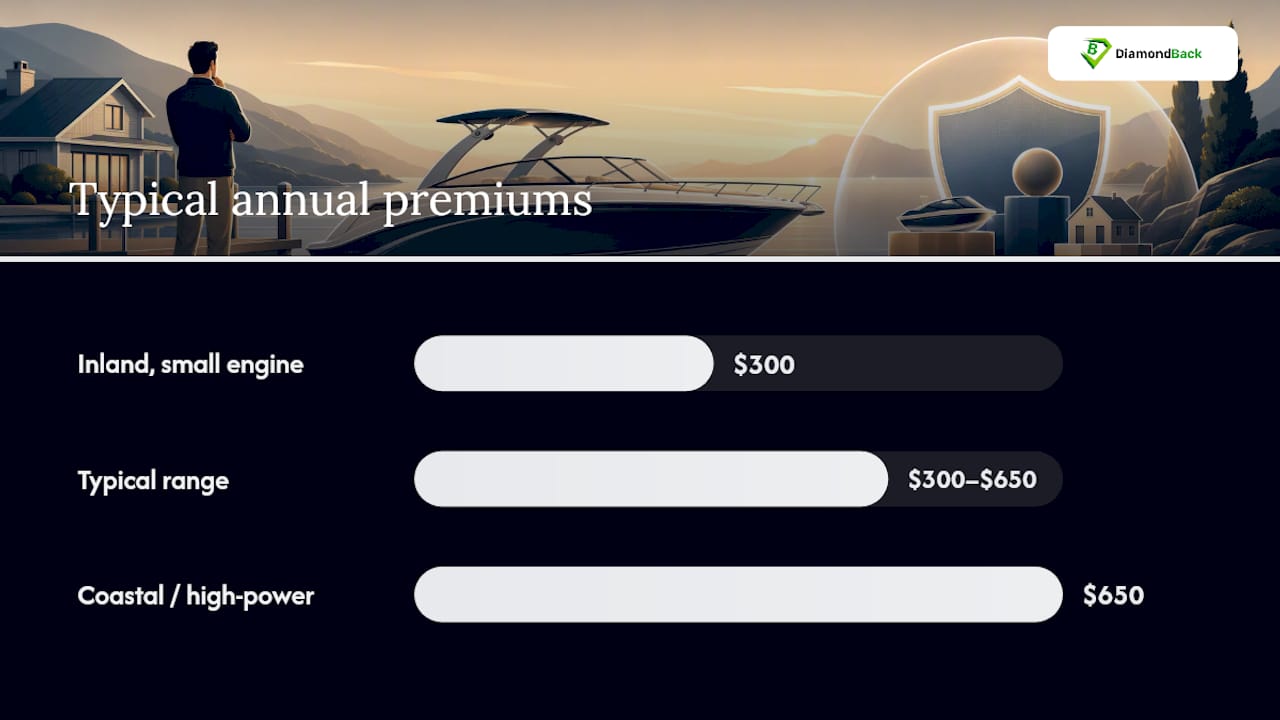
Annual premiums for recreational boats typically run between $300 and $650, with hurricane-exposed coastal states and higher-horsepower boats pushing costs toward the top of that range. Inland lake boaters with smaller engines tend to land near the bottom.
When Lenders and Marinas Make Insurance Mandatory
State law might not require coverage, but the people you do business with usually will.
If you financed your boat, your lender almost certainly requires continuous insurance for the life of the loan, with the lender named as loss payee and coverage set at agreed or full market value. Letting coverage lapse can trigger a default clause on your loan, even if your state has no insurance law at all.
Marinas and yacht clubs work the same way through slip agreements. Typical marina requirements start around $300,000 in liability coverage, and some upscale facilities ask for $500,000 to $1,000,000, plus a certificate naming the marina as additional insured.
Here’s how to get ahead of it:
- Read your loan documents and slip agreement before you assume you’re covered.
- Call your lender or marina office and ask for their exact minimum liability figure in writing.
- Request a certificate of insurance from your carrier that names the correct party as lienholder or additional insured.
- Check your trailer coverage separately. Auto policies frequently exclude boat trailers once detached, leaving a gap your boat policy needs to close.
Choosing the Right Limits and Endorsements
Start with liability. A $300,000 baseline covers most recreational situations, but owners with larger boats, higher horsepower engines, or frequent guests aboard should consider pushing toward $500,000 or more.
From there, match endorsements to your actual exposure:
- Add pollution and environmental liability if you boat anywhere near sensitive waterways. Cleanup costs can exceed the value of the boat itself.
- Add wreck removal coverage, since many marinas and waterway authorities can legally compel removal at the owner’s expense.
- Choose agreed value over actual cash value if your boat is newer or has upgraded equipment you’d want fully replaced.
- If you plan to charter, rent through a peer-to-peer platform, or carry passengers for hire, know that recreational policies routinely exclude commercial use, and you’ll need a dedicated charter or commercial marine policy instead.
Rating factors that move your premium include boat value, engine horsepower, whether you’re coastal or inland, and any completed boating safety course.
| What you’re deciding | Rule of thumb |
|---|---|
| Liability limit | $300,000 baseline; higher for larger or higher horsepower boats |
| Hull valuation | Agreed value for newer boats; actual cash value for older, lower-value boats |
| Pollution/wreck removal | Add if boating near marinas, reefs, or environmentally sensitive water |
| Commercial use | Requires a separate charter policy, not a recreational endorsement |
Before requesting quotes, gather your boat’s hull identification number (HIN), current value, mooring or storage location, and any lender information. Having these ready is the fastest way to get an accurate number instead of a rough estimate.
How Diamondback Insurance Helps You Get Compliant, Fast
Confirming what your state, lender, or marina requires is only half the job. Getting a policy that actually matches those numbers is the other half, and that’s where a comparison platform earns its keep.
Diamondbackins built its state-by-state boat insurance requirements guide specifically so owners don’t have to dig through statute language on their own. Pair that with the Boat Insurance Calculator, which estimates the coverage limits your boat’s value, horsepower, and location likely call for before you request a single quote.
Since most lender and marina disputes come down to timing, an instant-quote workflow matters. You can:
- Compare multiple carriers side by side instead of calling each one separately.
- Generate a certificate of insurance quickly enough to meet marina slip deadlines.
- Adjust limits on the spot if a lender’s minimum turns out higher than expected.
Why the “Check a Box” Approach to Boat Insurance Fails Owners
The conventional advice on boat insurance treats it like a legal compliance checklist: find out if your state requires it, buy the minimum, move on. That framing misses the point entirely. Only three states have a statute on the books, yet the overwhelming majority of financed or slip-docked boats carry coverage anyway, because a lender or marina office made it a condition of the deal.
That gap between legal minimums and practical reality is where most owners get caught off guard. Someone who checks Arkansas Code 27-101-207, confirms their engine is under 50 horsepower, and concludes they’re in the clear might still default on their boat loan the moment coverage lapses, because their lender’s contract, not the state, set the real requirement.
The smarter starting point isn’t “what does my state require?” It’s “who can actually enforce a requirement against me?” That usually means your lender first, your marina second, and your state’s statute a distant third. Pollution and wreck removal endorsements deserve more attention than they get, too. Cleanup liability can be enforced against a small boat owner just as easily as a large one, and it’s rarely cheap.
— Vladimir
Get Instant Boat Insurance Quotes with Diamondback Insurance
Once you know your state’s rules and your lender’s or marina’s minimums, the fastest path forward is comparing real quotes, not guessing at what a policy might cost. Diamondbackins pulls quotes from multiple carriers at once, so you can match coverage limits to what your lienholder or marina actually requires instead of settling for a generic policy that falls short.
Before you start, have your boat’s HIN, current value, mooring location, and any financing details on hand. That’s everything needed to get an accurate quote rather than a rough range. Run your numbers through the Boat Insurance Calculator, compare your recommended liability limit against what your marina or lender is asking for, and request a certificate of insurance that names the correct party as lienholder or additional insured. If you’re weighing options for a larger vessel, the yacht insurance basics guide covers endorsements worth reviewing before you bind a policy.
This article is general information, not a substitute for advice from a qualified financial advisor. Consult a qualified financial professional about your own circumstances before acting on anything here.
Sources
- Do You Have to Have Insurance on a Boat? — LegalClarity
- Is boat insurance required? — ValuePenguin
- Boat Insurance Requirements by State — BoatRegistrationUSA