

The MCS-90 endorsement is a federally required guarantee that obligates an insurer to pay final judgments to the public when a motor carrier’s primary policy would not. The insurer can later recover that amount from the carrier. It attaches to a motor carrier’s liability policy under 49 CFR § 387.15, and the Federal Motor Carrier Safety Administration requires it as proof of financial responsibility.
Three things follow from that one sentence:
- The endorsement protects injured members of the public, not the carrier’s balance sheet.
- It only pays out when the underlying policy has a gap, denial, or exclusion that would otherwise leave a judgment unpaid.
- The carrier usually owes the insurer back every dollar paid under an MCS-90 claim.
Key Takeaways
The MCS-90 endorsement guarantees payment to accident victims when a motor carrier’s primary policy fails, but the carrier typically owes that money back to the insurer.
| Point | Details |
|---|---|
| Public protection, not carrier benefit | The endorsement pays injured third parties when the primary policy denies or lacks coverage. |
| Reimbursement follows payout | Insurers generally retain the right to recover MCS-90 payments from the carrier. |
| Federal minimums vary by cargo | Federal minimum limits vary by cargo type, with higher minimums set for certain hazardous materials. |
| Filing responsibility sits with insurers | Insurers file the MCS-90 and BMC-91X/BMC-82 forms with FMCSA, not the carrier directly. |
| Compare coverage before renewal | Diamondbackins lets carriers shop multiple insurers to match limits to actual freight exposure. |
Table of Contents
- What Is an MCS-90 Endorsement, and How Does It Differ From the Primary Policy?
- How Does an MCS-90 Claim Actually Get Triggered?
- Which Motor Carriers Are Required to Carry MCS-90?
- How Do Carriers Confirm Their MCS-90 Filing Is Current?
- What Are the Federal Minimum Limits Under MCS-90?
- What Does MCS-90 Mean for Carriers and for Accident Victims?
- What Do People Get Wrong About the MCS-90 Endorsement?
- How DiamondBack Insurance Supports MCS-90 Compliance
- The Editorial Take: What Carriers Consistently Get Wrong
- Get Coverage That Doesn’t Leave You Exposed to MCS-90 Reimbursement
- Where to Find the Official MCS-90 Forms and Legal Analysis
- Frequently Asked Questions About the MCS-90 Endorsement
- Sources
What Is an MCS-90 Endorsement, and How Does It Differ From the Primary Policy?
An endorsement is not a separate insurance policy. It’s a rider that modifies what an existing policy must do, and the MCS-90 rider does one specific job: it forces the insurer to pay a public liability judgment even if the carrier’s own policy contains language that would normally excuse the insurer from paying.
Three distinctions matter here:
- It’s a promise to the public, not a benefit to the carrier. The MCS-90 doesn’t expand what the carrier is covered for. It closes a payment gap so an injured third party isn’t left with an uncollectible judgment.
- It attaches to the insurer’s policy, not to a specific truck. FMCSA guidance confirms the endorsement covers vehicles operated under that policy, regardless of whether a particular unit was properly scheduled.
- It only applies to vehicles subject to federal financial responsibility rules. Personal-use vehicles or equipment operating outside interstate commerce fall outside its reach.
That framing matters because a lot of carriers assume MCS-90 is extra coverage they’re paying for. It’s closer to a safety net woven into the policy by federal mandate, one you hope never gets used.
How Does an MCS-90 Claim Actually Get Triggered?
Two conditions have to line up before the MCS-90 pays anything. First, the primary policy has to deny or limit coverage for the accident in question, typically because of an exclusion, a coverage dispute, or a lapse. Second, there has to be no other applicable insurance, or the available insurance falls short of the judgment amount. When both are true, the insurer steps in and pays the public directly, then turns to the carrier for reimbursement.
Legal commentary on the endorsement describes this as a surety-like obligation: the insurer functions almost like a guarantor of last resort, separate from its normal contractual duties to the carrier. Industry sources agree that the insurer typically retains a right to seek reimbursement or pursue subrogation once it pays.
Real-world triggers tend to fall into a few recurring patterns:
- A driver excluded from the policy was behind the wheel at the time of the crash.
- The vehicle involved wasn’t listed on the carrier’s schedule of covered units.
- The truck was being used outside the scope of the carrier’s operating authority, sometimes called unauthorized use.
Pro Tip: If you’re a carrier, treat every driver exclusion and every unscheduled vehicle as a live reimbursement risk. An MCS-90 payout to a plaintiff doesn’t erase your exposure. It just moves the bill from the plaintiff’s lawyer to your insurer’s subrogation department.
Which Motor Carriers Are Required to Carry MCS-90?
Federal rules require the endorsement for for-hire interstate motor carriers, along with certain passenger carriers and hazardous materials haulers operating under FMCSA authority. KRCL’s analysis notes that carriers can satisfy federal financial responsibility three ways: an MCS-90 endorsement, a surety bond, or approved self-insurance, and the endorsement is by far the most common route.
Owner-operators split into two groups that behave differently under this rule:
- Owner-operators leased to a motor carrier typically operate under that carrier’s MCS-90 and insurance program, not their own.
- Owner-operators running under their own FMCSA authority need their own MCS-90 filing tied to their own policy.
Edge cases show up most often at the intrastate and private-carriage line. Purely intrastate operations sometimes fall under state financial responsibility rules instead of the federal MCS-90 requirement, and private carriers hauling only their own goods may face different obligations depending on cargo type and state law. If you’re unsure which bucket your operation falls into, that’s worth confirming before renewal, not after a claim.
How Do Carriers Confirm Their MCS-90 Filing Is Current?
The carrier doesn’t submit these forms directly. That responsibility sits with the insurance company, which is part of why choosing an insurer with clean regulatory habits matters as much as choosing one with a competitive premium.
When a coverage lapse happens, whether from a canceled policy, a nonrenewal, or a paperwork gap, the sequence is predictable and unforgiving:
- FMCSA flags the lapse in its records, often within days.
- Operating authority can be suspended until a new filing is submitted.
- Reinstatement may involve fees and processing delays that stack up fast if freight is already booked.
- The new insurer has to file a fresh MCS-90 and BMC form before authority is restored.
A short checklist helps here. Confirm your current insurer has an active MCS-90 on file with FMCSA. Verify your BMC-91X or BMC-82 filing matches your current USDOT number, especially since FMCSA’s 2025 consolidation to USDOT-only identification means older filings referencing a separate MC number should get updated at renewal. And check that every truck you’re dispatching is actually on your policy schedule, not just assumed to be covered. Our guide on new authority trucking insurance walks through the filing sequence in more detail for carriers just getting set up.
What Are the Federal Minimum Limits Under MCS-90?
The schedule tied to the MCS-90 sets minimums by cargo type, and the gap between categories is wide enough to change how you shop for coverage entirely.
Federal minimums: $750,000 for general freight, $1,000,000 for oil and certain other regulated substances, and $5,000,000 for specified hazardous materials, according to FMCSA’s official MCS-90 schedule.
Most brokers and shippers ask for more than the bare federal floor. A $750,000 general freight minimum sounds substantial until you’re negotiating a contract with a national retailer that requires $1 million in liability coverage as a condition of doing business. Carriers hauling anything remotely sensitive, chemicals, fuel, refrigerated pharmaceuticals, tend to carry limits well above the federal floor simply because shippers won’t sign otherwise. Our breakdown of how much insurance a trucking company needs gets into how carriers land on a number that satisfies both regulators and contract partners.
What Does MCS-90 Mean for Carriers and for Accident Victims?
For carriers, the endorsement is a double-edged tool. It keeps a catastrophic judgment from bankrupting your business outright, but it hands your insurer a reimbursement claim against you once the public is paid. That exposure is real, and it’s largely preventable.
- Keep driver rosters and vehicle schedules current with your insurer, since gaps are exactly what trigger MCS-90 payouts in the first place.
- Vet drivers thoroughly before dispatch. An excluded driver behind the wheel is one of the most common reimbursement triggers insurers pursue.
- Carry limits that match your actual exposure, not just the federal floor, so the MCS-90 rarely needs to activate at all.
For accident victims, the MCS-90 can be the difference between collecting a judgment and holding a worthless piece of paper. If a carrier’s insurer tries to deny coverage based on an exclusion or a coverage dispute, the endorsement often still requires payment to the injured party. Victims and their attorneys should confirm the carrier’s MCS-90 filing status with FMCSA early, since that filing determines whether this backstop even applies. Recovery paths and timing get complicated once litigation starts, which is why understanding policyholder rights in trucking claims early in the process tends to pay off later.
What Do People Get Wrong About the MCS-90 Endorsement?
The biggest misconception is treating the MCS-90 as bonus coverage the carrier can lean on. It isn’t. It’s a public-protection mechanism that comes with a reimbursement bill attached, and courts have consistently upheld insurers’ right to collect that reimbursement once a claim is paid.
A few more myths worth killing outright:
- It does not cover the carrier’s own employees or cargo losses. It’s limited to public liability and, in some cases, environmental restoration.
- It is not tied to a specific vehicle. Coverage follows the policy, not the truck.
- It does not apply to personal use or non-dispatch operation of a commercial vehicle.
Keep your policy schedules accurate, confirm your insurer has actually filed the MCS-90 and its companion BMC form with FMCSA, and carry limits above the federal floor whenever contracts demand it. Watch FMCSA’s public records for lapses in your own filing status. That’s the single fastest way to catch a problem before a claim forces you to.
How DiamondBack Insurance Supports MCS-90 Compliance
Confirming your MCS-90 filing status and matching your liability limits to your actual freight exposure shouldn’t require a law degree. DiamondBack Insurance built its platform to give fleet managers and owner-operators instant, comparable quotes from multiple carriers, so you can see where your current limits stand against what shippers are actually demanding.
- Compare quotes across insurers to find limits that satisfy both federal minimums and contract requirements.
- Review guides like motor carrier insurance requirements to understand filing mechanics before you’re mid-negotiation with a broker.
- Check coverage exclusions that commonly trigger MCS-90 disputes through our trucking coverage exclusions guide.
The Editorial Take: What Carriers Consistently Get Wrong
Most of what’s written about the MCS-90 online treats it as a footnote, a form to file and forget. That’s backwards. The endorsement is one of the few places in commercial trucking insurance where federal law openly admits the primary policy might fail the public, and builds a second layer of obligation specifically to cover that failure. Carriers who understand that distinction manage risk differently than carriers who don’t.
The conventional advice, “just make sure your insurer files the MCS-90,” misses the real lesson. The endorsement’s existence is a signal that policy exclusions and driver rosters matter far more than most carriers treat them. Every excluded driver, every unscheduled vehicle, every lapse in authority is a live reimbursement exposure waiting to happen, not a paperwork technicality.
If there’s one priority worth acting on first, it’s this: audit your policy schedule against your actual dispatch roster this quarter, not at renewal. The MCS-90 will do its job if something goes wrong. The real question is whether you’ll be the one paying for it afterward.

Get Coverage That Doesn’t Leave You Exposed to MCS-90 Reimbursement
A carrier that shops liability limits based on the federal floor alone is gambling that nothing ever goes wrong with a driver exclusion or an unscheduled truck. Diamondbackins gives you a faster way to close that gap: instant, side-by-side quotes from multiple insurers so you can see exactly where your current limits fall short of what shippers, brokers, and federal minimums actually require, without waiting days for a broker to call back.
Because Diamondbackins pulls quotes from several carriers at once, you can match your coverage to your real freight mix, whether that’s general dry van work at $750,000 or hazmat loads that need limits many times higher, instead of guessing at a single insurer’s rate sheet. Get an online truck insurance quote today and see what limits actually fit your operation before your next renewal puts you at risk.
Where to Find the Official MCS-90 Forms and Legal Analysis
For the endorsement itself and FMCSA’s filing instructions, see the official MCS-90 form page and the downloadable MCS-90 PDF with the full schedule of minimum limits. For legal interpretation of triggers and reimbursement rights, review KRCL’s analysis of the endorsement. For a plain-language industry definition, IRMI’s glossary entry is a solid reference point.
Frequently Asked Questions About the MCS-90 Endorsement
What is the MCS-90 endorsement in simple terms?
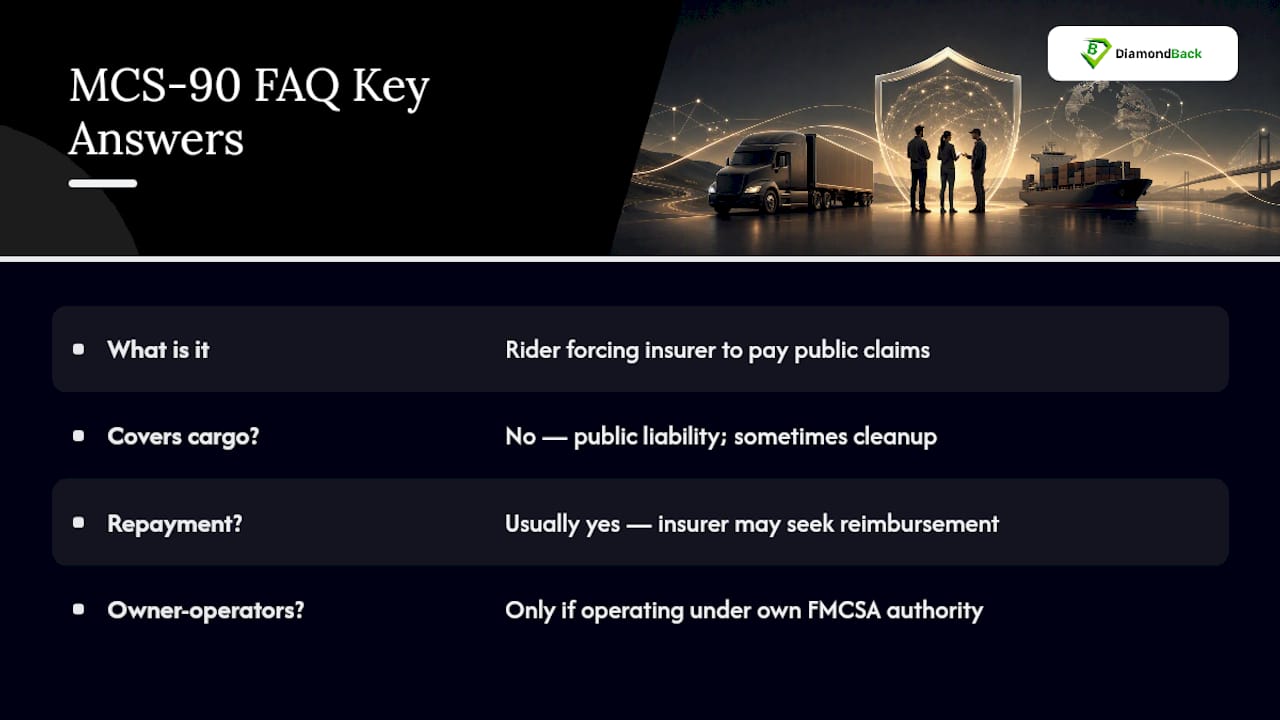
It’s a federally mandated rider on a motor carrier’s liability policy that forces the insurer to pay covered judgments to the public even when the primary policy would otherwise deny the claim.
Does the MCS-90 cover cargo damage or injuries to my own drivers?
No. It’s limited to public liability and, in some cases, environmental cleanup costs. Cargo losses and employee injuries fall outside its scope.
Who files the MCS-90 with FMCSA?
Can my insurer make me pay back an MCS-90 claim?
Usually, yes. Most insurers retain reimbursement or subrogation rights against the carrier once they’ve paid a claim under the endorsement.
Do owner-operators need their own MCS-90?
Only if they operate under their own FMCSA authority. Owner-operators leased to a carrier typically fall under that carrier’s endorsement instead.
This article is general information, not a substitute for advice from a qualified lawyer. Consult a qualified legal professional about your own circumstances before acting on anything here.
Sources
- Form MCS-90 – Endorsement for Motor Carrier Policies of Insurance for Public Liability under Sections 29 and 30 of the Motor Carrier Act of 1980 | FMCSA
- The MCS-90 Endorsement | KRCL
- MCS-90 endorsement (IRMI)
Recommended
- What Is Trucking Endorsement: Driver’s Career Guide
- Policyholder Rights in Trucking: Your 2026 Guide
- Navigating the Marine Insurance Exam What to Know with DiamondBack Insurance – Diamondback Insurance – Solutions with Instant Online Quotes
- Setting Sail with Confidence The Role of the Marine Insurance Association of Seattle – Diamondback Insurance – Solutions with Instant Online Quotes