

Most U.S. boat owners pay between $267 and $839 per year for boat insurance, which works out to roughly $22–$70 per month. That range reflects a genuinely wide spread: a modest fishing boat on a freshwater lake in Iowa sits at the low end, while a cabin cruiser kept in a Florida marina during hurricane season can push well past $1,000 annually. The single biggest drivers are where you keep your boat and what it’s worth. A $20,000 fishing boat typically runs about $300 per year, making boat insurance one of the more affordable protection decisions you’ll make as an owner. For a personalized figure, Diamondbackins lets you compare quotes from multiple carriers in minutes.
National average boat insurance cost: approximately $800 per year as of 2026, according to CostWhale’s state-by-state analysis, though most recreational owners with mid-range boats land closer to $300–$500.
Key Takeaways
Most U.S. boat owners pay $267–$839 per year for boat insurance, with location and boat value explaining the majority of premium variance across states.
| Point | Details |
|---|---|
| National annual range | Most owners pay $267–$839/year; the 2026 national average sits near $800. |
| Location impact | Coastal and hurricane-exposed states cost 50%–100% more than comparable inland states. |
| Boat value rule of thumb | Premiums typically run 1%–5% of boat value annually. A $20,000 boat costs about $300/year. |
| Top cost-reduction moves | Bundle with home/auto, pay annually, complete a safety course, and raise your deductible by 10%–20%. |
| Diamondbackins next step | Use the Diamondbackins instant-quote tool to compare multiple carriers with your specific boat details. |
Table of Contents
- How much does boat insurance cost in your state?
- What you’ll actually pay: costs by boat type, value, and age
- What factors drive your boat insurance premium?
- Coverage types: what’s required and what’s worth adding
- What information do you need to get an accurate quote?
- How to lower your boat insurance premium
- How these averages were calculated and where to get your own estimate
- When buying more coverage makes financial sense
- Get fast, comparable boat insurance quotes with Diamondbackins
- Sources
How much does boat insurance cost in your state?
Location is the single variable that can double or triple your premium overnight. Coastal states with hurricane exposure, higher marine repair costs, and greater theft risk consistently produce the highest premiums. Inland states with calm freshwater lakes and lower storm risk sit at the other end of the scale.
Lower-cost states (typically $200–$400/year for a mid-range recreational boat):
- Minnesota
- Wisconsin
- Michigan
- Ohio
- Indiana
Mid-range states (typically $400–$600/year):
- Texas
- North Carolina
- Virginia
- California
- New York
Higher-cost states (typically $600–$1,000+/year):
- Florida
- Louisiana
- South Carolina
- Georgia
- Alabama
Coastal vs. inland gap: Owners in hurricane-exposed Gulf and Atlantic coastal states can pay 50%–100% more than comparable inland owners, according to CostWhale’s 2026 state breakdown. Florida, in particular, consistently ranks among the most expensive states due to hurricane frequency and high marine repair labor rates.
Pro Tip: If you keep your boat in a hurricane-prone state, ask your insurer specifically about hurricane-zone underwriting and whether a named-storm deductible applies separately from your standard deductible. This is a common gap that surprises owners at claim time.
What you’ll actually pay: costs by boat type, value, and age
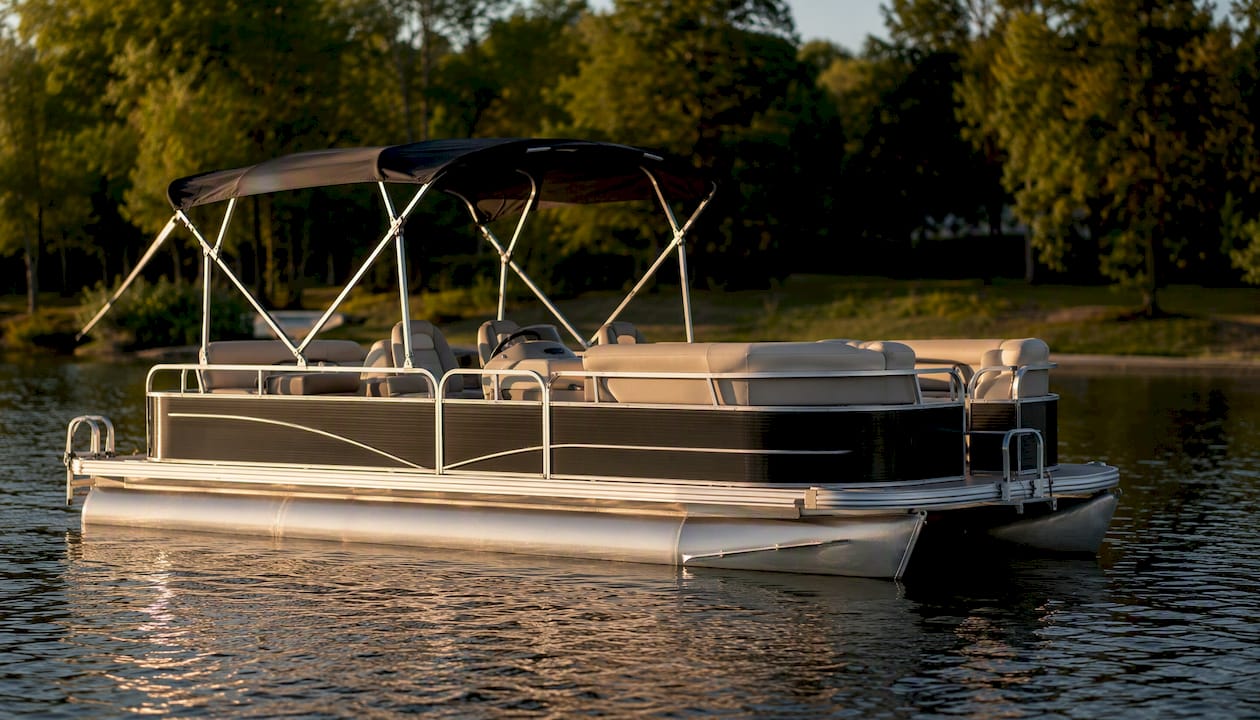
A $10,000 boat might cost $150–$500 annually; a $50,000 pontoon could run $500–$2,500 depending on location and coverage level.
Estimated annual premiums by common scenario:
A $20,000 fishing boat used on inland lakes: approximately $300/year. The same boat kept at a coastal marina in Florida: $500–$700/year. A $50,000 pontoon in the Midwest: roughly $500–$900/year. A 20-year-old cabin cruiser with a current market value of $30,000: $400–$750/year, though older vessels sometimes carry a surcharge because parts are harder to source and repair costs are less predictable.
Typical annual ranges by boat type:
- Fishing boat (under $25K): $150–$500
- Pontoon boat ($25K–$60K): $400–$900
- Bowrider ($20K–$50K): $300–$750
- Cabin cruiser ($50K–$150K): $700–$2,000
- Yacht (over $150K): $2,000–$5,000+
- Personal watercraft (PWC): $150–$400
Older boats present a specific pricing nuance. Age lowers replacement value, which tends to reduce the hull coverage premium. But if a vessel is 15–20 years old and hasn’t been recently surveyed, some insurers apply a condition surcharge or require a marine survey before binding coverage. For high-value vessels, understanding yacht insurance cost involves additional considerations around agreed value and survey requirements.
What factors drive your boat insurance premium?
Three primary variables shape most boat insurance premiums: the boat itself (make, model, value, horsepower), the operator (age, experience, claims history), and how and where you use it. Everything else is a modifier on top of those three.
Primary cost drivers:
- Boat value and type: Higher replacement value means higher hull premium. A high-performance speedboat with 300+ horsepower costs significantly more to insure than a 90-horsepower fishing boat of the same dollar value.
- Horsepower: Insurers treat high-horsepower engines as higher-risk. Some carriers apply surcharges above 200 or 300 HP.
- Navigation area: Coastal, offshore, or ocean use raises premiums versus inland-only use. Specifying “inland lakes and rivers only” on your policy can produce meaningful savings if that accurately describes your use.
- Operator profile: Younger operators (under 25) and those with no formal boating safety training typically pay more. A U.S. Coast Guard Auxiliary or National Safe Boating Council safety course can offset this.
- Claims history: Frequency matters more than severity for renewals. One large claim rarely spikes your renewal the way two or three small claims do, because frequent claims signal behavioral risk to underwriters.
- Storage method: Boats stored in a locked, covered facility year-round cost less to insure than those left in the water or on an open trailer. Documented winter layup (off-season storage) often qualifies for a seasonal rate reduction.
- Deductible level: Raising your deductible can reduce your premium by roughly 10%–20%, which is one of the fastest levers available to you at renewal.
- Credit history: Many states allow insurers to use credit-based insurance scores. A strong credit profile can modestly reduce your rate.
Pro Tip: *Of all the adjustments available, storage documentation and a completed boating safety course tend to produce the most consistent premium reductions when presented to your insurer at renewal.
Coverage types: what’s required and what’s worth adding
No federal law requires boat insurance, and only a handful of states mandate it. Most marinas, however, require proof of liability coverage before they’ll allow you to dock. A standard homeowners policy typically covers small boats (usually under 25 HP or under a specific value threshold), but it falls well short for anything larger or more valuable.
Common coverage types and what they pay for:
- Liability coverage: Pays for bodily injury or property damage you cause to others. This is the baseline coverage most marina agreements require.
- Hull coverage (physical damage): Pays to repair or replace your boat after a covered loss (collision, fire, theft, sinking). Without it, you bear the full repair cost.
- Agreed value vs. actual cash value (ACV): Agreed value pays the full insured amount at total loss with no depreciation deduction. ACV pays what the boat is worth at the time of loss, which can be significantly less for older vessels. Agreed-value policies typically cost 10%–20% more than ACV, but for boats worth $30,000 or more, the protection against depreciation is usually worth the added premium.
- Medical payments: Covers medical expenses for you and your passengers after an on-water accident, regardless of fault.
- Uninsured/underinsured boater: Pays your injury costs when the at-fault boater carries no insurance. Given how many recreational boaters operate without coverage, this endorsement is worth carrying.
- Trailer coverage: Covers physical damage to your trailer while in transit or storage. Often sold as an endorsement rather than a base policy feature.
- Equipment and personal effects: Covers fishing gear, electronics, and other equipment on board. Standard hull policies often exclude detachable equipment above a low sub-limit.
- Towing and assistance: Covers on-water towing, fuel delivery, and emergency assistance. Relatively inexpensive and frequently used.
For a side-by-side look at how different policy designs handle these coverage layers, comparing boat insurance policies before you buy helps you avoid gaps.
What information do you need to get an accurate quote?
Accurate quotes require accurate inputs. Providing incomplete or estimated information produces a quote that won’t hold at binding, which wastes time and creates surprises. Gather the following before you start:
Checklist of what insurers ask:
- Hull identification number (HIN)
- Year, make, model, and engine configuration
- Current market value or purchase price
- Primary navigation area (inland, coastal, offshore)
- Primary use (recreational, fishing, charter, racing)
- Primary operator’s name, date of birth, and boating experience (years)
- Any completed boating safety courses (certificate number if available)
- Trailer details (year, make, value) if you want trailer coverage
- Safety equipment on board (fire extinguishers, flares, life jackets, GPS)
- Prior claims history (past 3–5 years)
- Current storage arrangement (marina, dry storage, home, trailered)
Questions worth asking your agent or carrier:
- What is the navigation territory limit, and does it cover coastal or offshore use?
- Is the hull covered on agreed value or ACV?
- What is the named-storm deductible, and does it differ from the standard deductible?
- Does the policy cover the boat while in transit on a trailer?
- What are the deductible options, and how does each affect the annual premium?
Monthly costs generally run $25–$75 for most recreational boats, so the annual savings from paying in full often amounts to $30–$60, which is worth capturing if cash flow allows.
How to lower your boat insurance premium
Most owners have more control over their premium than they realize. The discounts below are widely available and, when stacked, can produce meaningful reductions.
Common discounts to ask about:
- Multi-policy (bundling): Combining boat insurance with your home or auto policy typically yields 5%–15% off the boat premium.
- Boating safety course: Completing a recognized course (U.S. Coast Guard Auxiliary, America’s Boating Club, or state-approved equivalents) earns a discount with most carriers.
- Anti-theft and secure storage: Documented locked storage, GPS tracking, or engine kill switches reduce theft risk and often qualify for a rate reduction.
- Claims-free discount: Maintaining a clean claims record for 3–5 years earns a loyalty discount at renewal with most carriers.
- Paid-in-full discount: Paying the annual premium upfront rather than monthly avoids financing fees and typically earns a small discount.
- Lay-up credit: If you store your boat out of the water for 4–6 months during winter, some carriers offer a seasonal or lay-up credit for the off-season period.
- Experienced operator discount: Operators with 5+ years of documented boating experience and no claims often qualify for preferred rates.
For more on budget-focused policy design, there are specific structural choices that reliably reduce premiums without sacrificing core protection.
Pro Tip: Bundling your boat policy with your home insurance and paying the full annual premium at once are the two fastest ways to reduce cost with zero change to your coverage. Add a completed safety course certificate and you can often stack three discounts simultaneously at renewal.
For families who also want to reduce the cost of on-water recreational activities more broadly, practical tips for budget-friendly boating can complement the savings you build into your insurance policy.
How these averages were calculated and where to get your own estimate
The national and state-level figures in this article draw from multiple industry sources: InsuredBetter’s 2026 cost analysis, CostWhale’s state-by-state premium data, Boat-Ed’s monthly cost breakdown, and CNBC Select’s insurer pricing review. State groupings reflect patterns across those sources rather than a single insurer’s rate filing.
A note on variance: Published averages reflect broad market patterns across many boat types, operators, and locations. Your actual premium will differ based on your specific hull value, navigation territory, operator profile, and chosen coverage limits. Averages are a starting point for budgeting, not a binding estimate.
Why individual quotes differ from averages:
- Underwriting rules vary by carrier. One insurer may penalize high horsepower heavily; another may weight operator age more.
- State-filed rates change annually and differ by zip code within a state.
- Coverage selections (agreed value vs. ACV, deductible level, endorsements) shift the premium independently of base rate.
The Diamondbackins Boat Insurance Calculator takes your specific inputs (hull value, navigation area, usage, operator profile) and returns personalized estimates across multiple carriers, which is the most reliable way to move from a published average to a number you can actually plan around.
When buying more coverage makes financial sense
Most owners default to basic liability because it’s the cheapest option. That’s a reasonable choice for a $5,000 older boat on a calm inland lake. It becomes a costly miscalculation as boat value climbs.
Consider upgrading your coverage when:
- Your boat’s current market value exceeds $30,000. At that threshold, the depreciation risk on an ACV policy becomes material enough that agreed value is worth the 10%–20% premium increase.
- You use the boat offshore or in coastal waters. Liability exposure and repair costs both rise significantly in open-water environments.
- You carry passengers regularly, whether family, guests, or paying customers. Medical payments and passenger liability coverage become genuinely important rather than optional extras.
- Your boat is financed. Most lenders require hull coverage as a loan condition, and agreed value protects both you and the lender from a depreciation shortfall at total loss.
The instinct to minimize premium is understandable, but the gap between what a $60,000 boat is worth today and what an ACV policy pays after three years of depreciation can be $15,000 or more. That’s the number worth keeping in mind when you’re deciding between coverage tiers.
Get fast, comparable boat insurance quotes with Diamondbackins
Diamondbackins gives you a faster path from average to actual: enter your boat details once, and the platform returns quotes from multiple carriers side by side, so you can compare coverage levels and premiums without calling five different agents.
The process takes minutes. You’ll see transparent pricing across carriers, with options to adjust deductibles, coverage types, and endorsements in real time. Whether you’re insuring a $15,000 fishing boat or a $200,000 yacht, the platform surfaces the coverage options that match your navigation area and usage profile. Use the boat insurance quote tool to start comparing now, or visit Diamondbackins to review all available coverage lines. If your situation involves custom endorsements or commercial use, an agent is available to walk through the details.
Sources
The figures and state groupings in this article draw from the following sources:
- How Much Does Boat Insurance Cost in 2026? | InsuredBetter
- What is the cost of boat insurance? | Protective
- How Much Does Boat Insurance Cost? (2026 Guide) | CostWhale
- How Much Does Boat Insurance Cost (and How to Choose it)
- Best Boat Insurance Companies of 2026
This article provides general information about boat insurance costs and coverage options. It is not a substitute for advice from a licensed insurance professional. Rates, requirements, and availability vary by state and insurer; confirm current figures directly with your carrier or a licensed agent.
Recommended
- Navigating Your Coverage: The Boat Insurance Calculator by DiamondBack Insurance – Diamondback Insurance – Solutions with Instant Online Quotes
- Navigating Boat Insurance A Comprehensive Comparison Guide by DiamondBack Insurance – Diamondback Insurance – Solutions with Instant Online Quotes
- Navigating Boat Insurance How to Effectively Compare Quotes – Diamondback Insurance – Solutions with Instant Online Quotes
- Boat Insurance Florida Requirements A Comprehensive Guide by DiamondBack Insurance – Diamondback Insurance – Solutions with Instant Online Quotes