

Uninsured motorist (UM) coverage pays for your medical bills, lost wages, and pain and suffering when an at-fault driver has no liability insurance — or, in the case of underinsured motorist (UIM) coverage, when their limits fall short of your actual losses. According to the Insurance Research Council, roughly one in seven U.S. motorists drives without insurance, which means the odds of encountering an uninsured driver over a lifetime of driving are not trivial. Many states, including the District of Columbia, mandate UM coverage; the rest either require insurers to offer it or allow you to decline it in writing. The Texas Department of Insurance is one of many state regulators that explicitly warns drivers not to rely on health insurance alone to cover these losses. Your immediate action: pull out your policy declarations page and confirm whether you carry UM/UIM and at what limits.
Most drivers should carry at least the UM/UIM limits their state requires, and many should carry more. If your liability limits are $100,000 per person, matching your UM/UIM limits to that figure gives you parity of protection on both sides of a crash.
Table of Contents
- What does uninsured motorist coverage actually pay for?
- How do uninsured and underinsured coverage differ from each other?
- Which states require UM/UIM, and can you opt out?
- How much UM/UIM coverage do you actually need?
- How does UM/UIM interact with health insurance, collision, and PIP?
- How do you file a UM/UIM claim?
- How do you add UM/UIM to your policy, and what affects the price?
- How Diamondbackins supports commercial and fleet drivers
- Key Takeaways
- Why the conventional wisdom on UM/UIM undersells the real risk
- Get instant UM/UIM quotes for your commercial fleet
- Useful sources and further reading
What does uninsured motorist coverage actually pay for?
The term “uninsured motorist coverage” covers three distinct protections that often appear as separate line items on your policy.
Uninsured Motorist Bodily Injury (UMBI) pays for medical expenses, lost wages, and pain and suffering when an at-fault driver carries no liability insurance at all. It also applies to hit-and-run accidents in most states, where the at-fault driver is legally treated as uninsured. Illinois law, for example, requires UMBI limits of at least $25,000 per person and $50,000 per accident, and mandates that the at-fault driver be either uninsured or a hit-and-run driver.

Uninsured Motorist Property Damage (UMPD) covers repairs to your vehicle caused by an identified, uninsured at-fault driver. Only six states plus D.C. require UMPD, making it far less common as a mandate than UMBI. Illinois, for instance, requires insurers to offer UMPD with a maximum $250 deductible, though you can decline it.
Underinsured Motorist (UIM) coverage steps in when the at-fault driver carries some liability insurance, but not enough to cover your full losses. It pays the gap between what their policy covers and what you are actually owed, up to your own UIM limits.
| Coverage Type | What It Covers | Typical Trigger |
|---|---|---|
| UMBI | Medical bills, lost wages, pain and suffering | At-fault driver has no liability insurance or is a hit-and-run driver |
| UMPD | Vehicle repairs up to actual cash value | At-fault driver is identified, uninsured, and at fault |
| UIM Bodily Injury | Gap between at-fault driver’s limits and your losses | At-fault driver’s liability limits are lower than your damages |
Three short scenarios show how each type applies in practice. A driver runs a red light and hits you; he carries no insurance at all. Your UMBI pays your hospital bills and compensates for missed work. In a second scenario, a driver rear-ends you and flees the scene. Your UMBI covers your injuries because a hit-and-run driver is treated as uninsured. In a third scenario, a driver with only $25,000 in liability coverage causes $80,000 in injuries. Their policy pays $25,000; your UIM coverage pays the remaining $55,000, up to your UIM limit.
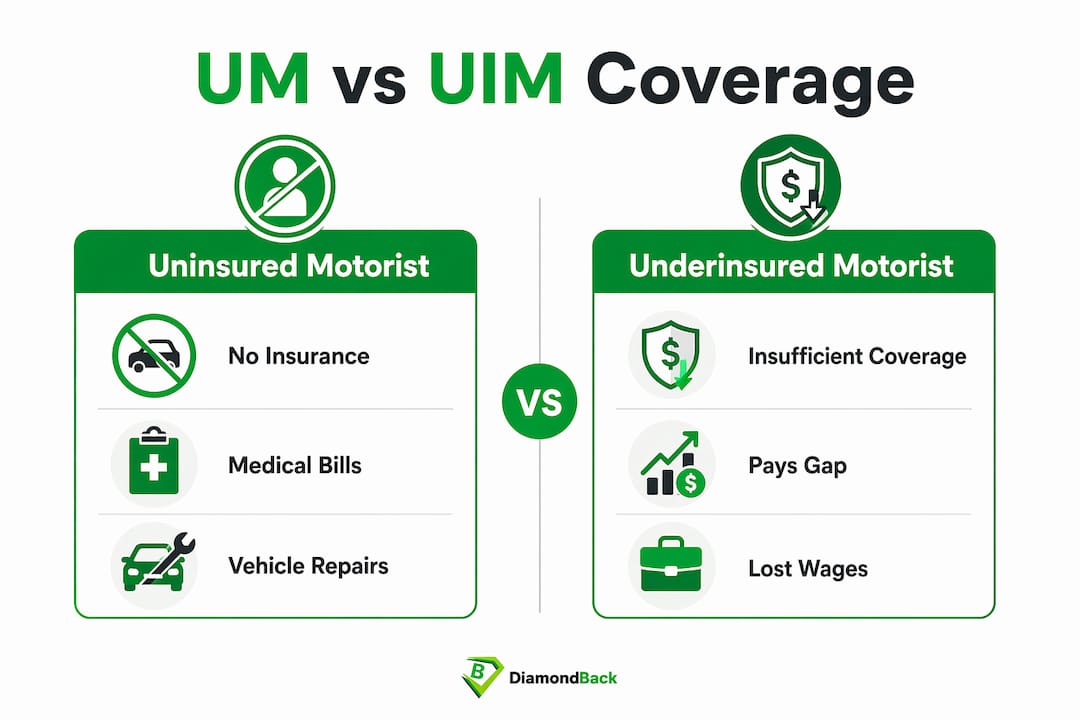
UM and UIM cover medical expenses, lost wages, and pain and suffering. UMPD covers vehicle repairs up to actual cash value where the coverage is available.
How do uninsured and underinsured coverage differ from each other?
The distinction is straightforward: UM applies when the at-fault driver has zero liability insurance; UIM applies when they have some, but not enough. Both protect you from the same underlying risk — an at-fault driver who cannot fully compensate you — but they trigger under different conditions.
UIM fills the gap. If the at-fault driver carries $25,000 in bodily injury liability and your medical bills total $90,000, your UIM coverage pays up to $65,000 more, subject to your policy limits. The uninsured motorist clause functions as a substitute for the liability protection the at-fault driver should have carried.

Stacking is a related concept worth understanding. When stacking is permitted, you can combine UM/UIM limits across multiple vehicles on your policy (or sometimes across multiple policies) to increase the total available coverage. If you insure two vehicles each with $100,000 in UIM coverage, stacked limits give you $200,000 in a single claim. Not every state allows stacking, and some insurers explicitly exclude it. Where stacking is available, it can make a significant difference in severe-crash outcomes, particularly for commercial drivers with multiple vehicles.
Key distinctions to keep in mind:
- UM applies when the at-fault driver has no liability insurance at all.
- UIM applies when the at-fault driver’s limits are lower than your actual damages.
- Stacking multiplies available limits across vehicles or policies where state law and your insurer allow it.
- Hit-and-run drivers are treated as uninsured in most states, triggering UMBI rather than UIM.
Which states require UM/UIM, and can you opt out?
State rules vary considerably, and knowing where your state falls determines whether UM/UIM is a legal requirement or a voluntary choice.
Many states, including the District of Columbia, mandate UM coverage. In those jurisdictions, you cannot legally register a vehicle without it. Many other states require insurers to offer UM/UIM but allow you to decline it — provided you do so in writing. A signed rejection form is typically required, and some states mandate that the insurer explain what you are waiving before you sign. A smaller group of states treats UM/UIM as fully optional, with no offer or rejection requirement.
UMPD is even less commonly mandated. Only six states plus D.C. require it, which means most drivers in most states must actively request UMPD as an add-on.
| State Rule Category | Description | Example States |
|---|---|---|
| Mandatory UM/UIM | Required by law; cannot be waived | Illinois, Oklahoma, New York |
| Offer with written rejection | Insurer must offer; driver may decline in writing | Texas, Colorado |
| Optional | No offer or rejection requirement | Many remaining states |
| UMPD mandated | Property damage UM required by law | D.C. and six states |
Check your state DOI directly. The Oklahoma Insurance Department, the Texas Department of Insurance, the Illinois Department of Insurance, and the Colorado Division of Insurance all publish plain-language summaries of UM/UIM requirements for their states. State DOI pages are the binding legal reference; insurer marketing materials are not.
Statistic: Roughly one in seven U.S. motorists drives without insurance, according to Insurance Research Council data cited by Forbes. In some states, that rate is considerably higher.
How much UM/UIM coverage do you actually need?
The right amount depends on four factors: your state’s minimum requirement, your household’s financial exposure, your health coverage, and local uninsured-driver rates. Working through each one gives you a clear answer.
A practical decision checklist:
- Does your state mandate UM/UIM? If yes, you must carry at least the required minimum.
- Do you have significant income or assets that a lawsuit could reach? Higher limits protect those assets.
- Does your health insurance cover long-term care, lost wages, or pain and suffering? It almost certainly does not, which means UM/UIM fills that gap.
- Do you drive in a state or metro area with high uninsured-driver rates? Higher local risk justifies higher limits.
The clearest rule of thumb: align your UM/UIM limits with your liability limits. If you carry $100,000/$300,000 in bodily injury liability, set your UMBI at the same level. This gives you equivalent protection whether you are the injured party or the at-fault driver. For UMPD, consider whether you already carry collision coverage. If you do, UMPD may be redundant for vehicle repairs, though its deductible is often lower.
A short example: you carry $50,000 in UMBI and are hit by an uninsured driver. Your medical bills total $75,000. Your UMBI pays $50,000; you absorb the remaining $25,000 out of pocket. Had you carried $100,000 in UMBI, your out-of-pocket exposure would be zero. The premium difference between those two limits is typically modest compared to that $25,000 gap.
Pro Tip: For commercial drivers and fleet operators, consider how UM/UIM limits interact with your commercial trucking policy — personal auto UM/UIM limits do not extend to vehicles covered under a commercial policy.
How does UM/UIM interact with health insurance, collision, and PIP?
Many drivers assume their health insurance or collision coverage makes UM/UIM redundant. That assumption has real gaps.
Health insurance and PIP do not replace UM/UIM for non-medical damages. Health plans cover medical bills, but they rarely compensate for lost wages, long-term care needs, or pain and suffering. UM/UIM covers all three. PIP (Personal Injury Protection) covers medical expenses and sometimes lost wages, but its limits are typically low and it does not address pain and suffering at all.
Collision coverage handles vehicle repairs regardless of fault, but it carries its own deductible and does not cover bodily injury. UMPD, by contrast, can carry a lower deductible specifically designed to substitute for the at-fault driver’s liability. The Texas Department of Insurance cites a $250 UMPD deductible as an example of how this works in practice.
Subrogation is the mechanism that coordinates these coverages. If your health insurer pays your medical bills after an uninsured-driver crash, it may seek reimbursement from your UM settlement. Understanding this coordination matters when you file a claim, because the order of payment affects your net recovery.
Common exclusions that limit UM/UIM:
- Vehicles not listed on your policy may not be covered.
- Permissive-use situations (a friend borrowing your car) may have reduced limits.
- Some policies exclude motorcycles or commercial vehicles from personal UM/UIM.
- UIM may not apply if the at-fault driver’s limits equal or exceed your UIM limits.
| Damage Type | Health Insurance | PIP | Collision | UM/UIM |
|---|---|---|---|---|
| Medical bills | Yes | Yes (limited) | No | Yes |
| Vehicle repairs | No | No | Yes | Yes (UMPD only) |
| Lost wages | Rarely | Sometimes | No | Yes |
| Pain and suffering | No | No | No | Yes |
How do you file a UM/UIM claim?
Acting quickly and methodically after an accident protects your claim. Here is the sequence that gives you the strongest position.
- Report the accident to police immediately, even if the other driver is gone. A police report is the primary evidence for hit-and-run UMBI claims.
- Notify your insurer as soon as possible. Most policies require prompt notice; delayed reporting can jeopardize your claim.
- Document the scene: photograph vehicle damage, road conditions, and any visible injuries. Collect witness contact information.
- Seek medical attention and keep all records. Medical documentation establishes causation — the direct link between the crash and your injuries.
- Gather proof of lost wages from your employer, including pay stubs and a written statement of missed time.
- Obtain repair estimates from licensed shops and preserve any damaged property until the insurer inspects it.
- Submit all documents to your insurer’s claims representative and follow up in writing.
Insurers review UM/UIM claims closely for two things: proof that the at-fault driver was uninsured (or underinsured), and proof that your injuries were caused by the accident. For UIM claims, you will also need to document the at-fault driver’s policy limits, typically through their insurer’s coverage confirmation. For hit-and-run claims, a timely police report and corroborating witness evidence are often required to establish entitlement.
Common documents your insurer will request:
- Police report number and copy
- Medical records and itemized bills
- Employer letter and pay stubs for lost wages
- Repair estimates or total-loss valuation
- At-fault driver’s insurance declaration page (for UIM claims)
Pro Tip: If your insurer disputes liability or the value of your claim, consult an attorney who handles policyholder rights before accepting any settlement. UM/UIM disputes can go to arbitration under many policy terms.
How do you add UM/UIM to your policy, and what affects the price?
Adding UM/UIM is straightforward. Contact your agent or insurer, request the specific limits you want, and confirm whether UMPD is available in your state. If your state allows written rejection and you previously signed one, you will need to revoke that rejection in writing before coverage can be added. Keep a copy of any signed forms.
Steps to add or increase UM/UIM:
- Review your current declarations page to identify existing UM/UIM limits or any signed rejection on file.
- Contact your agent or insurer and request a quote for your desired limits.
- Confirm whether UMPD is available and whether stacking is permitted in your state.
- Ask for the incremental premium cost between your current limits and the higher limits you are considering.
- Sign the updated policy endorsement and request written confirmation of the new limits.
Price factors that affect your UM/UIM premium:
- Your driving record and claims history
- Your state’s uninsured-driver rate (higher local risk often means higher premiums)
- The limits you choose (higher limits cost more, but the increment is usually modest)
- Whether you elect stacking, which increases available coverage and premium
- Your vehicle type and age
- Your insurer’s underwriting guidelines
UM/UIM is typically added as an endorsement to your existing auto policy rather than as a separate policy. For commercial fleet operators, UM/UIM may appear as a separate coverage line on a commercial auto policy, and the underwriting factors differ from personal auto.
How Diamondbackins supports commercial and fleet drivers
Diamondbackins specializes in commercial vehicle and trucking insurance, helping fleet managers and owner-operators compare UM/UIM options across multiple top-rated insurers in minutes. The platform aggregates instant quotes so you can see the incremental cost of adding or increasing UM/UIM limits without calling multiple agents.
For commercial drivers, UM/UIM decisions intersect with motor carrier requirements, state filing obligations, and fleet-wide limit strategies. Diamondbackins provides access to coverage options across these categories, with transparent pricing and no obligation to buy. Drivers and fleet managers can review available limits, confirm state-specific requirements, and purchase coverage directly through the platform.
Key Takeaways
Uninsured motorist coverage is the single most direct protection against the financial risk posed by the roughly one in seven U.S. drivers who carry no liability insurance.
| Point | Details |
|---|---|
| UM vs. UIM distinction | UM covers drivers with zero insurance; UIM fills the gap when at-fault limits are too low. |
| State mandate check | Many states plus D.C. require UM; verify your state’s rule at your state DOI page. |
| Limits rule of thumb | Match your UM/UIM limits to your liability limits for equal protection on both sides of a crash. |
| Health insurance gap | Health plans cover medical bills but not lost wages or pain and suffering — UM/UIM does. |
| Diamondbackins | Compare UM/UIM options for commercial and fleet policies instantly through Diamondbackins. |
Why the conventional wisdom on UM/UIM undersells the real risk
Most articles on uninsured motorist insurance frame the decision as a cost-benefit calculation: small premium, big potential payout, easy yes. That framing is correct but incomplete. The deeper issue is that UM/UIM is the only coverage in your policy that substitutes for another driver’s legal obligation to you. Every other coverage you carry protects against your own risk. UM/UIM protects against someone else’s failure.
That distinction changes how you should think about limits. Drivers routinely carry $100,000 or more in liability coverage to protect others from their mistakes, then carry $25,000 in UM/UIM to protect themselves from someone else’s. The asymmetry is hard to justify. If you believe a serious crash can cost $100,000 in medical bills and lost wages, you should believe it whether you caused the crash or someone else did.
The stacking question is similarly underappreciated. In states where stacking is available, the premium increase is often small relative to the coverage gain. Fleet operators and owner-operators with multiple vehicles should ask their insurer directly whether stacking is permitted and what it costs. The answer is frequently worth the conversation.
Get instant UM/UIM quotes for your commercial fleet
Choosing the right UM/UIM limits for a commercial fleet is more complex than a personal auto decision. You are weighing state filing requirements, per-vehicle limits, stacking options, and the interaction between your commercial auto policy and any personal coverage your drivers carry.
Diamondbackins gives fleet managers and owner-operators a faster path to that answer. The platform compares UM/UIM options from multiple top-rated insurers in real time, so you can see exactly what each limit tier costs before you commit. Pull together your current declarations page, your desired limits, your vehicle list, and your drivers’ history, then get an instant quote online in minutes. If you want to talk through stacking options or state-specific opt-out requirements first, Diamondbackins connects you with a coverage specialist who knows commercial auto inside and out. Start your quote at Diamondbackins.com today.
Useful sources and further reading
These sources give you the binding legal rules, product-level detail, and data behind the guidance in this article.
-
Texas Department of Insurance — Uninsured Motorist Tips: Plain-language guidance on how UM/UIM works, including deductible examples and the limits of health insurance as a substitute. Use this for Texas-specific rules and general coverage mechanics.
-
Investopedia — Uninsured Motorist Coverage: Clear definitions of UM and UIM, state mandate counts, and opt-out rules. Good starting point for understanding the national picture.
-
WalletHub — Uninsured Motorist Coverage Guide: State-by-state summaries of UM/UIM requirements and what each coverage type pays. Useful for comparing your state’s rules against others.
-
WalletHub — Which States Require UMPD?: Focused summary of UMPD mandates by state. Check here if you want to know whether your state requires property-damage UM.
-
Forbes Advisor — Uninsured Motorist Coverage: Covers the Insurance Research Council uninsured-driver statistic and practical limit-selection advice. Useful for understanding the risk data behind the coverage decision.
-
Cornell Law — Uninsured Motorist Clause (Wex): Legal definition of the uninsured motorist clause and its function as a substitute for the at-fault driver’s missing liability coverage. Authoritative for legal context.
-
Illinois Department of Insurance — Auto Definitions: State regulator definitions of UMBI, UMPD, and UIM for Illinois. Use this as a model for how state regulators define these terms, and check your own state DOI for the equivalent page.
-
Your state’s Department of Insurance website: For legally binding rules on UM/UIM mandates, opt-out procedures, and minimum limits in your state, your state DOI page is the authoritative source. Insurer marketing materials and third-party guides are useful for orientation, but your declarations page and your state DOI page govern what you actually owe and what you are actually owed.
This article provides general information about uninsured motorist coverage and is not legal or insurance advice. Coverage terms, state requirements, and limits vary. Confirm the current rules for your state and your specific policy with your state’s Department of Insurance or a licensed insurance professional.