

Insurance audits exist for one reason: to make sure the premium you paid actually matches the risk your insurer covered. When you buy a policy for general liability, workers’ compensation, or commercial auto coverage, your carrier sets an estimated premium based on projected payroll, sales, or vehicle usage. At the end of the policy period, an audit reconciles those estimates against your real numbers. If your business has grown, you may owe additional premium. If it has contracted, you could receive a refund.
The audit process applies most commonly to three policy types: Workers’ Compensation, General Liability, and Commercial Auto. These are the policies where key rating factors, particularly payroll and revenue, can shift significantly over a 12-month period. Audits also serve a broader purpose beyond premium math. They help prevent premium fraud, protect insurer reserves for paying claims, and give policyholders a fair shot at paying only what their actual risk warrants. Two audit structures exist: one-way audits, where additional premium can be charged but no refund is issued, and two-way audits, where the adjustment runs in either direction.
How insurance audits work: the step-by-step process
Understanding the insurance audit process removes most of the anxiety around it. Here is how a standard audit unfolds from start to finish.
1. Policy issuance with estimated premium. Your carrier sets an advance premium at the start of the policy period based on your projected payroll, sales, or vehicle count. This figure appears on your declarations page as “estimated premium” or “advance premium.”

2. Audit notification. Audits typically begin about 90 days before your policy expires. Your carrier sends a formal notice outlining what documentation you need to provide.
3. Documentation request. The auditor asks for financial records covering the full policy period. Commonly requested documents include payroll summaries, general ledgers, profit and loss statements, tax returns, and subcontractor certificates of insurance.
4. Audit format selection. The review can happen in person at your business location, over the phone, or through an online portal. In-person audits are more common for larger operations or when classification questions arise.
5. Review and classification check. The auditor verifies that your employees are correctly classified by job type, since classification codes directly affect your Workers’ Compensation and General Liability rates. Misclassified employees are one of the most common sources of premium discrepancies.
6. Premium recalculation. Using your actual payroll and sales figures, the carrier applies the same rate from your original policy to calculate the true premium for the period.
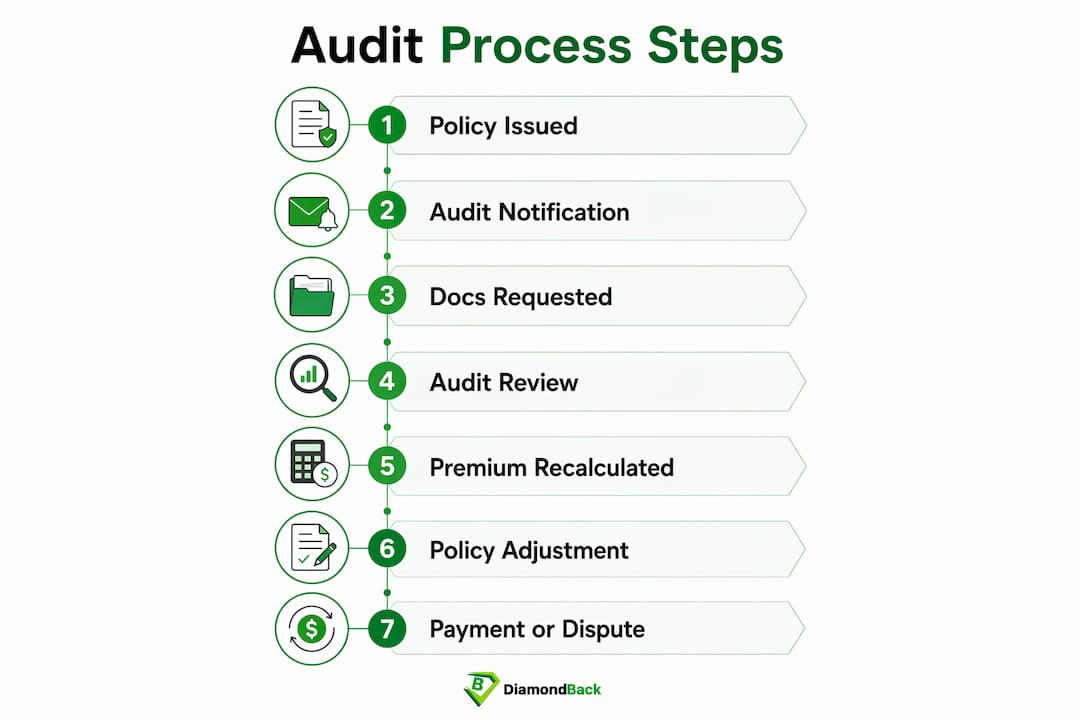
7. Endorsement and adjustment. The carrier issues a policy endorsement reflecting the corrected premium. If you owe additional premium, a bill follows. Under a two-way audit structure, a credit or refund is issued when actual exposure came in below projections.
8. Payment or dispute. You pay any balance due, or you contest the findings through your broker if you believe a classification error or calculation mistake occurred.
| Audit Stage | Typical Timing | Key Action Required |
|---|---|---|
| Audit notification | Several weeks before expiration | Review notice and gather records |
| Documentation submission | Soon after request | Submit payroll, tax forms, subcontractor certificates |
| Auditor review | Weeks after submission | Respond to follow-up questions |
| Premium adjustment issued | Following review | Pay balance or request dispute review |
| Renewal preparation | At policy renewal | Update projections based on audit findings |
Non-compliance carries real consequences. Failing to provide documentation can result in an “unobtainable audit” fee, policy cancellation, or a coverage lapse that complicates your next renewal. Staying organized throughout the year is far less costly than scrambling after the fact.
Which policies are subject to insurance audits?
Not every policy your business carries will go through an audit. The audit requirement depends on whether the policy’s premium is tied to a variable metric that can change over time.
Workers’ Compensation is the most frequently audited policy type. Premiums are calculated using payroll figures multiplied by classification codes that reflect the risk level of each job. Because payroll fluctuates with hiring, layoffs, overtime, and seasonal work, the estimated premium at policy inception rarely matches the final exposure precisely. Audits correct that gap.
General Liability policies are typically rated on gross sales or revenue. A contractor whose revenue doubles mid-year was carrying more risk than the carrier originally priced. The audit captures that difference. Most GL policies are two-way auditable, meaning a revenue shortfall can produce a premium credit.
Commercial Auto policies may be audited when the fleet size or vehicle usage changes during the policy period. Carriers review vehicle mileage logs, driver records, and usage classifications to confirm the policy reflects actual operations. For trucking and transportation businesses, where insurance premiums are sensitive to mileage and cargo type, this review carries particular weight.
Policies generally not subject to audits include Directors and Officers (D&O) liability and Employment Practices Liability (EPL) insurance. These policies are priced on fixed factors like company size and industry, not on variable operational metrics.
Pro Tip: Check your declarations page for the phrase “auditable premium” or “minimum earned premium.” If either term appears, your policy will be audited. Knowing this at policy inception lets you build record-keeping habits from day one rather than reconstructing data under deadline.
How to prepare your business for an insurance audit
Preparation is the single biggest factor in how smoothly an audit goes. Businesses that maintain organized records throughout the year rarely face surprises. Those that reconstruct data at audit time often end up with classification errors, missed credits, or inflated premiums.
Start with your payroll records. Your auditor will want payroll tax forms such as 941s and W-2s, along with detailed payroll summaries broken down by employee classification. If you use a payroll service, request a year-end report that separates employees by job function before the audit notice arrives.

Subcontractor documentation deserves special attention. If you hire subcontractors without obtaining their certificates of insurance, your carrier may include their payroll in your premium calculation. That can increase your Workers’ Compensation premium substantially. For transportation businesses that rely on owner-operators or freight subcontractors, maintaining current certificates from each subcontractor is a year-round responsibility. Carriers like those serving freight and trucking operations treat subcontractor classification as a primary audit focus.
Sales and revenue statements support your General Liability audit. Keep monthly revenue reports accessible, and reconcile them against your tax filings so the numbers align when the auditor compares them.
Your business operations description also matters. If your company expanded into new service lines, added locations, or changed how employees perform their work, document those changes. An outdated operations description can trigger incorrect classification codes, which affect your rate.
Finally, stay in contact with your insurance agent throughout the year. Informing your agent of significant payroll changes or fleet additions as they happen means your audit will reflect accurate data rather than a year’s worth of undisclosed changes.
Common misconceptions about insurance audits
“An insurance audit is like an IRS audit.” The comparison is understandable but inaccurate. An insurance audit is a routine premium reconciliation, not an investigation into wrongdoing. The auditor is not looking for fraud; they are verifying that your policy premium aligns with your actual business activity.
“Audits always mean you owe more money.” Under a two-way audit structure, actual payroll or sales lower than projected result in a premium refund. Businesses that had a slow year, reduced headcount, or lower revenue than expected can recover real dollars through the audit process. This makes accurate record-keeping valuable in both directions.
“You have no say in the audit results.” Policyholders have the right to contest audit findings. If you believe an employee was misclassified or a calculation contains an error, your broker can push the carrier to recalculate. Carriers do revise audit results when documentation supports a correction.
“Carrier audits and independent audits serve the same purpose.” They do not. A carrier-conducted audit focuses on premium reconciliation for that specific policy. An independent insurance audit reviews your entire coverage portfolio to identify gaps, outdated terms, and potential savings that a carrier audit would never surface. Independent audits can identify inefficiencies and coverage gaps that save businesses money beyond what any single premium adjustment would achieve.
“Ignoring an audit request has no real consequences.” Carriers treat non-response as an unobtainable audit, which can trigger fees, policy cancellation, and a coverage lapse. A lapse on your record complicates future renewals and can raise your rates. Compliance protects your coverage continuity.
Your rights as a policyholder include receiving clear notice of the audit, understanding what documentation is required, reviewing the auditor’s findings before final adjustment, and disputing results through a formal process. Your obligations include providing accurate records, responding within the timeframe specified, and notifying your carrier of material changes to your operations during the policy period.
Why proactive audits strengthen your business risk management
Risk managers who treat audits as a management tool rather than an administrative obligation get more value from their insurance programs. The core insight is straightforward: business operations change faster than insurance policies are updated. A company that adds a new service line, hires a new class of workers, or expands its fleet mid-year may be operating with coverage that no longer fits its actual risk profile. Annual audits catch those gaps before a claim exposes them.
Regular insurance audits do more than correct premium calculations. They force a structured review of how your business has changed, which classifications apply to your workforce, and whether your coverage limits still match your exposure. That review is where businesses find both savings and protection they did not know they were missing.
Independent audits add a layer that carrier audits cannot provide. Because a carrier audit is focused on its own policy, it has no incentive to flag coverage gaps in policies held with other carriers or to suggest that your limits are inadequate. An independent review examines your full program, compares it against your current operations, and identifies where you are over-insured, under-insured, or carrying redundant coverage.
For fleet operators and trucking businesses, reviewing coverage regularly is especially valuable because fleet composition, driver rosters, and cargo types shift frequently. A policy written for five trucks and three drivers does not automatically adjust when you add two vehicles and change your freight classification. The audit, whether carrier-initiated or independent, is the mechanism that keeps your coverage current.
Pro Tip: Schedule an internal coverage review 60 days before your policy renewal, before the carrier’s audit notice arrives. Compare your current payroll, revenue, and fleet data against what your policy reflects. Addressing discrepancies proactively gives you time to correct classifications and avoid a large unexpected premium bill at audit time.
Key Takeaways
Insurance audits reconcile estimated premiums with actual business exposure, ensuring policyholders pay for the risk they incurred and giving businesses a structured opportunity to recover overpaid premiums or correct coverage gaps.
| Point | Details |
|---|---|
| Audits start ~90 days early | Carriers typically initiate the audit process about 90 days before policy expiration. |
| Three core policy types | Workers’ Compensation, General Liability, and Commercial Auto are the most commonly audited policies. |
| Two-way audits can refund premium | If actual payroll or sales were lower than projected, two-way audit policies return the difference to the policyholder. |
| Non-compliance has real costs | Failing to respond to an audit request can trigger fees, policy cancellation, and a coverage lapse. |
| Independent audits go further | Carrier audits verify premium accuracy; independent audits uncover coverage gaps and savings across your full program. |
Ready to make sure your commercial coverage actually fits your operations? Diamondbackins helps trucking and transportation businesses get instant, tailored quotes from top carriers so your policy starts with accurate numbers. Explore your options at Diamondbackins and get coverage that holds up when it counts.