

Split limit liability is defined as an auto insurance structure that divides your liability coverage into three separate maximum payouts: bodily injury per person, bodily injury per accident, and property damage per accident. A policy written as 100/300/100 means your insurer pays up to $100,000 per injured person, $300,000 total for all injuries in one accident, and $100,000 for property damage. These three numbers are not interchangeable. Each category has a fixed ceiling, and once that ceiling is reached, your insurer stops paying. For individuals and business owners alike, understanding what is split limit liability is the first step toward choosing coverage that actually protects your assets.
What is split limit liability and how does it work?
A split limit policy is expressed as three numbers representing the maximum payout for bodily injury per person, bodily injury per accident, and property damage per accident. Think of each number as a locked bucket. Money in one bucket cannot flow into another, no matter how large the claim grows.
The bodily injury per person limit caps what your insurer pays for any single injured individual. If that person’s medical bills exceed the cap, your insurer stops paying on that claim. The bodily injury per accident limit sets the total your insurer pays for all injured people combined in one accident. The property damage limit covers repairs or replacement of the other party’s vehicle, fence, building, or other physical property.
Here is a concrete example. You carry a 100/300/100 policy and cause an accident injuring three people. One person has $180,000 in medical bills. Your insurer pays only $100,000 for that person, leaving $80,000 unpaid. The remaining $200,000 in your per-accident bucket is still available for the other two injured parties. Your property damage bucket is completely separate and unaffected by the medical claims.

Pro Tip: Review your declarations page today. The three numbers on that page define your exact financial exposure in any accident you cause.
How does split limit liability compare to combined single limit coverage?
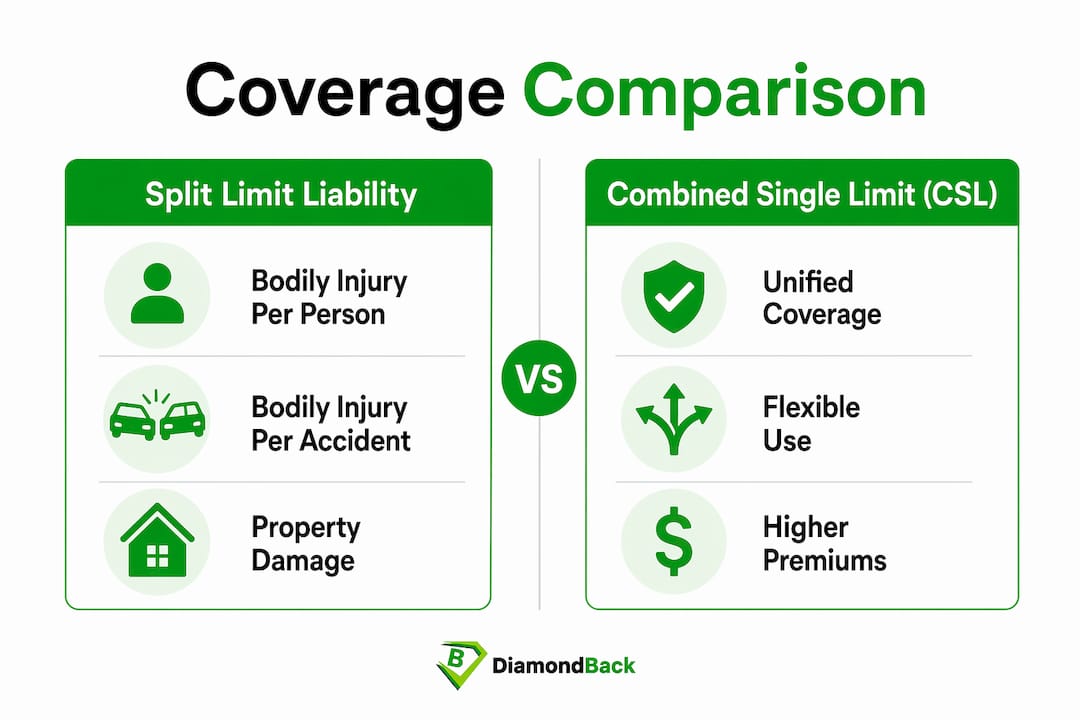
Combined single limit (CSL) coverage is defined as one lump sum that covers bodily injury and property damage combined. CSL allows the full amount to be applied to any combination of bodily injury and property damage, giving your insurer flexibility to pay claims where they are largest.
Split limits are more rigid but generally carry lower premiums. CSL policies cost more because the insurer accepts greater uncertainty about where the money will go. For most personal auto drivers, split limits are the standard offering. Commercial trucking and fleet operators often have access to both structures, and the right choice depends on the size and nature of the risk.
| Feature | Split limit liability | Combined single limit (CSL) |
|---|---|---|
| Coverage structure | Three separate buckets | One pooled total |
| Premium cost | Generally lower | Generally higher |
| Flexibility | Rigid by category | Fully flexible |
| Common use | Personal auto | Commercial and fleet |
| Risk of gaps | Higher if one bucket runs out | Lower due to pooling |
The table above shows the core trade-off clearly. Split limits cost less but create exposure when one category is exhausted while others remain unused. CSL removes that exposure but at a higher price.
Pro Tip: If you operate a commercial fleet, ask your broker to quote both structures side by side. The premium difference is often smaller than business owners expect, and the added flexibility of CSL can prevent a catastrophic out-of-pocket loss.
What are the practical implications for individuals and business owners?
Split limits create locked buckets that cannot be shared between bodily injury and property damage claims, potentially leaving you exposed beyond your limits. This rigidity has real financial consequences that many policyholders do not anticipate until a claim is filed.
Consider a business owner whose driver causes a multi-vehicle accident. Two injured parties each have $120,000 in medical bills. With a 100/300/100 policy, the insurer pays $100,000 per person, leaving $40,000 per person unpaid. The business owner faces a lawsuit for the remaining $80,000 combined, plus any legal fees. Personal assets, business accounts, and equipment are all at risk.
Transportation and logistics businesses often need higher split limits to protect valuable assets and fleets. A single commercial truck accident can generate medical claims, cargo damage, and property damage simultaneously, each hitting a separate limit. Choosing limits that reflect the actual value of your fleet and business assets is not optional. It is a basic risk management decision.
Key considerations when selecting your liability limits:
- Net worth alignment. Your liability limits should match or exceed your total personal or business net worth to protect assets from seizure in a lawsuit.
- State minimums as a floor, not a target. North Carolina’s minimum liability increased to 50/100/50 in 2025, but experts advise carrying at least 100/300/100. State minimums represent the legal floor, not adequate protection.
- Fleet size and driver exposure. More drivers on the road means more daily accident exposure. Higher limits are proportionally more important as your fleet grows.
- Cargo and property values. If your trucks carry high-value freight, property damage limits need to reflect replacement costs, not just vehicle repair.
- Underinsured motorist (UIM) coverage. UIM coverage often follows the same split limit structure, so failing to update those limits leaves you exposed when the at-fault driver carries inadequate insurance.
How do you determine the right split limit coverage for your needs?
Insurance experts recommend matching liability limits to personal or business net worth and supplementing with umbrella policies. This is the clearest framework for deciding where to set your limits.
Start by calculating your net worth. Add up your business assets, personal savings, real estate equity, and equipment value. Your liability limits should cover at least that total. If a judgment exceeds your coverage, the plaintiff’s attorney can pursue your personal and business assets directly.
Next, understand your state’s minimum requirements and treat them as a starting point only. Adequate liability coverage should surpass state minimums to align with rising medical and repair costs in 2026, especially for commercial vehicles. Medical costs, legal fees, and pain and suffering awards have all increased significantly in recent years.
Follow these steps to set your limits with confidence:
- Calculate your total net worth. Include all personal and business assets that could be targeted in a lawsuit.
- Check your state’s minimum requirements. Know the legal floor, then plan to exceed it.
- Estimate realistic accident costs. A serious multi-person accident can generate $500,000 or more in combined medical and property claims.
- Price an umbrella policy. Umbrella insurance extends your liability protection beyond your split limits at a relatively low cost per year.
- Review your limits annually. Proactive insurance reviews help avoid gaps caused by changing asset portfolios, risk profiles, or state regulations.
For commercial trucking companies, the stakes are higher. Fleet size, driver exposure, and cargo value all affect the right limit. A single-truck owner-operator has different needs than a 20-truck fleet hauling hazardous materials. Review your trucking insurance limits every year, and after any significant change in fleet size or operations.
Pro Tip: Pair your split limit policy with a commercial umbrella policy. The umbrella activates after your primary limits are exhausted, giving you a second layer of protection without replacing your base coverage.
Key Takeaways
Split limit liability divides your auto coverage into three fixed buckets, and choosing limits below your net worth creates direct personal and business financial exposure.
| Point | Details |
|---|---|
| Three separate limits | Split limit policies cap bodily injury per person, per accident, and property damage independently. |
| No fund sharing between categories | Unused funds in one bucket cannot cover overages in another, leaving gaps in major accidents. |
| State minimums are insufficient | Experts recommend at least 100/300/100; state minimums often fall well below that threshold. |
| Net worth sets your target | Match your liability limits to your total personal or business net worth to protect your assets. |
| Annual review is required | Changing assets, fleet size, or state regulations can make last year’s limits inadequate today. |
Why minimum limits cost more than you think
Most policyholders focus on the premium when choosing split limits. That is the wrong number to watch. The number that matters is the gap between your coverage limit and the actual cost of a serious accident.
I have seen business owners carry 25/50/25 limits because the premium was $400 a year cheaper. Then one accident produces $300,000 in medical claims and a lawsuit that targets their business accounts, trucks, and personal savings. The $400 in annual savings cost them everything above their limits. That math never works in the policyholder’s favor.
The other misconception I encounter constantly is that “full coverage” means high limits. Full coverage refers to adding comprehensive and collision to your policy. It says nothing about how high your liability limits are. You can carry full coverage with dangerously low split limits and not realize it until a claim is filed.
For commercial fleet operators, I always recommend treating split limits as a business continuity decision, not just an insurance purchase. One serious accident can generate claims that exceed personal auto limits by a factor of five or ten. Trucking insurance mistakes around liability limits are among the most financially damaging errors a fleet owner can make. Review your limits every year, align them with your current net worth, and price a commercial umbrella policy before you decide the base limits are enough.
— Vladimir
Protect your fleet with the right liability limits
Choosing the right split limit liability coverage for your commercial fleet or personal vehicle does not have to be complicated. Diamondbackins specializes in commercial truck and fleet insurance, giving you instant access to quotes from multiple top-rated insurers in minutes.
Whether you operate a single truck or a growing fleet, Diamondbackins makes it straightforward to compare liability coverage options and select limits that match your actual risk. You can get a commercial truck insurance quote online today, review your options side by side, and secure coverage without the back-and-forth of a traditional broker. Your assets deserve limits that reflect their real value.
FAQ
What does split limit liability mean?
Split limit liability is an insurance structure that sets three separate maximum payouts: bodily injury per person, bodily injury per accident, and property damage per accident. Each limit is fixed and cannot be transferred to cover overages in another category.
How does a 100/300/100 policy work?
A 100/300/100 policy pays up to $100,000 per injured person, $300,000 total for all injuries in one accident, and $100,000 for property damage. If any single category is exhausted, the insurer stops paying for that category regardless of remaining funds elsewhere.
What is the difference between split limit and CSL coverage?
Split limit coverage uses three fixed buckets by category, while combined single limit (CSL) coverage pools all liability into one total that can be applied to any combination of bodily injury and property damage claims.
Are state minimum split limits enough coverage?
State minimums are rarely enough. North Carolina’s minimum increased to 50/100/50 in 2025, but insurance experts recommend carrying at least 100/300/100 to keep pace with rising medical costs and legal judgments.
Do commercial trucking policies use split limits?
Commercial trucking policies can use either split limits or combined single limit structures. Trucking companies generally need higher limits than personal auto drivers due to greater fleet exposure, cargo values, and the severity of commercial vehicle accidents.
Recommended
- Limited liability coverage explained: safeguard your business and trucks
- Types of liability coverage: protect your fleet and business
- Demystifying General Liability Insurance: What It Covers – Diamondback Insurance – Solutions with Instant Online Quotes
- Unveiling the Coverage Spectrum of General Liability Insurance with DiamondBack Insurance – Diamondback Insurance – Solutions with Instant Online Quotes