

If you manage more than one commercial vehicle, fleet insurance is not just a convenience. It is one of the most strategic decisions you make for your business. Fleet insurance explained simply: it is a single policy that covers multiple vehicles under one agreement, replacing the tangle of individual policies that drain time and budget. Yet many business owners still treat it as a bulk version of personal auto coverage, and that misunderstanding costs them. This article walks you through how fleet insurance works, what coverage you actually need, what it costs, and how to use safety data to your financial advantage.
Table of Contents
- Key takeaways
- Fleet insurance explained: how it actually works
- Coverage types and real-world examples
- What drives fleet insurance costs
- Safety culture as an underwriting asset
- How coverage needs evolve as your fleet grows
- My perspective on fleet insurance after years in the industry
- Get the right fleet coverage with Diamondbackins
- FAQ
Key takeaways
| Point | Details |
|---|---|
| One policy, multiple vehicles | Fleet insurance consolidates coverage, reducing administrative burden and often lowering overall premiums. |
| Coverage types vary by risk | Liability, physical damage, cargo, and excess liability each address distinct exposures your fleet faces daily. |
| Cost depends on driver data | Fleet size, CSA scores, cargo type, and telematics use are the biggest levers on your annual premium. |
| Safety culture lowers rates | Insurers reward active safety programs and transparent data sharing with better underwriting terms. |
| Coverage must grow with you | As your fleet expands past five or ten vehicles, your policy structure needs a formal reassessment. |
Fleet insurance explained: how it actually works
Most people picture fleet insurance as simply buying multiple vehicle policies in one transaction. The reality is more structured than that, and understanding the difference is worth real money to you.
A fleet insurance policy covers all your commercial vehicles under a single contract with one renewal date, one insurer relationship, and one claims process. Instead of tracking six or ten separate policy expiration dates, you manage one. That alone reduces the administrative overhead that quietly erodes productivity in smaller operations.
What qualifies as a fleet? Most insurers define a fleet as two or more commercially operated vehicles, though some set the threshold at five. The vehicle mix can include box trucks, flatbeds, pickups used for business, vans, or tractor-trailers. A mixed fleet is common, and a good policy accommodates it.
The basic structure of fleet coverage includes three core components. Liability coverage protects you when one of your drivers causes bodily injury or property damage to a third party. Physical damage coverage handles repairs or replacement of your own vehicles after a collision or non-collision event. Cargo insurance protects the freight your vehicles carry while it is in transit.
Pro Tip: Ask your insurer whether your fleet policy includes a blanket or scheduled approach. A blanket policy covers all vehicles under one limit, which is simpler to manage. A scheduled policy lists each vehicle individually, which can be more precise but requires more updates as your fleet changes.
Beyond simplicity, fleet policies often produce cost savings compared to insuring each vehicle separately. Insurers price fleet policies based on aggregate risk across the entire operation, which tends to be more favorable than individual risk pricing on each vehicle.
Coverage types and real-world examples
Understanding fleet insurance basics means knowing what each coverage layer actually does when something goes wrong. Here is a breakdown of the coverage types most relevant to commercial fleets.
Liability coverage is the foundation of any fleet policy. The FMCSA mandates $750,000 in minimum liability for interstate general freight carriers, but the practical market minimum is $1 million. Carriers hauling petroleum need $1 million, and those moving hazardous materials must carry $5 million. If one of your drivers causes a serious accident, base liability limits can be exhausted faster than you expect, particularly with today’s verdict sizes.
Physical damage coverage splits into two parts. Collision covers vehicle damage resulting from an impact with another vehicle or object. Comprehensive covers non-collision events like theft, vandalism, fire, or weather damage. If you run older trucks with low book values, you may choose to carry liability only on those units, but newer or financed vehicles almost always require both.
Cargo insurance covers the goods your trucks haul during transit. Cargo coverage is not federally mandated, but most shippers and brokers require it. Minimum carrier requirements typically start at $100,000, and higher-value or temperature-sensitive loads may require $250,000 to $500,000 or more with special endorsements.
| Coverage Type | What It Protects | Typical Minimum |
|---|---|---|
| Primary liability | Third-party injury and property damage | $750K to $1M |
| Physical damage | Your own vehicles (collision + comprehensive) | Based on vehicle value |
| Cargo insurance | Freight in transit | $100K (broker minimum) |
| Bobtail/non-trucking liability | Truck use outside of dispatch | Varies by insurer |
| Umbrella/excess liability | Claims exceeding primary limits | $5M to $10M+ |
Umbrella and excess liability deserve more attention than most fleet managers give them. Many fleets need $5M to $10M+ in total liability coverage when you factor in catastrophic bodily injury claims or multi-vehicle accidents. Your primary policy is the floor, not the ceiling.
Pro Tip: Bobtail and non-trucking liability are separate products that cover your truck when it is being operated outside of a load dispatch. If your drivers use their trucks for personal use or deadhead regularly, you need this coverage. Without it, you have a meaningful gap in protection.
What drives fleet insurance costs
Fleet insurance cost is not arbitrary. Insurers are pricing the probability that a claim will occur and estimating its likely severity. When you understand the variables they are evaluating, you can influence the outcome.
Annual insurance costs for a small fleet of two to five trucks typically run between $15,000 and $40,000, depending on driver history, CSA scores, and cargo type. A single owner-operator with one truck pays roughly $8,000 to $14,000 annually. For larger operations, costs can reach $400,000 or more annually. The spread is wide because the underlying risk variables differ significantly.

The major cost drivers your underwriter will examine include driver history and turnover rate, vehicle type and age, cargo classification, operating radius and routes, and your fleet’s CSA safety scores. High driver turnover signals operational instability to insurers. An experienced driver roster with clean records is one of the most direct ways to lower your premium.
Your CSA scores and safety programs carry real weight in underwriting. Insurers look at your Compliance, Safety, Accountability scores as a proxy for operational discipline. A poor BASIC score in unsafe driving or hours of service compliance will push your premium up. Conversely, investing in driver training and maintaining clean scores gives you legitimate leverage at renewal.
Telematics is increasingly a differentiating factor. Active safety data sharing can reduce premiums when it demonstrates that your safety management is proactive, not reactive. Fleets that provide ELD data and dashcam footage as evidence of coaching programs present a materially different risk profile than those with no data trail.
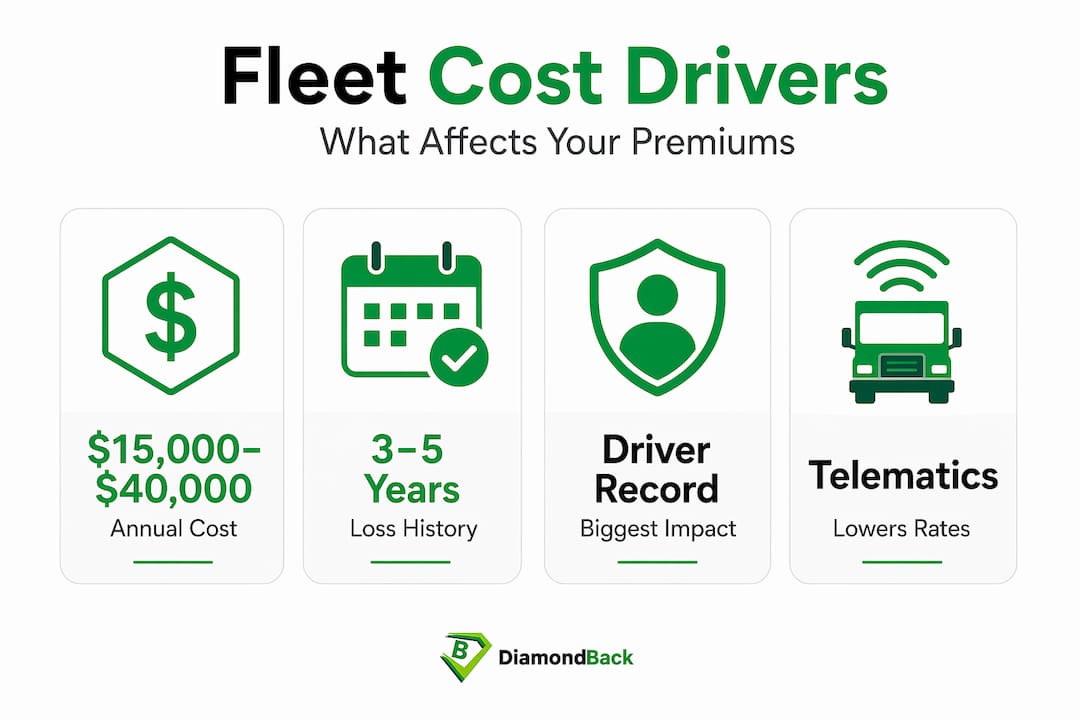
To compare quotes across insurers effectively, prepare a complete loss run history going back three to five years, a clean driver roster with MVR records, and documentation of any safety training programs. Underwriters price what they can verify. The more organized and transparent your submission, the better your positioning.
Safety culture as an underwriting asset
Risk management is not separate from fleet insurance strategy. It is the strategy. The way your operation handles safety directly shapes your insurance costs, your renewal options, and your exposure to liability.
Underwriters evaluate driver quality, safety records, and claims history to determine both pricing and whether they want your business at all. A fleet with three at-fault accidents in two years will struggle to get competitive quotes. A fleet with documented safety meetings, regular MVR checks, and dashcam coaching programs is a fundamentally different underwriting proposition.
ELD data and dashcam systems are tools that serve two purposes. They protect you legally in the event of a dispute about fault. They also create a documented record of driver behavior that you can present to insurers as evidence of active risk management. Insurers reward fleets that use this data for coaching, not just collection.
There is a legal dimension here that often gets overlooked. Freight brokers face increased liability exposure under recent court rulings related to negligent carrier selection. If you work with brokers, their scrutiny of your safety record and insurance documentation has intensified. Maintaining clean records and adequate liability protection is not just about your own exposure. It affects your ability to secure loads from quality brokers.
“The fleets that consistently secure the best underwriting terms are not necessarily the largest. They are the ones that treat safety data as a business asset and share it proactively with their insurers.”
Pro Tip: Request a pre-renewal underwriting review six to eight weeks before your policy expires. Bring your safety data, driver MVR reports, and any improvements made since the last renewal. This gives your insurer or broker time to market your account properly and gives you time to shop alternatives if the terms are not competitive.
How coverage needs evolve as your fleet grows
Fleet insurance is not a set-and-forget decision. Coverage requirements change significantly as your fleet grows, and the gaps that form during rapid expansion are exactly where the most expensive claims occur.
Here is how insurance needs typically shift at different stages of fleet growth:
-
One to three vehicles. At this stage, a basic commercial auto policy with liability and physical damage may be adequate. Cargo coverage depends on what you haul. Most operations at this level should also consider non-trucking liability if drivers use vehicles outside of dispatch.
-
Four to ten vehicles. This is where a formal fleet policy structure becomes worth the investment. You gain efficiency on renewals and claims, and insurers begin to evaluate your operation as a fleet risk rather than individual vehicle risk. CSA scores become a more prominent factor in pricing here.
-
Ten or more vehicles. At this level, you need to think seriously about umbrella or excess liability layers, structured safety programs, and potentially a dedicated risk management relationship. Expanding fleets face new exposures that require multi-line programs and integrated telematics-based pricing models.
-
Annual reassessment as a standard practice. Regardless of size, fleet insurance requires annual review as operations change. Adding vehicle types, entering new states, or shifting cargo classifications can all create coverage gaps if your policy has not kept pace.
Reviewing your insurance coverage annually is not just good financial hygiene. It is the practical way to avoid paying for coverage you no longer need while making sure you have coverage you do.
My perspective on fleet insurance after years in the industry
I have reviewed hundreds of fleet insurance programs across all sizes of operation, and the pattern I see most often is the same. Business owners understand the basics but dramatically underestimate the liability exposure they carry.
The uncomfortable truth is that most fleets are underinsured on the excess liability side. Carriers see their $1 million primary limit and assume that is sufficient. It rarely is in today’s litigation environment. Rising liability verdicts mean a single catastrophic accident can expose you well beyond that primary layer. An umbrella policy that costs a fraction of your primary premium can be the difference between surviving a claim and losing the business.
I have also seen too many fleets treat their safety program as a compliance checkbox rather than an underwriting tool. The fleets that get the best renewal terms are the ones that walk into the conversation with organized data, documented improvement programs, and a clear story about their risk profile. That takes work, but the payoff in premium savings and insurer options is real.
On the broker side, my experience is that transparency consistently outperforms negotiation tactics. Trying to hide loss history or downplay operational risks rarely works. Underwriters find it, and when they do, your credibility is gone. Being upfront about past claims and showing what you have done to address root causes positions you as a serious operator.
— Vladimir
Get the right fleet coverage with Diamondbackins
Once you have a clear picture of what your fleet needs, the next step is getting quotes that reflect your actual operation and risk profile, not a generic estimate.

Diamondbackins makes this process direct and efficient. The platform aggregates quotes from multiple top-rated commercial insurers, so you can compare actual fleet policy options side by side without spending days on the phone. Whether you are managing three trucks or thirty, you can get a fleet insurance quote online in minutes. If you want a deeper look at what your fleet specifically requires, the coverage amount guidance resource walks you through the numbers by fleet size and cargo type. For Georgia-based operations, Diamondbackins also offers tailored fleet coverage in Georgia with options built for regional carriers. Use what you have learned here to come prepared, and let Diamondbackins help you secure a policy that actually fits.
FAQ
What is fleet insurance and who needs it?
Fleet insurance is a single commercial policy covering two or more business vehicles under one agreement, simplifying management and often reducing total premium costs. Any business operating multiple vehicles, from delivery vans to tractor-trailers, benefits from this structure.
How much does fleet insurance typically cost?
Costs vary widely based on fleet size, cargo type, driver history, and CSA scores. Small fleets of two to five trucks typically pay $15,000 to $40,000 annually, while larger operations can exceed $400,000 per year.
What are the minimum liability requirements for commercial fleets?
The FMCSA requires interstate general freight carriers to carry at least $750,000 in liability coverage, though most brokers and shippers set a practical minimum of $1 million. Hazardous materials carriers must carry $5 million in liability coverage.
Does fleet insurance cover cargo?
Cargo coverage is typically available as part of a fleet policy but is not automatically included in every base package. Most shippers require a minimum of $100,000 in cargo insurance, and higher-value loads may need $250,000 to $500,000 or more with specialized endorsements.
How often should you review your fleet insurance coverage?
You should reassess your fleet policy at least once a year, and any time you add vehicles, change routes, or shift cargo types. Coverage needs for a five-vehicle operation differ significantly from those for a ten-vehicle fleet, making regular review a standard operational practice.