

Many drivers assume that holding a Commercial Driver’s License gives them the authority to haul any load in any truck. That assumption is wrong, and it can cost you your operating authority, your insurance coverage, and your income. A trucking endorsement is a specialized authorization added to your CDL that permits you to operate specific vehicle types or transport particular cargo categories. Without the right endorsements, you are legally barred from those operations regardless of how many years you have been behind the wheel. This guide breaks down what trucking endorsements are, how they work, and how to get them so you can protect your license and grow your career.
Table of Contents
- Key takeaways
- What is a trucking endorsement and why it matters legally
- Types of trucking endorsements and what they allow
- Trucking endorsement requirements and how to get them
- Benefits of trucking endorsements for drivers and businesses
- Common misunderstandings about endorsements
- My take on endorsements as career and business tools
- Protect your fleet with the right insurance coverage
- FAQ
Key takeaways
| Point | Details |
|---|---|
| Endorsements expand your CDL | A trucking endorsement adds legal authority beyond your base CDL class for specific cargo or vehicles. |
| Six core endorsements exist | The H, N, T, P, S, and X endorsements each unlock different freight types and vehicle categories. |
| Requirements vary by type | Hazmat requires TSA fingerprinting and costs $150-$250, while a tanker endorsement can be added the same day. |
| Earnings can rise significantly | Endorsed drivers, especially those holding X endorsements, earn up to $20,000 more annually than non-endorsed peers. |
| Insurance compliance is tied to endorsements | Missing endorsements can lead to denied claims and financial exposure for both drivers and carriers. |
What is a trucking endorsement and why it matters legally
A trucking endorsement is a code added to your CDL by your state’s Department of Motor Vehicles that authorizes you to perform driving operations beyond the scope of your base license class. Think of your CDL as a general permission slip and your endorsements as the specific clearances that allow you to enter restricted freight categories. Without them, hauling tank vehicles, hazardous materials, or passengers is not just inadvisable. It is illegal.
The Federal Motor Carrier Safety Administration sets the framework, but FMCSA guidelines mandate that endorsements are legal requirements for specific operations, not optional credentials. States enforce these rules at the license level, and carriers are equally responsible for verifying that every driver on their payroll holds the correct endorsements for the loads they are assigned. A carrier who deploys an unendorsed driver is exposed to serious regulatory penalties.
“Endorsements are not optional but mandatory for specific cargo; employer compliance hinges on accurate driver endorsements.” — CDL Endorsements Explained, GetLicenseMap
The liability stakes are high. Operating without required endorsements can trigger fines, out-of-service orders, and both civil and criminal liability in the event of an accident. For fleet managers, that risk compounds across every truck and every driver on the road. Proper endorsement compliance is not just a regulatory checkbox. It is a foundational element of sound fleet risk management.
Insurance consequences are equally serious. Missing endorsements can lead to denied claims and uncovered financial exposure for drivers and carriers alike. When an insurer discovers that a driver lacked the required endorsement during an incident, coverage can be voided entirely. That is an outcome no owner-operator or fleet manager can afford to ignore.
Types of trucking endorsements and what they allow
Six primary CDL endorsements exist under federal regulation, each with a distinct scope of authority. Understanding what each one permits is the starting point for making smart decisions about your license and career.
| Endorsement | Code | Vehicle or Cargo Type | Notable Requirement |
|---|---|---|---|
| Hazardous Materials | H | Federally regulated hazardous substances | TSA Security Threat Assessment |
| Tank Vehicle | N | Liquid or gas cargo in large tanks | Knowledge test only |
| Double/Triple Trailers | T | Pulling two or three trailers | Knowledge test only |
| Passenger | P | Vehicles carrying 16+ passengers | Skills test required |
| School Bus | S | School buses with student passengers | Skills test and background check |
| Combination (H + N) | X | Hazardous liquids in tank vehicles | TSA clearance plus knowledge test |
The H endorsement is the most regulated of all six because it requires passing a TSA Security Threat Assessment. The N endorsement covers tank vehicles transporting liquid or gas cargo and is the gateway to fuel hauling work. The T endorsement for double and triple trailers is common in western states where longer combination vehicles are permitted on highways.

The X endorsement deserves special attention. It combines the H and N authorizations, qualifying drivers for the highest-paying tanker jobs in the industry, including fuel, chemical, and industrial gas transport. Drivers who hold the X endorsement operate at the premium end of the freight market, hauling cargo that most drivers simply cannot legally touch.
The P and S endorsements serve the passenger transportation sector. They both require a pre-trip vehicle inspection skills test in addition to a knowledge test, and the S endorsement includes a mandatory background check due to the sensitivity of transporting minors.
Pro Tip: If you are considering multiple endorsements, evaluate the X combination first. Earning the H and N together through a single application process is more cost-effective than obtaining them separately later.
Trucking endorsement requirements and how to get them
The process of obtaining a trucking endorsement follows a clear sequence, but the specific steps vary meaningfully depending on which endorsement you are pursuing.
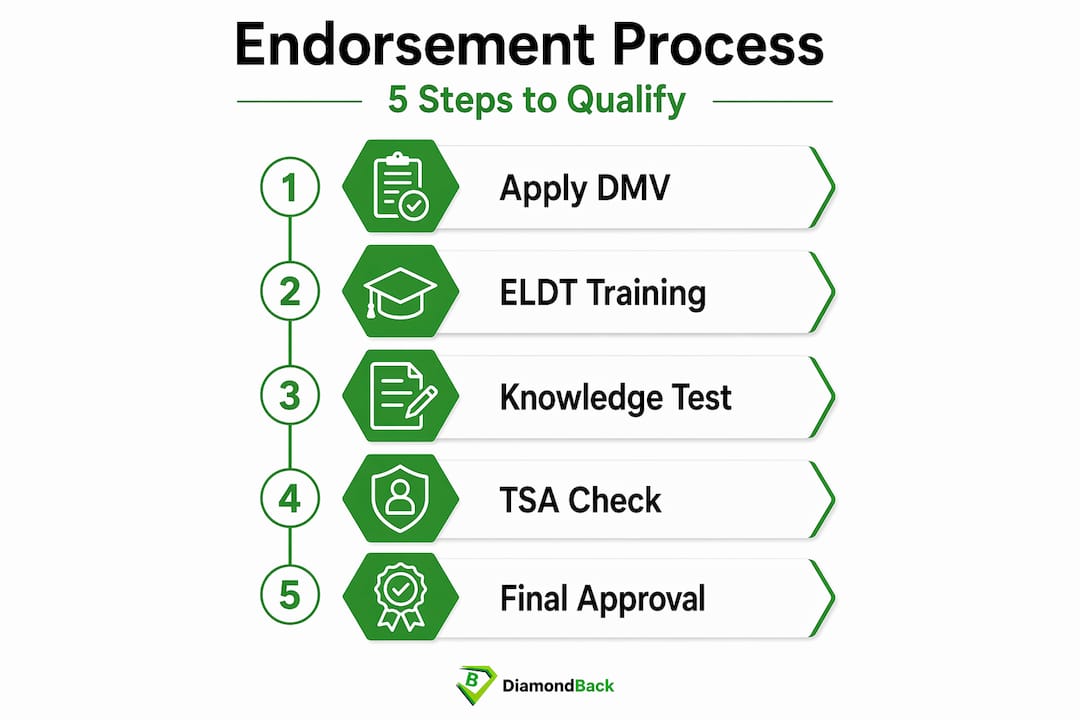
The first step for any endorsement is confirming that you already hold a valid CDL of the appropriate class. Endorsements are added to an existing CDL and cannot exist independently. Your state DMV is the official processing authority, and each state publishes its own commercial driver handbook with endorsement-specific study materials.
The general process for most endorsements follows this sequence:
- Study the endorsement-specific section of your state’s CDL manual, focusing on federal regulations and cargo handling procedures.
- Schedule and pass the required knowledge test at your state DMV office.
- For endorsements requiring a skills test such as the P or S, schedule a separate behind-the-wheel evaluation.
- Pay the applicable DMV fee and submit your application. Fees typically range from $10 to $50 depending on your state.
- For the H or X endorsement, complete the Entry-Level Driver Training requirement, submit fingerprints, and pass a TSA Security Threat Assessment before your license is updated.
The Hazmat endorsement process is the most demanding of the six. Hazmat candidates must pass ELDT training, a written knowledge test, and a TSA Security Threat Assessment that includes fingerprinting and a background check. The TSA fee alone is $86.50, and total costs land between $150 and $250 as of 2026. Processing time runs 30 to 60 days from fingerprint submission.
The tanker endorsement sits at the opposite end of the complexity scale. The tanker endorsement requires only a knowledge test with no TSA background check, and drivers can complete the process and receive an updated license the same day. DMV fees range from $10 to $50 depending on the state, making it one of the most accessible endorsements available.
Pro Tip: For the Hazmat endorsement, submit your fingerprints as early as possible and keep a copy of your TSA application confirmation number. TSA processing timelines fluctuate, and knowing your status prevents surprises close to your planned start date.
Fleet managers dealing with multiple drivers should build endorsement tracking into their compliance calendars. Knowing exactly which drivers hold which endorsements and when those endorsements expire is as important as tracking vehicle maintenance schedules. The impact on fleet insurance management is direct and measurable.
Benefits of trucking endorsements for drivers and businesses
Trucking endorsements are career multipliers. The most straightforward benefit is access to freight categories that are completely off-limits to non-endorsed drivers, which means fewer competing applicants for each available load and stronger negotiating power when setting rates.
The earnings impact is documented. Endorsements increase earning potential by 10 to 30%, with X endorsement holders potentially earning up to $20,000 more annually than drivers running standard dry van freight. That number alone justifies the investment of time and fees required to earn even the most demanding endorsements.
The scarcity factor amplifies that advantage further. Hazmat endorsement drivers command higher pay precisely because the TSA background check and wait time reduce the supply of qualified applicants. Industry experts consistently note that this barrier creates a premium market where demand for endorsed drivers outpaces availability. That dynamic shows no sign of reversing as chemical, fuel, and specialty liquid freight volumes continue to grow.
For businesses and fleet operators, the advantages extend well beyond individual driver pay rates. Carriers with fully endorsed fleets can compete for contract types that are simply unavailable to fleets with limited endorsement coverage. Specialty freight contracts, government logistics work, and hazardous materials shipping agreements all require carriers to demonstrate that their drivers hold the right credentials.
Endorsements also affect liability coverage limits in meaningful ways. Insurers evaluate driver qualifications when underwriting commercial truck policies, and a fleet with verified endorsements presents a lower risk profile than one where compliance is uncertain. That translates to more favorable terms, lower premiums in some cases, and stronger protection when claims arise.
Avoiding common trucking insurance pitfalls starts with making sure every driver is properly endorsed for the freight they are assigned. It sounds simple, but compliance gaps in this area remain one of the most preventable sources of claim denials in commercial trucking.
Common misunderstandings about endorsements
One of the most frequent points of confusion involves the TWIC card and the Hazmat endorsement. Both require a TSA Security Threat Assessment, which leads many drivers to assume they are interchangeable. They are not. TWIC grants access to maritime facilities such as ports and terminals, while the Hazmat endorsement authorizes hazardous material transport on public roads. The TWIC costs about $125 and the Hazmat TSA fee is $86.50, and both remain valid for five years, but they serve entirely different operational purposes.
Renewal is another area where assumptions can cause compliance problems. Some states require retaking knowledge tests upon CDL renewal, while others auto-renew endorsements with the base license. The Hazmat endorsement is the exception because it requires a renewed TSA Security Threat Assessment before expiration regardless of how other endorsements are handled in your state.
New drivers often ask which endorsement to pursue first. The honest answer depends on your target freight sector, but the N endorsement offers the fastest return. It unlocks tank vehicle work quickly, requires only a knowledge test, and creates a direct path toward the X endorsement later.
Pro Tip: Track your endorsement expiration dates separately from your CDL expiration. Some endorsements have independent renewal cycles, and letting one lapse can remove you from active load eligibility even if your base CDL is current.
My take on endorsements as career and business tools
I’ve watched too many experienced drivers treat endorsements as an afterthought rather than a deliberate career investment. In my experience, that’s a costly mistake that usually doesn’t reveal itself until a driver misses out on a high-value contract or gets hit with a compliance violation during a roadside inspection.
What I’ve learned is that the Hazmat endorsement’s reputation for being complicated actually works in your favor once you have it. The friction it creates for other drivers is exactly what protects your earning advantage. I’ve seen owner-operators with the X endorsement turn down loads that standard CDL holders are competing hard for because better-paying specialty freight keeps their calendar full.
The other thing most articles won’t tell you is how directly endorsements affect your insurance position. I’ve spoken with fleet managers who discovered only after a claim was denied that a driver had been assigned freight outside their endorsement scope. That is not a regulatory nuance. It’s a serious and avoidable financial exposure. Understanding your types of liability coverage in the context of your drivers’ actual endorsements is something every fleet owner should review annually.
The regulatory framework is not going to get simpler. FMCSA oversight is expanding, and states are tightening compliance audits for carriers. Treating endorsements as a proactive investment now is far less expensive than addressing a compliance gap after an incident.
— Vladimir
Protect your fleet with the right insurance coverage
Holding the right trucking endorsements is only half of the compliance equation. The other half is making sure your insurance coverage accurately reflects what your drivers are authorized to haul. At Diamondbackins, the platform gives you instant access to quotes from multiple top-rated insurers so you can compare commercial truck insurance options in minutes without spending hours on the phone with brokers.
Whether you operate a single owner-operator rig or a multi-unit fleet, Diamondbackins makes it straightforward to secure commercial truck insurance that aligns with your drivers’ endorsement profiles and your specific freight categories. You can also review trucking insurance fundamentals to understand exactly how endorsements influence your coverage terms. Get your quote today and keep your operation fully protected.
FAQ
What is a trucking endorsement on a CDL?
A trucking endorsement is a code added to a Commercial Driver’s License that authorizes a driver to operate specific vehicle types or transport certain regulated cargo categories, such as hazardous materials or passengers.
Do I need a trucking endorsement to haul tanks or hazmat?
Yes. Federal regulations require drivers to hold the N endorsement for tank vehicles and the H endorsement for hazardous materials. Operating without these endorsements is a violation that can result in fines, out-of-service orders, and denied insurance claims.
How much does a trucking endorsement cost?
Costs vary by type. The tanker endorsement typically costs $10 to $50 in DMV fees, while the Hazmat endorsement totals $150 to $250 including the $86.50 TSA Security Threat Assessment fee.
How long does the Hazmat endorsement take to get?
The full process takes 30 to 60 days from fingerprint submission due to TSA background check processing times, so plan ahead if you have a specific freight start date in mind.
Is a TWIC card the same as a Hazmat endorsement?
No. While both require a TSA Security Threat Assessment, a TWIC card grants access to maritime and port facilities, while a Hazmat endorsement specifically authorizes the transport of hazardous materials on public roads.