

Renewing your commercial vehicle insurance is not a routine checkbox. Miss a filing deadline, submit outdated driver records, or let coverage lapse during an insurer transition, and you could face suspended operating authority, regulatory fines, and exposure to claims that could financially devastate your business. This commercial vehicle insurance renewal guide is built for fleet managers and small business owners who want to move through the renewal process with confidence, not guesswork. The following sections cover every stage from early preparation to post-renewal verification, with practical advice that directly protects your fleet, your bottom line, and your authority to operate.
Table of Contents
- Understanding federal insurance requirements and minimum coverage
- Preparing your fleet for a smooth insurance renewal
- Executing your commercial vehicle insurance renewal review
- Common renewal pitfalls and verification best practices
- Why early, thorough insurance renewal preparation is a game changer
- Streamline your commercial vehicle insurance renewal with Diamondback Insurance
- Frequently asked questions
Key Takeaways
| Point | Details |
|---|---|
| Start early | Begin your insurance renewal preparation at least 60 to 90 days before your policy expires to avoid rushed decisions and higher premiums. |
| Meet FMCSA minimums | Ensure your commercial vehicle insurance meets or exceeds federal minimum coverage requirements to maintain legal operating authority. |
| Audit and update records | Regularly review fleet schedules, driver MVRs, loss runs, and DOT/CSA scores to present accurate information during renewal. |
| Use safety programs | Implement telematics, dashcams, and driver training to lower risks and negotiate better insurance rates. |
| Verify filings | Confirm your insurance filings (like BMC-91) are current and continuous to prevent costly authority suspensions. |
Understanding federal insurance requirements and minimum coverage
Before you renew a single policy, you need a clear understanding of the coverage floors the federal government requires. The FMCSA (Federal Motor Carrier Safety Administration) sets mandatory minimum liability coverage levels based on vehicle weight, cargo type, and the type of freight you haul. These are not suggestions. Without current, compliant filings in place, your trucks cannot legally operate across state lines.
The FMCSA requires minimum liability coverage of $750,000 for general freight carriers and up to $5,000,000 for certain hazmat cargos. If you haul oil or other hazardous materials, your minimums climb sharply. Many shippers and brokers set their own internal requirements that exceed FMCSA floors, so you may face contractual pressure to carry $1,000,000 or more regardless of cargo classification.
The filing side matters just as much as the coverage amount. The BMC-91 form is the standard liability filing that proves your insurance is active with the FMCSA. It must remain continuous. A lapse in this filing, even for a single day, can trigger automatic suspension of your operating authority. Understanding transportation insurance basics is the foundation every fleet manager needs before approaching any renewal negotiation.
| Vehicle / Cargo Type | FMCSA Minimum Liability Coverage |
|---|---|
| General freight (non-hazmat, 10,001+ lbs) | $750,000 |
| Household goods carriers | $300,000 |
| Oil transported in cargo tanks | $1,000,000 |
| Hazardous materials (certain types) | $5,000,000 |
| Passenger carriers (buses, vans) | $5,000,000 |
Review your specific cargo classifications carefully each renewal period. If your freight mix has changed, your required minimums may have changed too.
Preparing your fleet for a smooth insurance renewal
To comply with federal coverage requirements, you need specific documentation and current operational data ready well before your renewal date. Rushing this stage is where most fleet managers make costly mistakes.
Preparation should start 60 to 90 days before your policy expiration date. That timeline gives you room to gather the right documents, address any issues with driver records, and have real conversations with multiple carriers rather than accepting the first quote out of urgency. The documents and data points your underwriter will scrutinize include the following.
Loss runs covering three to five years. These records show your claim history. Request them from your current insurer early because processing can take time. Underwriters use loss runs to evaluate whether your fleet is improving or getting riskier. If you have had claims, be ready to explain what changed operationally to prevent recurrence.
Driver Motor Vehicle Records (MVRs). Every driver’s MVR needs to be current. Violations, suspensions, or DUI entries you are unaware of can affect your premium or lead to a declination. Pull these records proactively so you are not surprised during the underwriting review.
Fleet schedule accuracy. Your fleet schedule lists every insured vehicle, its value, and where it is garaged. Incorrect garaging locations or outdated actual cash values directly affect your premium calculations. Verify this list against your actual active fleet before submission.
DOT and CSA scores. Your Compliance, Safety, Accountability (CSA) scores from the FMCSA portal reflect your safety performance across seven Behavior Analysis and Safety Improvement Categories (BASICs). High scores in categories like unsafe driving or crash indicators will raise red flags for underwriters. Review them at why renew trucking insurance to understand how these metrics influence your renewal outcomes.

Pro Tip: Some insurers also want to see maintenance logs and driver qualification files. Organizing these before the underwriter asks signals that your operation is well managed, which can translate to better pricing.
For additional operational context on how fleet data is used in broader industry decisions, container haulage insights from the haulage sector offer useful perspective on documentation practices that translate across commercial transportation.
Executing your commercial vehicle insurance renewal review
Once your documentation is assembled, you move into the active renewal review. This is where coverage decisions get made and premiums are negotiated. Entering this stage without preparation puts you at a disadvantage. Entering it with clean data and a clear picture of your risk profile puts leverage in your hands.
The renewal review involves a full risk evaluation covering driver safety, fleet changes, loss history, and operational shifts that affect premiums and coverage terms. Here is how to approach it step by step.
Step 1: Disclose all operational changes. If your fleet has grown, shrunk, added new routes, shifted commodities, or expanded into new states, your insurer needs to know. Withholding this information is not only a compliance risk but can void coverage at the worst possible moment.
Step 2: Review your coverage limits and deductibles. Renewal is the right time to ask whether your current limits still match your actual risk exposure. A fleet that has expanded significantly since the last renewal may be dangerously underinsured at the same limits.
Step 3: Present safety investments. If you have installed fleet tracking and dashcams, implemented driver training programs, or introduced a formal safety culture since your last renewal, put this in front of the underwriter. Insurers reward documented safety improvements with better rates. This is not anecdotal. Safety technology is one of the clearest levers you can pull to reduce what you pay.
Step 4: Get quotes from multiple carriers. Never renew with only one option on the table. Insurers price risk differently, and a carrier who rated your fleet conservatively last year may be replaced by one who values your safety record more competitively this year. Understanding factors affecting truck insurance rates helps you explain your risk profile more persuasively to each carrier.
Step 5: Negotiate terms, not just price. Premium is one number. But deductible amounts, covered perils, cargo limits, and non-owned trailer coverage are all terms that affect your real cost of risk. Evaluate the full policy, not just the bottom line.
The trucking risk management decisions you make during this phase will shape your coverage for the next 12 months. Treat it as a business negotiation, because that is exactly what it is.
Common renewal pitfalls and verification best practices
Submitting your renewal is not the finish line. Coverage gaps, filing errors, and inaccurate fleet schedules after renewal are just as damaging as mistakes made before it. Verification is the step most fleet managers undervalue, and it is the step that protects everything else.
Lapsing coverage or incorrect filings can cause immediate suspension of operating authority and heavy fines. Seamless insurer transitions and accurate data updates prevent these costly errors. If you are switching carriers, the new carrier’s BMC-91 filing must be active before the prior carrier’s policy cancels. Even a single day of gap in FMCSA filings can result in your authority being suspended automatically.
After renewal is confirmed, work through this verification checklist before your trucks roll.
Confirm BMC-91 filings are active. Log into the FMCSA’s Licensing and Insurance portal and verify your filing shows as “active.” Do not rely solely on your broker’s word. Check it yourself.
Audit the declarations page. The declarations page lists your covered vehicles, coverage limits, effective dates, and named insureds. Compare it line by line against what you submitted. Errors here can mean a claim is denied when you need coverage most.
Verify driver records and exclusions. Some insurers exclude specific drivers based on their MVR. Make sure no key driver has been silently excluded in the policy language.
Cross-check fleet schedules against actual vehicles. A vehicle added after the effective date but before formal endorsement is not covered. Track additions carefully and confirm endorsements are processed promptly.
“Seamless insurer transitions and accurate data updates prevent the costly errors that result from even brief coverage lapses, including authority suspension and regulatory fines.” — FMCSA Insurance Filing Standards
For a closer look at how coverage decisions directly affect your costs, insurance costs for trucks breaks down the specific factors that drive your premium up or down year over year.
Why early, thorough insurance renewal preparation is a game changer
Here is the perspective most fleet managers do not hear until it is too late: the insurance renewal process is no longer a bureaucratic formality. Underwriting scrutiny across the commercial trucking sector has increased significantly over the past several years. Carriers are tightening their appetites, pricing more conservatively, and paying closer attention to operational details that once went unnoticed.
Your trucking insurance renewal is no longer just paperwork. It is a critical business event that can directly affect your profitability, and early preparation is the clearest way to negotiate better rates amid tightening underwriting conditions.
What we have observed is that fleets who treat renewal as a strategic opportunity, not an administrative task, consistently outperform their peers on coverage quality and cost control. They come to their underwriters with clean loss runs, documented safety programs, current driver files, and a clear narrative about their operation. That narrative matters. Underwriters are human. When your file tells a story of a well-managed, safety-focused fleet, pricing reflects that.
The opposite is equally true. A fleet that submits late, with outdated driver records and a disorganized loss run, signals disorder. Underwriters price for uncertainty, and disorder is uncertain. You end up paying for the risk they perceive, not the risk you actually represent.
The fleets that gain the most negotiating leverage are those who review their renewal importance 90 days out, not 10 days out. The difference between those two timelines is often thousands of dollars in annual premium, better coverage terms, and the ability to walk away from a carrier who is not offering a fair deal.
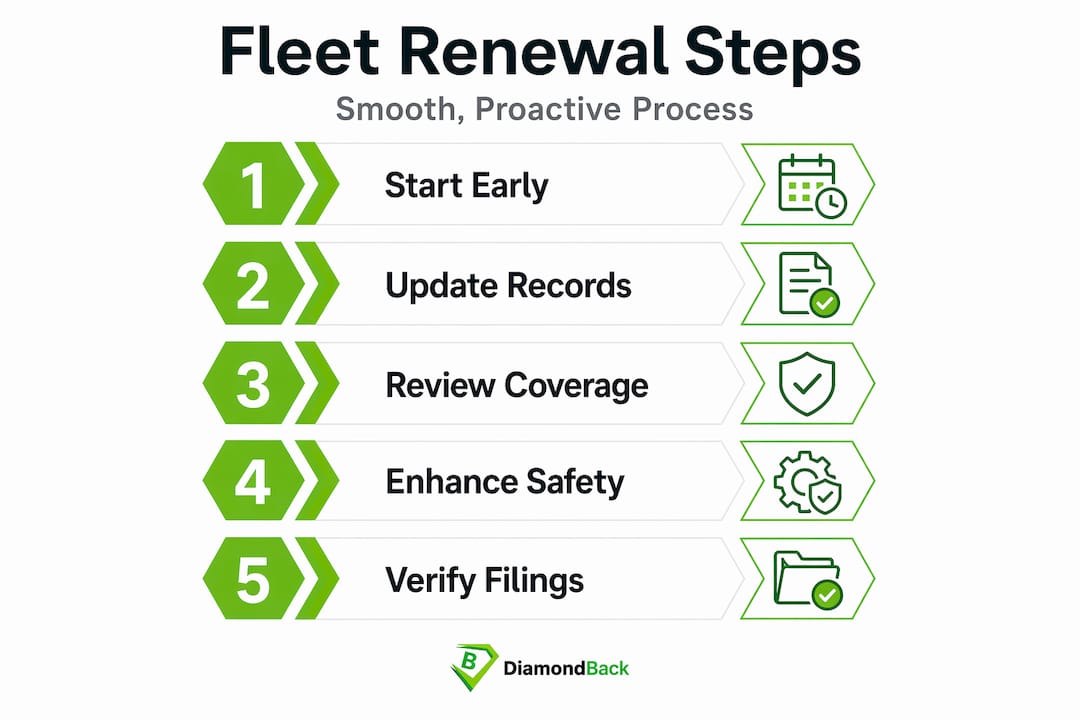
Start early. Document everything. Present your operation with confidence. That is not just good insurance practice. It is good business.
Streamline your commercial vehicle insurance renewal with Diamondback Insurance
Navigating every step of this process on your own takes time your operation does not always have. That is where Diamondback Insurance steps in.

Diamondback Insurance is built specifically for fleet managers and trucking businesses who need fast, transparent, and competitive insurance solutions without the friction of traditional brokers. You can streamline your fleet insurance by accessing instant quotes from multiple top-rated carriers in one place, comparing coverage options side by side, and securing your policy in minutes. Whether you are renewing a single commercial truck or managing a large fleet, the platform gives you real options and real pricing with no guesswork. Take the first step and get your truck insurance online quote today. When renewal season arrives, you will already be ahead of it. Protect your fleet and comply with confidence backed by expert support.
Frequently asked questions
What is the minimum commercial vehicle insurance coverage required by FMCSA?
The FMCSA mandates minimum liability coverage of $750,000 for most interstate carriers hauling non-hazardous freight over 10,001 lbs, with higher limits required for hazardous materials depending on cargo type, reaching up to $5,000,000 for certain classifications.
How early should I start preparing for commercial vehicle insurance renewal?
Fleet managers should start preparing 60 to 90 days before the policy expiration date, giving enough time to collect loss runs, review driver records, and compare multiple carrier quotes without rushed decisions.
What common mistakes cause commercial vehicle insurance lapses and penalties?
The most frequent causes include gaps during insurer transitions, inaccurate fleet schedules submitted at renewal, and failure to update driver qualification files, all of which can lead to FMCSA authority suspension and significant fines.
Can safety technology reduce commercial vehicle insurance premiums?
Yes. Telematics and dashcams are among the most effective tools fleets can deploy to document safe driving behavior, reduce claim frequency, and negotiate meaningful discounts from carriers during the renewal review.